
BY Issah Olegor
For the first time in Ghana’s Fourth Republic, a sitting Chief Justice has been uprooted from office like a cassava tree, in apparent fulfilment of campaign promise.
John Mahama had promised to alter the chain of command in his attempt to reset the judiciary during his campaign for re-election.
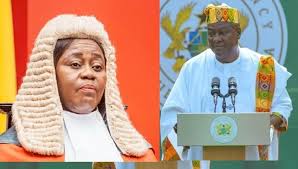
On Monday, September 1, 2025, President John Dramani Mahama succeeded in dismissing Chief Justice Gertrude Araba Esaaba Sackey Torkornoo, acting on the binding recommendation of a constitutional committee that found her guilty of misconduct.
At the centre of the case was an allegation of per diem payments to her family members who travelled with her.
The investigative committee concluded that Justice Torkornoo unlawfully authorised allowances for her husband and daughter during foreign trips, expenses that were charged to the Judicial Service.
But former occupants of the Chief Justice office who testified before the Pwamang Committee said the sacked Chief Justice committed no offence to warrant her removal from office.
The Per Diem Scandal
The controversy stemmed from two trips in September 2023: one to Tanzania with her husband and another to the United States with her daughter. In both cases, the Chief Justice was alleged to have facilitated the payment of per diem allowances to her relatives, even though they were neither officials of the Judiciary nor entitled to state-funded benefits.
“The travel expenses which the Chief Justice heaped on the Judicial Service, together with the payment of per diem to her husband and daughter, constitute unlawful expenditure of public funds. It cannot be justified in law or policy,” the committee’s report stated.
Although Justice Torkornoo later refunded the money after internal audits raised questions, the panel insisted that the initial authorisation itself was a reckless use of public resources. It concluded that the act amounted to “stated misbehaviour” under Article 146(1) of the Constitution.
The Petition and Committee Inquiry
The case began when businessman Daniel Ofori petitioned the President earlier this year, alleging abuse of office and misuse of funds by the Chief Justice.
Following constitutional procedure, the Council of State reviewed the petition and advised that a prima facie case had been established.
This led President Mahama to form a five-member Article 146 Committee of Inquiry, chaired by Supreme Court Justice Gabriel Scott Pwamang.
Other members are former Auditor-General Daniel Yaw Domelevo, Major Flora Bazaawaanuba Dalugo of the Ghana Armed Forces, and Professor James Sefah Dzisah of the University of Ghana.
The committee held its proceedings in camera, as required by law, but heard extensive testimony: 13 witnesses for the petitioner, 12 witnesses for the Chief Justice, and nearly 10,000 pages of documents were submitted. Justice Torkornoo herself appeared before the panel and was cross-examined.
Mahama’s Decision
In a letter signed by Secretary to the President, Callistus Mahama, the Chief Justice was formally notified of her dismissal.
A presidential warrant of removal, bearing the national seal, confirmed her immediate exit from office.
“NOW THEREFORE, KNOW YE ALL MEN that I, JOHN DRAMANI MAHAMA, President of the Republic of Ghana, in pursuance of Article 146(9), do hereby REMOVE the said Chief Justice, Justice Gertrude Araba Esaaba Sackey Torkornoo, from the office of Chief Justice and Justice of the Supreme Court, with effect from the date hereof,” the warrant read.
Political and Legal Implications
Justice Torkornoo, who assumed office in June 2023 as Ghana’s 15th Chief Justice and third woman to occupy the post, had already been the subject of three separate petitions.
The per diem case was the first to be completed, with the other two inquiries still pending. Critics are questioning the rationale behind the rush to see the back of the Chief Justice when the Committee had not finished its assignment.
Her removal has triggered sharp debate.
The ruling National Democratic Congress (NDC) has defended the action as proof that no official is above accountability, while critics warn that the decision risks undermining judicial independence.
Beyond the politics, however, the case sets a new precedent in the democratic history: even the Chief Justice is not immune from sanction when public funds are misapplied.
Justice Torkornoo now leaves office stripped of her title and entitlements, her tenure ending not with reform and legacy, but with a scandal that will mark the Judiciary for years to come.
Critics also point to Mahama’s 2023 comments about appointing “NDC-friendly judges” as evidence that the removal is part of a broader plan to tilt the judiciary in the ruling party’s favour as promised in his electioneering campaign.


