By Nadia Ntiamoah
The Ivorian presidential election held across polling centres in Ghana recorded an alarmingly low voter turnout, exposing deep-rooted voter apathy and disinterest among the Ivorian diaspora community.
Out of 1,432 registered voters, only 164 individuals participated in the polls — representing a mere 11.45% turnout — leaving over 88% of eligible voters absent.
Diaspora Disengagement Despite Electoral Preparations
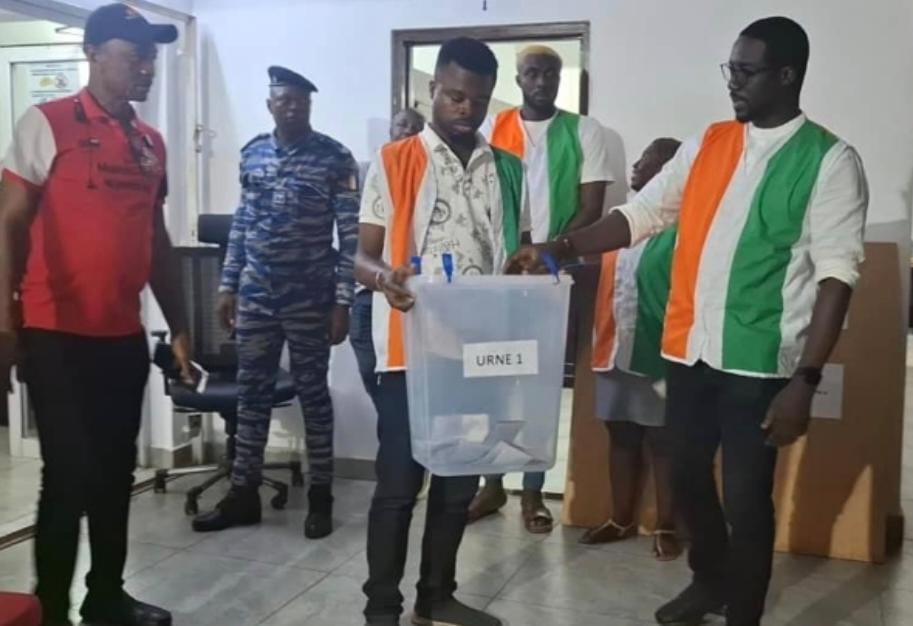
Five polling stations were established across Ghana — four in Accra and one in Kumasi — to facilitate voting for Ivorians living in the country.
However, the low participation shocked election officials and campaign agents who had anticipated a stronger showing from the sizeable Ivorian community, particularly those studying or working in Ghana.
Polling agents attributed the poor attendance to the absence of many registered voters, most of whom are believed to be university students who travelled back to Côte d’Ivoire during the academic break.
Others cited waning political enthusiasm and limited awareness campaigns within the diaspora as additional factors contributing to the dismal turnout.
Minor Irregularities Delay Counting
The counting process faced a temporary suspension after election officials noticed inconsistencies between the number of ballots cast and the number of verified voters.
Upon cross-verification, four extra ballots were detected.
The issue prompted a brief standoff among party representatives before an agreement was reached to exclude the disputed papers from the final count, ensuring transparency and credibility in the results.
Results: Ouattara Retains Diaspora Support
When results from all five polling stations were tallied, incumbent President Alassane Ouattara emerged with a commanding lead, securing 88 votes, or 56.66% of the total valid ballots cast.
Former First Lady Simone Ehivet Gbagbo followed distantly with 15 votes (9.15%), while Don-Mello Jacob garnered 10 votes (6.10%).
The other candidates, Billon Jean Eugene and Lagou Adjoua Henriette, received 8 votes (4.88%) and 2 votes (1.22%) respectively.
A remarkable 41 ballots (25%) were left blank — a figure election observers say could indicate silent protest votes or political disillusionment among participants.
Supervision and Transmission of Results
The exercise was officially supervised by the Ivorian Electoral Commission’s diplomatic representative in Ghana, operating under Côte d’Ivoire’s national election management authority.
The results have since been electronically transmitted to Abidjan for verification as part of the nationwide collation process.
Diaspora’s Historical Role In Ivorian Elections
Ivorians living abroad have historically played a symbolic, though numerically modest, role in their country’s elections.
Ghana, which hosts one of the largest Ivorian student and business communities in West Africa, has often been a key voting hub during national polls.
However, participation has dwindled in recent years. During the 2020 Ivorian presidential election, turnout among Ivorians in Ghana was also below 30%, reflecting growing disconnection between diaspora voters and home politics.