

BY Issah Olegor
The Coalition of Muslim Organisations, Ghana (COMOG), through the Executive Director of the Centre for Creative Leadership, Africa, Hajj Abdel-Manan Abdel-Rahman, has announced plans to pilot a Shura-based leadership framework in selected districts across the Ashanti Region.
The initiative aims to establish a participatory and consultative governance model within Ghana’s Muslim community, drawing on the Islamic principle of Shura — consultation — as a means to promote unity, accountability, and sustainable development.
The announcement was made during the Ashanti Regional Municipal and District Imams Conference in Kumasi.
The conference, which gathered Imams, Islamic scholars, and representatives of Muslim organisations, focused on the theme, “Imamship and Muslim Leadership Framework in Ghana.”
In his presentation, Hajj Abdel-Manan outlined the concept of the “Umma Constitution,” a governance framework inspired by Islamic history and designed to serve as a guide for decision-making, collaboration, and institutional growth within the Muslim Ummah.
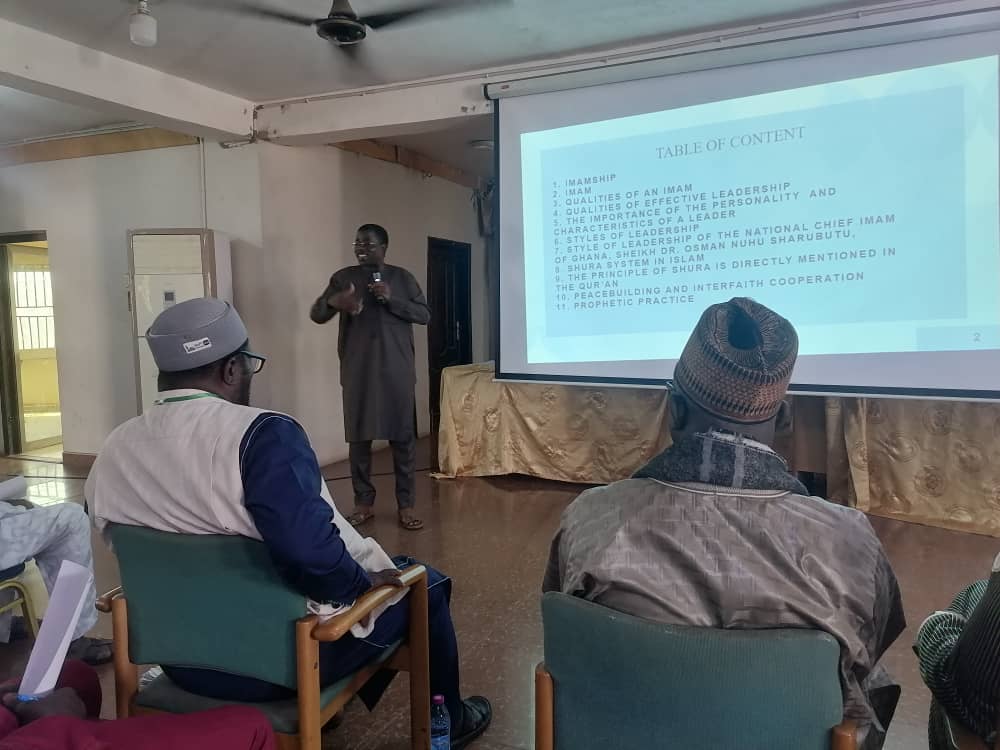
According to him, the proposed Umma Constitution builds on the historical roots of the Shura system — a leadership principle established during the early days of Islam — where decisions were made through broad consultation and consensus among leaders and community members.
He explained that such a model ensures transparency and shared responsibility, values that reflect the leadership approach of the National Chief Imam of Ghana, His Eminence Sheikh Dr. Osman Nuhu Sharubutu.
He noted that Sheikh Sharubutu’s style of inclusive and consultative leadership has long served as a unifying force for Muslims in Ghana.
“Our Chief Imam’s humility, wisdom, and commitment to dialogue have become the living example of how Shura can work in modern times,” Hajj Abdel-Manan remarked.
The idea of adopting a Shura-based framework, he added, was first endorsed at the 2020 National Muslim Representative Conference in Accra, where Muslim leaders across the country recognized the need for a more structured and collective system of governance for the Ummah.
The new pilot in the Ashanti Region represents the first step toward implementing that national vision.
Highlighting the objectives of the framework, Hajj Abdel-Manan explained that the Umma Constitution seeks to strengthen inter-organizational cooperation, promote peaceful coexistence among the diverse Islamic sects, and coordinate socio-economic initiatives to empower the Muslim youth and business community. The model envisions establishing Shura councils at the district, regional, and national levels — functioning as representative forums or “parliaments” for the Muslim Ummah to deliberate on community affairs.
“These councils will not only serve as advisory bodies but will also help coordinate development programmes in education, entrepreneurship, and employment creation,” he said. “The goal is to ensure that every Muslim institution contributes meaningfully to the collective progress of our community.”
The proposal received overwhelming support from the Imams present at the conference. They commended COMOG and the Centre for Creative Leadership for the initiative and unanimously agreed to reconvene in 2026 for a follow-up forum to assess progress and plan the full rollout across all districts in the Ashanti Region.
In his remarks, the Deputy Executive Secretary of the Regional Chief Imam’s Office in the Ashanti Region praised the Shura initiative as a “timely intervention” that will strengthen the capacity of local Imams and enhance grassroots leadership training.
The Ashanti Regional Chief Imam, in his welcome address, also lauded the programme, recalling that the capacity-building initiative was first introduced by his predecessor. He expressed optimism that the continuation of such programmes would deepen collaboration, provide refresher training for Imams, and nurture a new generation of Muslim leaders rooted in knowledge, unity, and accountability.
Hajj Abdel-Manan concluded by reaffirming that the future of Muslim leadership in Ghana lies in cooperation and consultation.
“When leaders consult and communities participate, progress becomes inevitable. Shura is not just a religious ideal — it is a practical solution for unity, good governance, and development,” he said.
The planned pilot in the Ashanti Region is expected to serve as a model for other regions across Ghana, potentially reshaping Muslim leadership structures through a more organized, inclusive, and development-oriented framework.


