BY Daniel Bampoe
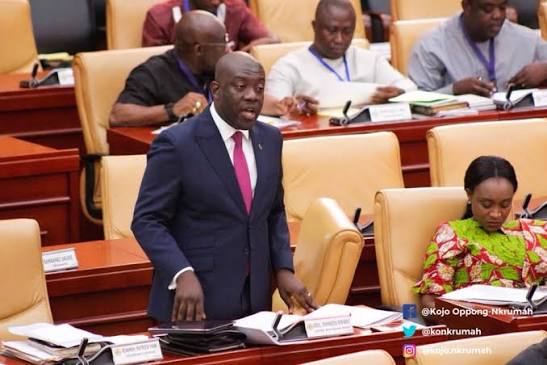
Kojo Oppong Nkrumah, the Member of Parliament for Ofoase-Ayirebi and Ranking Member on Parliament’s Economy Committee, has called for an immediate halt to the approval process of a new GH¢5 billion allocation under the government’s flagship infrastructure programme, the “Big Push,” citing what he describes as serious inconsistencies in the Ministry of Finance’s reporting.
Speaking on the floor of Parliament on Tuesday, Oppong Nkrumah said the numbers contained in the 2026 Budget—particularly those relating to the 2025 expenditure performance—“do not add up” and must be corrected before any further allocations can be approved.
His submission followed days of heightened scrutiny over the government’s infrastructure spending, especially after concerns from civil society groups that the Big Push lacked transparency in its reporting structure.
Providing background, Oppong Nkrumah explained that in the 2026 Budget, the Ministry of Finance reported that GH¢13 billion had been allocated for the Big Push in 2025.
The allocation, he noted, was made up of GH¢8.8 billion from the Annual Budget Funding Amount (ABFA) and GH¢4.8 billion from mineral royalties.
As of the end of September 2025, the Ministry had programmed to spend GH¢9.9 billion out of the total allocation.
However, the MP pointed out a major discrepancy: the Ministry’s own report claims that GH¢10 billion had already been spent on the Big Push by the end of September.
According to him, this was not feasible given the timeline.
Oppong Nkrumah reminded the House that the Big Push was officially launched on 16th September 2025, leaving only a two-week window before the end of the quarter.
It was therefore impossible, he argued, for GH¢10 billion worth of construction work to have been executed, certified, and paid for within just 14 days.
“This is a very serious matter. Let’s not play with it,” he stressed. “Between 16th September and the end of September, it is not possible that GH¢10 billion worth of certificates had been presented, processed, and paid. We must correct this data.”
The Ranking Member also highlighted contradictions in the allocation for outstanding payments owed to old contractors.
In the original GH¢7 billion allocation, he said, there was no earmarking for clearing arrears owed to contractors before the Big Push commenced. Yet, the new budget documents reveal that GH¢3.3 billion from the GH¢7 billion is now being assigned to settle old contractor debts—under the banner of the Big Push.
Oppong Nkrumah warned that this reclassification could mislead the public into believing the funds are being used for new infrastructure works instead of settling old obligations.
“This fuels the suspicion that old contractors are being paid, but it is being captured as though the payments are under the Big Push. That would be deceptive,” he told Parliament.
His concerns deepened when he examined the mineral royalties component.
The Ministry reported that GH¢5.1 billion had already been paid out of the Minerals Royalties Fund under the Big Push as of end-September.
Yet, the projections suggest that by December, the recorded amount would shrink to GH¢4.9 billion—something he described as mathematically and financially impossible.
“Money that has been paid out cannot be taken back from contractors,” he emphasised. “How then does GH¢5.1 billion paid become GH¢4.9 billion at year-end?”
Oppong Nkrumah said the inconsistencies—both in classification and expenditure reporting—were enough grounds to stand down the approval of the additional GH¢5 billion until the Ministry of Finance corrects all anomalies and provides transparent, reconcilable figures.
“These are not small sums of money,” he said. “Before we approve this new allocation, the numbers must be aligned properly so that Parliament and the public can trust the reporting.
He urged the Speaker and the House to demand accuracy and accountability, warning that approving the new allocation without clarity would undermine public confidence in the government’s financial reporting.