

By Daniel Bampoe
The National Democratic Congress government claimed it has recorded a major breakthrough in the protracted MASLOC corruption case following the arrest of former Chief Executive Officer, Sedina Tamakloe-Attionu, in the United States.
Her arrest marks the first concrete step toward enforcing a prison sentence handed down nearly two years ago after she absconded from the jurisdiction.
According to a press release issued by the Ghana Embassy in the US and signed by Victor Emmanuel Smith, Tamakloe-Attionu was arrested by U.S. Marshals on January 6, 2026, and has since been held at the Nevada Southern Detention Centre in Pahrump, Nevada.
The arrest was executed pursuant to an extradition request formally submitted by the Government of Ghana in July 2024, signaling a decisive move by Ghanaian prosecutors to bring the former public official back to serve her sentence.
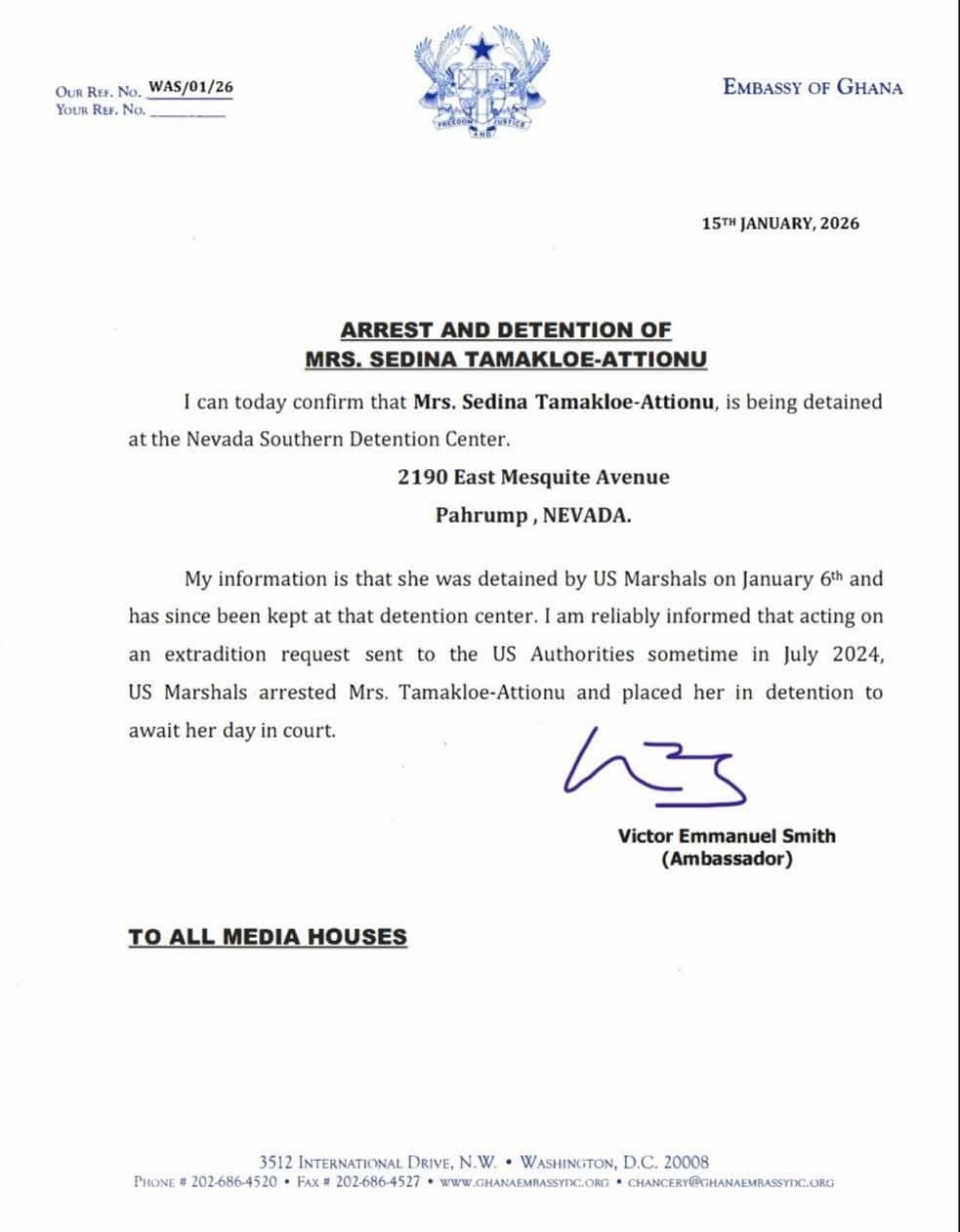
U.S. authorities are currently holding Tamakloe-Attionu pending court proceedings to determine the next phase of the extradition process. While no specific timeline has been disclosed, her detention confirms that American law enforcement has accepted the request and that the matter has entered the judicial phase under U.S. extradition laws.
The arrest revives public attention on one of the most high-profile public corruption cases, which dates back over a decade.
Tamakloe-Attionu, together with former MASLOC Chief Operating Officer Daniel Axim, was convicted on 78 counts including causing financial loss to the state, theft, conspiracy to steal, money laundering, and violations of public procurement laws.
On April 16, 2024, the Accra High Court sentenced Tamakloe-Attionu to 10 years’ imprisonment after finding that she embezzled GH¢3.19 million and deliberately caused an estimated GH¢90 million financial loss to the state during her tenure between 2013 and 2016. Axim was also sentenced to five years’ imprisonment with hard labour.
The trial, which began in 2019, was notable for being conducted in absentia against Tamakloe-Attionu after she failed to return to Ghana following court-approved medical travel abroad.
Despite repeated assurances from her sureties and legal representatives, she never reappeared before the court, prompting the issuance of bench warrants and later the extradition request.
Financial Crimes
Evidence presented during the trial detailed a pattern of systemic abuse of public funds.
Prosecutors established that the convicts withdrew GH¢500,000 from Obaatampa Savings and Loans as a purported MASLOC loan and demanded a refund when the institution declined to offer an interest rate of 24 percent.
Although a refund was claimed, the amount was never reflected in MASLOC’s official accounts.
The court also found that over GH¢1.7 million allocated for a nationwide sensitisation programme was largely misappropriated, with only a fraction spent on the intended activities.
Funds earmarked for victims of a fire disaster at Kantamanso Market were similarly diverted, leaving beneficiaries shortchanged.
Further evidence revealed inflated procurement costs for vehicles and Samsung mobile phones purchased for MASLOC, with payments exceeding prevailing market prices despite bulk procurement, raising red flags over deliberate procurement manipulation.
Political Accountability
The development comes barely days after the Supreme Court granted Daniel Axim bail in the sum of GH¢500,000, pending the hearing of his stalled appeal.
Daniel Axim had already served nearly two years of his sentence when his lawyers successfully argued that prolonged judicial delays justified his release on bail.
The juxtaposition of Axim’s bail and Tamakloe-Attionu’s arrest has reignited public debate over political influence, selective justice, and the integrity of the anti-corruption framework.
Critics argue that recent decisions, including the discontinuation of several high-profile cases involving former government officials, risk undermining public confidence in the rule of law.
Observers warn that the perception that convicted public officials can regain freedom following a change in political power sets a dangerous precedent.
What Lies Ahead
With Tamakloe-Attionu now in U.S. custody, attention shifts to whether she will contest extradition or consent to return to Ghana to serve her sentence.
Legal experts suggest that she may choose not to oppose extradition, particularly given the weight of the conviction already secured against her and with her party in power.
Her return, if completed, would likely see her committed to Nsawam Medium Security Prison, but critics insist that the real test will be whether the sentence is fully enforced or quietly unravelled through legal or political manoeuvres.


