By Grace Zigah
President John Dramani Mahama’s pledge to run a lean and efficient government is again under intense public scrutiny following detailed disclosures about a growing network of regional political coordinators and presidential staffers whose appointments, critics argue, contradict the administration’s own austerity narrative.
At the centre of the controversy are party regional organisers who have been absorbed into government as coordinators to Regional Ministers, alongside an expanding number of presidential aides whose roles and cost to the state remain hotly debated.
The regional organisers are acting as deputy ministers and on the same salary and perks as such, even though government had denied it.
The appointments have added to the troubling ballooning of appointees under the Mahama presidency, making it the most bloated government in recent past, while claiming to be operating a lean government.
The issue recently resurfaced after the Minister for Government Communications, Felix Kwakye Ofosu, publicly confirmed that regional party organisers had been appointed as Regional Political or Technical Coordinators to work with Regional Ministers across the country.
He claimed that the appointments were made to provide political liaison and coordination support in the regions, particularly because the 16 Regional Ministers do not have officially designated deputies.
However, he strongly denied claims that these coordinators are deputy ministers in disguise or that they receive the same remuneration and benefits as deputy ministers.
According to Felix Kwakye Ofosu, the coordinators are presidential staffers and not ministers of state.
He however explained that presidential staffers are on the same conditions of service as ministers while presidential aides are of deputy ministers’ conditions of service.
Strangely he insisted that the regional political coordinators do not enjoy the salaries, emoluments or status of deputy ministers, even though they operate closely with Regional Ministers and perform politically sensitive functions on behalf of the Presidency.
A list of the appointments shows that nearly all regions have at least one coordinator assigned to the Regional Minister. The appointees are mostly of northern extractions, in furtherance of the ‘northernisation’ of the current Mahama administration.
In the Greater Accra Region, Anthony Kwame Mensah Nukpenu has been appointed as Regional Political Coordinator to the Regional Minister.
The Ashanti Region has Isham Alhassan serving as Regional Political Coordinator, with Faisal Dauda additionally appointed as Deputy Regional Political Coordinator to the Regional Minister.
In the Western Region, Charles Kojo Adu-Fordjour has been named Regional Political Coordinator, while Robert Kofi Agyekum holds the same position in the Western North Region.
The Eastern Region’s coordinator is Seidu Salihu Kabore, and in the Volta Region, Ben-Habib Sikiru Abibu has been appointed to serve the Regional Minister in a similar capacity.
For the Oti Region, Sulemana Abdul Mumuni has been appointed Regional Political Coordinator, while Dery Micheal Mwinbe serves as Regional Political Coordinator to the Regional Minister in the Central Region.
In the Northern Region, Abubakar Abdullah Baba has been named Regional Political Coordinator, with Sorku Kassim Yahuza holding the same position in the Savannah Region
The North East Region’s coordinator is Godfred Mayeem, while Ibrahim Mutawakilu Yasaana has been appointed Regional Political Coordinator to the Regional Minister for the Upper East Region.
In the Upper West Region, Thomas Saad Ngminbahaara serves as Regional Technical Coordinator, a slightly different role but still attached directly to the Regional Minister.
In the Bono Region, Mohammed Seidu has been appointed Regional Political Coordinator, while Prince Opoku Mensah occupies the same position in the Bono East Region.
The Ahafo Region’s coordinator is Iddrisu Dauda Loaman, completing the list of coordinators attached to Regional Ministers across the 16 administrative regions.
Read full story on the dailygistonline.com
Government officials say these appointments were designed to enhance political communication, stakeholder engagement and the smooth implementation of government programmes at the regional level.
They argue that in the absence of deputy regional ministers, coordinators serve as political liaisons between the Presidency, Regional Ministers and party structures on the ground.
Despite these explanations, critics remain unconvinced. They point to the growing number of presidential staffers and aides as further evidence of a bloated administration. Most of these appointees are without office space, and as they say in Ghanaian parlance “jobs for the boys and girls”.
Concerns have been amplified by comments from the Chief Executive Officer of the Ghana Free Zones Authority, Mary Awusi, who recently disclosed that many presidential staffers currently have no office space, raising questions about planning, efficiency and clearly defined responsibilities within the Presidency.
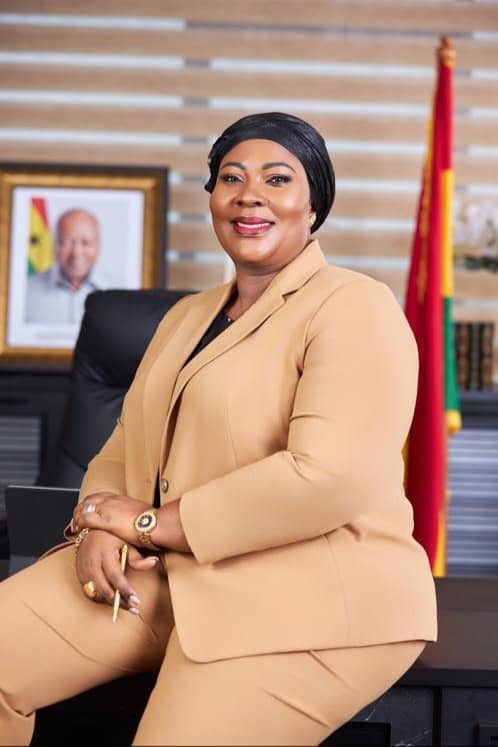
Mary Awusi—Chief Executive Officer of the Ghana Free Zones Authority
Awusi dropped the bombshell when NDC footsoldiers went after a ‘snitcher’, Resemond Obeng, after she was appointed a presidential staffer having crossed over from the NPP few days to the 2024 election.
Obeng was a front desk officer at the Campaign Office of the NPP presidential candidate, Dr Mahamudu Bawumia and allegedly traded the NPP candidate for a favour as Mary Awusi encapsulated.
Another appointment that raised an eyebrow was that of Dr. Bernice Makafui Brempong who was initially appointed the Chief Executive Officer of the Ghana Investment Promotion Centre, GIPC.

Dr. Bernice Makafui Brempong
Her appointment was immediately withdrawn after it became clear that she may not have the needed pedigree and appointed a presidential in charge of Investments in Healthcare and Pharmaceuticals at the office of the President. Sources said her initial appointment was on the blind side of the president.
Makafui Brempong, is a pharmacist and a daughter of a former NDC parliamentary candidate for Ayawaso West Wuogon constituency in the Greater Accra region, Delali Kwasi Brempong.
The list is endless with some equally dodgy appointments in state run agencies clothed as technical advisers when there are technocrats trained for the jobs.
Despite this, these staffers reportedly enjoy state-funded perks, including vehicles, fuel allocations and allowances.
The issue of fuel and perks has become especially sensitive following the government’s recent announcement that fuel allowances for political appointees had been scrapped as part of austerity measures.
Yet earlier disclosures by Felix Kwakye Ofosu indicated that fuel entitlements remain embedded in appointment letters for ministers and other political officeholders, deepening public skepticism about the sincerity and implementation of cost-cutting policies.
Critics describe the situation bluntly as “jobs for the boys and girls,” arguing that loyalty to the ruling party has been rewarded with publicly funded positions that add little demonstrable value to governance.
They point to the growing number of presidential staffers as evidence that the Mahama administration is presiding over what is now being described as the largest government in the political history—surpassing even the much-criticised size of the Akufo-Addo administration.
Particular outrage has been directed at the proliferation of specialised coordinators within ministries and programmes.
For instance, questions have been raised about the need for four staffers at the Office of the National Anti-Corruption Programme at the Presidency, when institutions such as CHRAJ and the National Commission for Civic Education already exist to perform related functions.
Similarly, critics question why the Minister for Youth Development and Empowerment requires as many as 11 Technical Coordinators, whose combined salaries alone could reportedly pay nearly 1,000 nurses.
As these details emerge, opposition voices argue that President Akufo-Addo was unfairly vilified for the cost of governance under his tenure, and that Ghanaians were misled into believing the current administration would represent a sharp break from past excesses.
The growing silence of the public, critics warn, risks normalising what they describe as organised waste at a time of economic hardship and calls for national sacrifice.