By Nadia Ntiamoah
Ghana’s electricity access rate has reached nearly 90 percent, marking a major milestone in the country’s decades-long effort to achieve universal power coverage.
While the progress is widely regarded as significant, energy sector experts and development advocates argue that the focus must now shift from celebrating gains to accelerating the final push toward 100 percent nationwide access.
The foundation of Ghana’s electrification journey was laid in 1989 with the launch of the National Electrification Scheme (NES), a long-term national programme designed to ensure reliable electricity access across the country by the year 2020.
The target was later extended to 2025, reflecting the scale of infrastructure expansion required to reach remote and underserved communities.
The scheme has since become one of the most transformative development initiatives in the history, driving sustained investments in power generation, transmission, and rural electrification.
At the start of the programme in 1990, only about 20 percent of Ghana’s population had access to electricity, leaving the vast majority of rural communities without reliable power.
In line with the United Nations Sustainable Development Goal 7 (SDG 7), which seeks to ensure access to affordable, reliable, sustainable, and modern energy for all, successive governments expanded grid infrastructure, rural electrification projects, and off-grid solutions, steadily increasing national access levels.
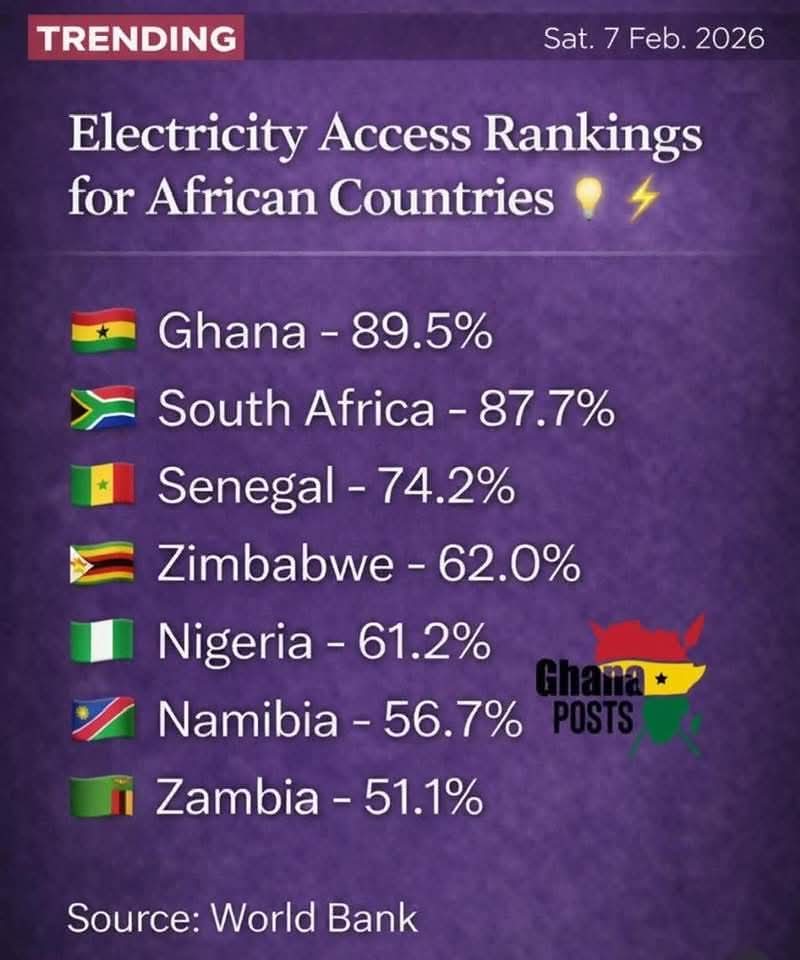
By the end of 2024, the national electricity access rate had reached 89.5 percent, according to official data. Urban areas have achieved near-total coverage at 100 percent, while rural access stands at 76.7 percent, reflecting the remaining challenge of connecting hard-to-reach communities.
These figures place Ghana among the leading countries in Sub-Saharan Africa in terms of electricity access.
Recent continental rankings further underscore the regional leadership in electrification.
As of February 2026, the electricity access rate of approximately 89.6 percent surpasses several major African economies, including South Africa (87.7 percent), Senegal (74.2 percent), Zimbabwe (62.0 percent), Nigeria (61.2 percent), Namibia (56.7 percent), and Zambia (51.1 percent), according to international development and energy access data sources.
Energy analysts note that while the progress reflects decades of sustained policy commitment, the remaining gap to universal access is the most difficult to close.
Rural and island communities, remote settlements, and low-density populations present higher infrastructure costs and logistical challenges.
However, experts argue that achieving full coverage is critical for inclusive development, economic growth, healthcare delivery, education, and digital inclusion.