BY Daniel Bampoe
A convergence of political messaging, legal introspection, and professional guidance defined the 2026 Law Students’ Network (LSN) Leadership and Law Series, as leading figures from the New Patriotic Party (NPP) and Parliament used the platform to shape narratives around governance, justice, and the future of legal practice in Ghana.
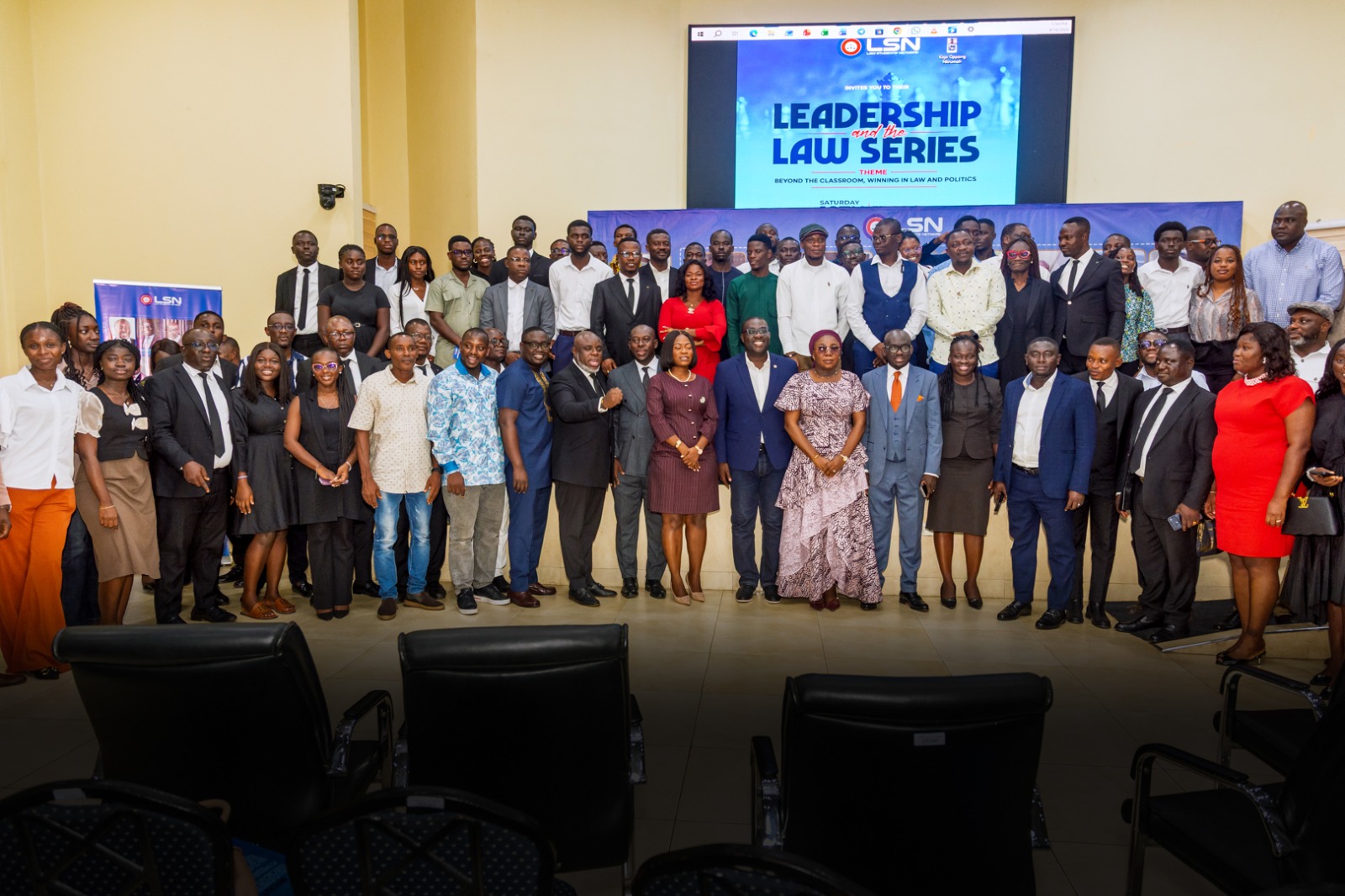
Held on April 18, 2026, at the ISSER Conference Centre of the University of Ghana, the event—under the theme “Beyond the Classroom: Winning in Law and Politics”—brought together political actors, legal practitioners, and students at a time when the political climate remains sharply contested following the 2024 general elections and ongoing debates about governance, accountability, and institutional independence.
At the centre of the political messaging was Kwame Kyeretwie-Amponsah, the NPP’s Director of International Affairs, who used the platform to signal what appears to be an early strategic mobilisation toward the 2028 elections.
Framing the party’s electoral symbol as a rallying force, he declared that the “elephant” remains the party’s strongest asset and insisted that the NPP is reorganising to return to power.
His remarks come against the backdrop of the NPP’s post-2024 rebuilding phase, following its electoral defeat to the National Democratic Congress (NDC).
Party insiders have since hinted at structural reforms aimed at addressing internal weaknesses, reconnecting with grassroots supporters, and repositioning the party’s ideological identity.
Mr. Kyeretwie-Amponsah revealed that a nationwide membership registration exercise is underway to clean up party data and strengthen internal structures.
He stressed that members must ensure they are formally captured in party records, with new digital and physical membership cards being introduced.
He also underscored the importance of dues payment, describing it as both a constitutional obligation and a necessary financial backbone for party operations.
In what signals a broader reorganisation agenda, he disclosed plans for comprehensive internal elections—from polling station to national level—expected to be completed by December 2026.
According to him, this timeline is designed to ensure the party enters the 2028 electoral cycle with a unified and fully constituted leadership structure.
Beyond organisational reforms, he urged party members—especially the youth—to actively engage in political communication by promoting the NPP’s achievements while criticising the current administration.
He also referenced ideological training through platforms linked to the Danquah Institute, reinforcing the party’s centre-right philosophy.
While the NPP’s forward-looking strategy dominated one part of the discussion, concerns about ethics, justice, and political conduct formed a sharp counterpoint from the Minority side in Parliament.
Speaking on behalf of Minority Leader Alexander Kwamena Afenyo-Markin, Jerry Ahmed Shaib delivered a cautionary message about what he described as declining political integrity in Ghana.
He warned that some political actors publicly profess commitment to national values while allegedly defending corruption or shifting principles for convenience.
He emphasised that justice must be applied without exception, stressing that no individual—regardless of power or influence—should be above the law. His remarks reflect growing public discourse around accountability, especially amid ongoing corruption-related controversies and perceptions of selective justice in the political landscape.
Addressing the next generation of legal professionals, Mr. Shaib urged law students to remain disciplined, courageous, and ethically grounded.
He argued that the evolving political environment—marked by heightened scrutiny and intense partisanship—requires lawyers who can resist pressure and uphold justice even when it is politically inconvenient.
He further highlighted the intersection between law and politics, noting that while legal frameworks define governance boundaries, political actors shape how those frameworks are applied. According to him, individuals who understand both systems are critical to strengthening democratic institutions.
Complementing the ethical discourse was a strong focus on the realities of legal practice, led by Frank Davies, who challenged conventional perceptions about the legal profession.
Mr. Davies warned against the common assumption that being called to the Bar represents the peak of a lawyer’s journey. Instead, he described it as merely the starting point of a demanding career that requires continuous learning, adaptability, and strategic planning.
He pointed to the rapid evolution of legal practice in Ghana, noting that the profession has expanded far beyond courtroom litigation. Lawyers, he said, are increasingly operating in diverse sectors such as finance, taxation, natural resources, technology, intellectual property, and international arbitration.
According to him, the modern legal environment demands multidisciplinary competence and practical exposure. He encouraged students to explore emerging opportunities early and to approach their careers with intentionality and flexibility.
His remarks align with broader global trends in legal practice, where specialisation and cross-sector expertise are becoming essential for competitiveness.
The forum also featured contributions from other political and legal figures, reinforcing the event’s role as a platform for shaping both professional and political consciousness among young people.
Sammi Awuku urged students to look beyond academic qualifications and understand the dynamics of power and influence, describing law and politics as interconnected “living systems.”
Meanwhile, the Akuampem North MP, Samuel Abu Jinapor emphasised the importance of attitude, mentorship, and humility in career development.
On gender inclusion, the former Minister for Information, Fatimatu Abubakar called for greater participation of women in politics and governance, highlighting structural and cultural barriers that continue to limit their representation despite their significant role in the economy.
Taken together, the LSN 2026 forum reflected a broader moment in the political and legal evolution—where political parties are recalibrating for future elections, public officials are confronting questions of integrity, and young professionals are being urged to adapt to a rapidly changing landscape.