BY Nadia Ntiamoah
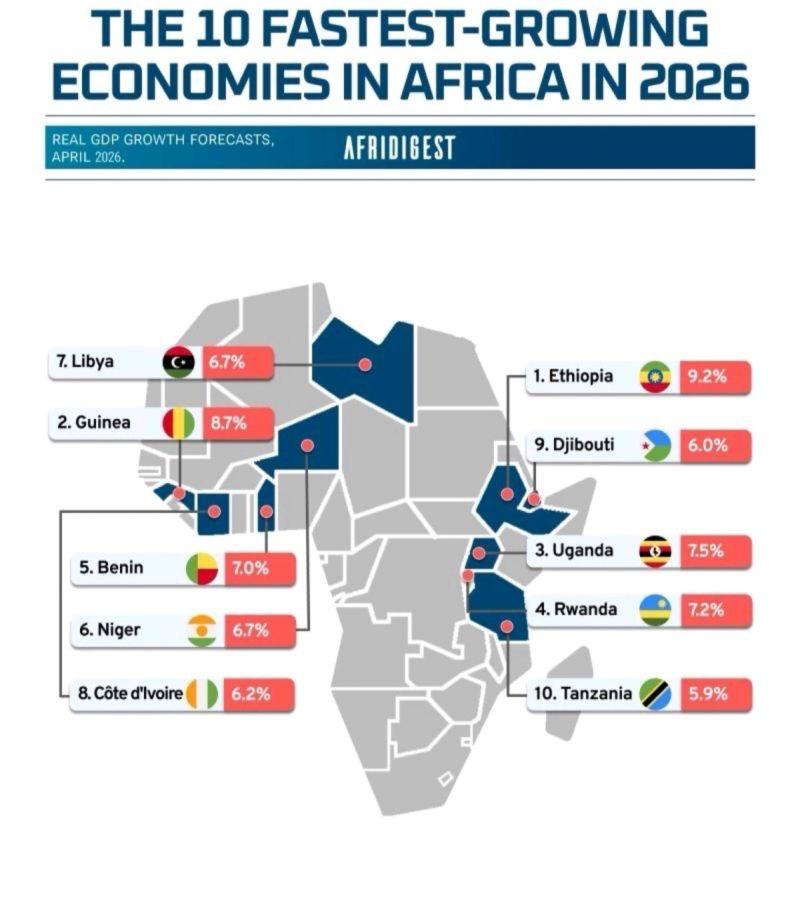
Africa’s economic outlook for 2026 is being reshaped by a new generation of fast-growing economies, with fresh data from the International Monetary Fund pointing to a shift away from the continent’s traditional heavyweights.
At the forefront of this transformation is Ethiopia, projected to record a remarkable 9.2 percent growth rate, making it the fastest-growing economy on the continent this year.
The broader picture reveals a strong showing from several emerging economies across East and West Africa. Countries such as Uganda, Rwanda, and Benin are maintaining consistent growth rates above 6 percent, underscoring a pattern of steady, structural expansion rather than short-term economic rebounds.
They are joined by other high-performing economies including Senegal, Tanzania, Côte d’Ivoire, Democratic Republic of the Congo, Mozambique, and Niger, all benefiting from a mix of natural resources, infrastructure investments, and improving policy environments.
This emerging trend signals a clear shift in Africa’s growth narrative. For years, economic performance on the continent was largely associated with a handful of dominant economies.
However, current projections suggest that growth is becoming increasingly decentralised, with smaller and reform-driven countries rising as key engines of expansion.
These nations are leveraging targeted policies, improved governance, and strategic investments to position themselves as competitive players in the global economy.
Analysts note that countries like Uganda, Rwanda, and Benin are not just experiencing growth spikes but are building resilient economic systems anchored in long-term planning. Their progress reflects deliberate efforts to strengthen institutions, improve ease of doing business, and invest in sectors such as infrastructure, technology, and agriculture—factors that continue to attract investor confidence.
At the same time, the evolving landscape highlights a widening gap between countries that are implementing reforms and those lagging behind. Policy direction, infrastructure development, and political stability are increasingly determining which economies surge ahead.
Governments that prioritise these elements are seeing tangible gains, while others struggle to keep pace in a rapidly changing economic environment.
Ultimately, Africa’s economic story in 2026 is less about size and more about strategy. The real opportunities are emerging in markets that may not dominate headlines but are scaling quietly and consistently.