BY DANIEL BAMPOE
A fresh controversy has emerged over the documentation supporting Ghana’s GH¢49.72 million evacuation of citizens from South Africa, following claims that a minor appears in records associated with the payment of a GH¢5,000 reintegration grant.
The claim has triggered renewed scrutiny of the beneficiary registers submitted by Foreign Affairs Minister Samuel Okudzeto Ablakwa in response to a Right to Information (RTI) request from the Parliamentary Minority.
The controversy centres on the documentation used to account for the financial support provided to Ghanaians who returned home following xenophobic attacks in South Africa.
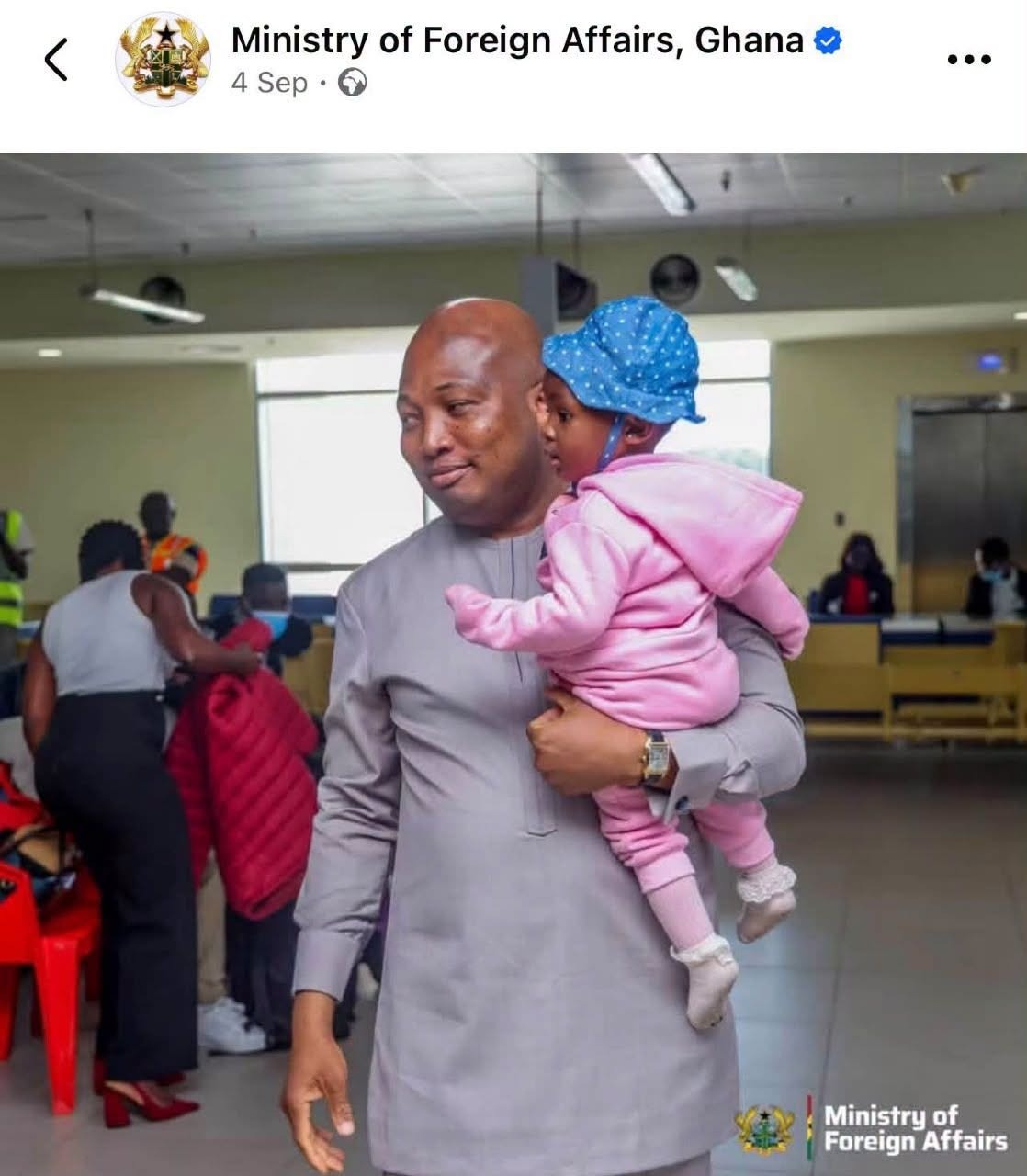
Although the claim that a “baby signed for cash” has circulated in political discussions, the available information does not establish that an infant personally collected or signed for state funds.
Rather, the issue concerns the identification of minors in the payment registers and questions about how their payments, if any, were verified and received.
The Minority has argued that the records released by the Foreign Affairs Ministry contain inconsistencies that require further explanation, including differences between beneficiary lists, duplicated entries and questions about the treatment of children under the reintegration support scheme.
The allegations have added another dimension to the political dispute over whether the government can fully account for the cost of the evacuation.
The dispute follows the evacuation of 1,964 Ghanaians from South Africa after xenophobic violence and threats against foreign nationals prompted concerns about their safety.
Foreign Affairs Minister Samuel Okudzeto Ablakwa announced that the exercise cost GH¢49,721,786, comprising GH¢33,721,786 in government-funded expenditure and GH¢16 million attributed to support from Engineers & Planners for air tickets and reintegration assistance.
The government also stated that each evacuee was entitled to a GH¢5,000 reintegration grant and a GH¢500 transport allowance, bringing the combined support package to GH¢5,500 per person.
However, the Minority subsequently invoked the Right to Information Act, 2019 (Act 989), requesting detailed records covering the expenditure, the number of beneficiaries, flight arrangements, payment registers and supporting documentation.
The Ministry responded with more than 200 pages of documents, including records relating to payments and travel arrangements.
The Minority says it examined the material and identified discrepancies that, in its view, require a more comprehensive reconciliation. Over GHC 16 million could not accounted for after reconciliation.
The issue involving minors emerged from the Minority’s examination of the reintegration payment register.
According to the statement delivered by Bosome-Freho MP and Deputy Ranking Member of the Foreign Affairs Committee, Nana Asafo-Adjaye Ayeh, the Minority identified 442 minors among the names recorded in the GH¢5,000 reintegration register.
The MP questioned whether the Ministry had clearly documented how the support intended for those children was administered, including whether payments were made directly to eligible beneficiaries or received by parents and guardians on their behalf.
The concern is particularly significant because children evacuated from a potentially dangerous situation may require different payment and safeguarding arrangements from adult beneficiaries.
However, the presence of a minor’s name in a payment register does not, on its own, establish that the child personally signed for or received money.
Establishing what happened in any individual case would require examination of the relevant entry, the beneficiary’s identity and age, the signature or acknowledgment recorded, and any documentation showing who actually received the funds.
The available information therefore does not justify presenting the allegation that a baby personally signed for GH¢5,000 as an established fact.
The questions surrounding the minors form part of the Minority’s broader challenge to the Ministry’s financial documentation.
In its analysis, the Minority said it matched names appearing in the signed registers for the GH¢5,000 reintegration grant against those in the GH¢500 transport allowance register.
According to the figures presented in the Minority’s statement, only 824 names could be matched across both lists, despite the government’s reported total of 1,964 evacuees.
The Caucus calculated that 1,140 beneficiaries remained inadequately reconciled across the two payment records, representing GH¢6.27 million in combined reintegration and transport support requiring further explanation.
The Minority also questioned the number of passengers documented in the commercial-flight records. It said its review identified 247 commercial-flight passengers, which, when added to the 926 people it said travelled on chartered flights, produced a total of 1,173 people that it could account for through the records examined.
The resulting difference of 791 people prompted further questions about whether the flight documentation supplied by the Ministry adequately supported the reported total of 1,964 evacuees.
These are the Minority’s findings based on its review of the supplied documents. A complete reconciliation by the Ministry and an independent audit would be needed to determine whether the apparent gaps reflect missing records, incomplete documentation, errors or actual discrepancies in expenditure.
The Minority has also alleged that some names appear more than once in the reintegration, transport and flight records.
It wants the Ministry to establish whether these repetitions were clerical errors or whether they affected the calculation of beneficiaries and expenditure.
The Caucus has argued that the payment registers should allow each beneficiary to be identified clearly, with records showing the amount paid, the date of payment and evidence that the money reached the intended recipient.
Where a minor is listed, the Minority says the records should also clarify the applicable payment arrangements and identify any parent, guardian or authorised person who received support on the child’s behalf.
The central question is whether the records are sufficiently complete and reliable to support the government’s published figures.
Ablakwa has maintained that the Ministry has made records available in response to the RTI request and has indicated that the Auditor-General has been invited to examine the exercise.
The Minister has also stated that there is nothing to hide and has supported an audit of the operation.
Reports indicate that he has called for broader examination of previous evacuation exercises conducted by the Ministry, including operations associated with the COVID-19 pandemic and the conflict in Ukraine.
The Majority Caucus has defended the Minister and rejected the Minority’s interpretation of the records, maintaining that the allegations do not establish that public funds have gone missing.
The Minority, meanwhile, wants a fully independent audit conducted by a reputable accounting firm, proposing Deloitte Ghana, KPMG Ghana, PwC Ghana or EY Ghana, or another firm with comparable standing and independence.