
BY NADIA NTIAMOAH
The Asantehene, Otumfuo Osei Tutu II, has called on government, educational institutions, investors and other stakeholders to increase investment in the arts and creative industry, warning that the country risks losing significant economic opportunities if its cultural resources and creative talents are not adequately developed.
He said the creative sector, particularly the fashion industry, had the potential to become a major source of employment, wealth creation and economic growth, but required deliberate investment, improved technical skills and stronger support for locally manufactured products.
According to the Asantehene, the fashion industry alone is estimated to contribute about GH¢2 billion to the national economy.
However, he believes the sector could generate substantially more revenue if local designers and manufacturers received the necessary support to expand production, improve quality and compete effectively in both domestic and international markets.
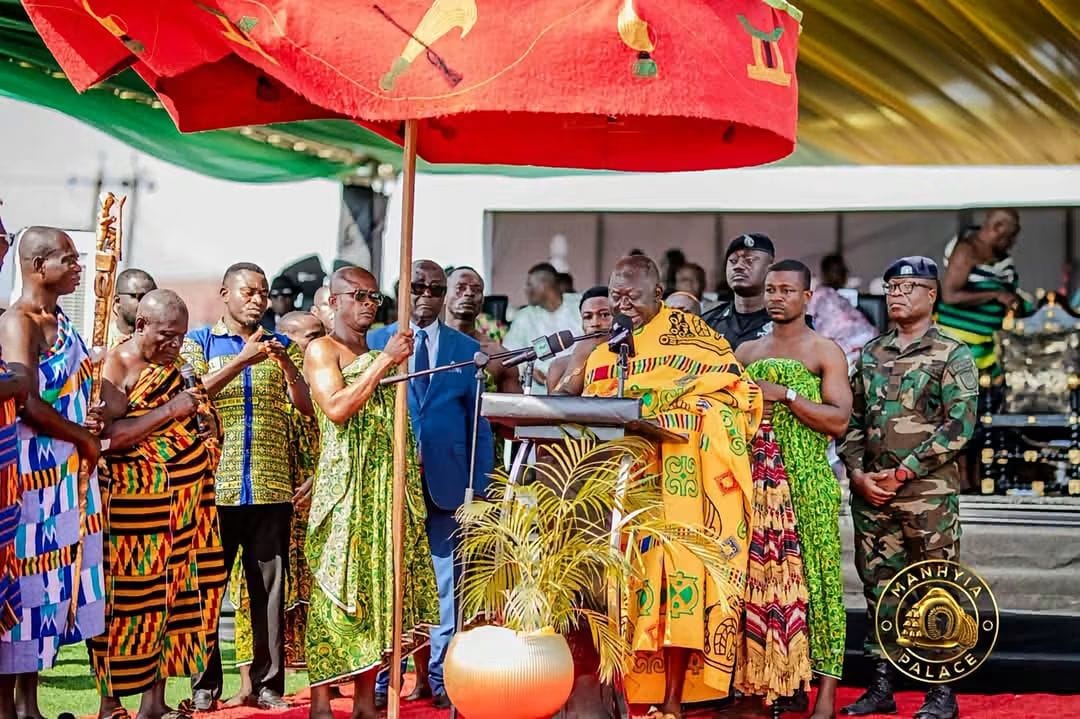
Otumfuo made the remarks at the Faculty of Applied Arts and Technology (FAAT) Week celebration at Takoradi Technical University (TTU), where he challenged the institution to take a leading role in developing the technical and creative skills required to transform Ghana’s arts industry into a more organised and commercially competitive sector.
He expressed concern that despite the growing international recognition of Ghanaian designers, artists and other creative professionals, locally manufactured fashion products remained underrepresented in shops across the country.
“What you cannot find in the shops, though, are Made-in-Ghana labels and sadly, even on the domestic market, our shops are dominated by foreign products, save for the growing indigenous sector,” he observed.
The Asantehene said the situation reflected a gap between the international appreciation of Ghanaian creative talents and the ability of the country to translate that recognition into commercial success for locally produced goods.
He urged artists, fashion designers, students and other practitioners to pay greater attention to the quality of their work, develop products that could compete internationally and use their creativity to promote Ghana’s cultural identity.
He also identified the shortage of middle-level technical skills as one of the major constraints affecting industrial development and the expansion of the creative sector, despite the progress made in tertiary education.
Addressing the university community, he described TTU as occupying an important position in the creative industry’s value chain because of its ability to connect cultural heritage with modern production and economic activity.
“Your university stands at the critical point in the value chain where heritage and culture meet economic value,” he said.
He therefore challenged the university to bridge the existing skills gap by bringing indigenous knowledge into formal education, connecting experienced artisans with young designers and ensuring that traditional craftsmanship was supported by modern technology.
The Vice-Chancellor of Takoradi Technical University, Rev. Prof. John Frank Eshun, also called for a change in the way Ghana approaches the creative arts, arguing that the sector should be treated as an organised economic activity rather than being viewed mainly as a cultural or recreational pursuit.
He said the celebration was designed to recognise the importance of preserving Ghana’s cultural identity while encouraging innovation, creativity and excellence among students and practitioners.
According to him, the country needed to move beyond showcasing its cultural heritage at festivals and public events and begin building sustainable economic opportunities around it.
“The creative arts must move beyond being treated largely as a cultural and recreational sector, but as an organised economic development agenda,” he said.


