BY DANIEL BAMPOE
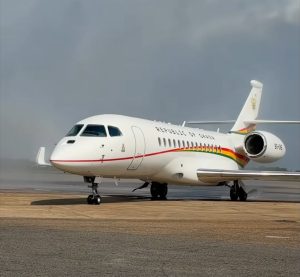
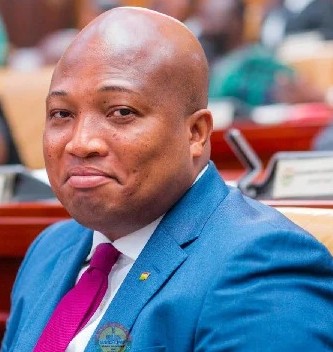
The arrival of Ghana’s new US$60.68 million Falcon 6X presidential jet has reignited a fierce political controversy, with opposition figures accusing the National Democratic Congress (NDC) of abandoning positions it strongly defended while in opposition and placing Foreign Affairs Minister Samuel Okudzeto Ablakwa under renewed pressure to explain his earlier promise to resign if an NDC government resorted to private jet travel.
The aircraft, manufactured by French aerospace company Dassault Aviation, arrived at the Accra International Airport on Monday, November 16, 2026, marking the latest chapter in Ghana’s long-running debate over presidential travel, the cost of executive aircraft and the appropriate use of public funds.
Secretary to the President, Callistus Mahama had announced in March that Ghana will add new aircraft to the presidential fleet by November 2026, including one dedicated to presidential travel, as part of broader efforts to strengthen state aviation capacity and end temporary travel arrangements. And as indicated the executive aircraft was delivered in November.
While the Mahama administration has defended the acquisition as a necessary replacement for an ageing aircraft that has experienced serious technical problems, critics argue that the development exposes what they describe as political inconsistency among NDC leaders who previously criticised the Akufo-Addo administration over its approach to presidential aviation.
At the centre of the controversy is Okudzeto Ablakwa, who, as an opposition Member of Parliament for North Tongu, became one of the most vocal critics of former President Nana Addo Dankwa Akufo-Addo’s use of chartered private aircraft for international trips arguing that the presidential jet was in a pristine position.
His campaign was built around the argument that Ghana already owned a presidential aircraft capable of undertaking official journeys and that spending substantial sums on luxury private jet charters was unnecessary and insensitive to the economic difficulties facing the country.
However, with the NDC now in government and the Ghana Air Force taking delivery of a new executive jet, opponents are revisiting his previous statements, particularly his declaration that he would resign if a future NDC government hired private jets for presidential travel or acquire one.
Ablakwa’s Past Opposition to a New Presidential Jet
During the Akufo-Addo administration, Ablakwa repeatedly challenged proposals and discussions surrounding the acquisition of a replacement of the presidential aircraft.
In 2021 and 2022, he maintained that the existing Dassault Falcon 900EX, which entered service in 2010, remained suitable for presidential travel and should not be replaced merely because the government wanted a larger or more luxurious aircraft.
He relied on assurances previously attributed to former National Security Minister Albert Kan-Dapaah regarding the aircraft’s expected lifespan, arguing that the presidential jet should be capable of serving the country for approximately 20 years.
Ablakwa therefore questioned why the Akufo-Addo administration would consider acquiring another aircraft when the existing one had not reached the end of its projected service life.
In December 2021, he argued that a government facing serious unemployment challenges should not be holding consultations towards purchasing a new presidential jet.
He described the proposed acquisition as misguided and insensitive to taxpayers, insisting that public resources should be directed towards more pressing national priorities.
The North Tongu MP also declared that the NDC Minority in Parliament would resist attempts to secure parliamentary approval for a new presidential aircraft.
Speaking in July 2022, Ablakwa made a particularly strong declaration about what he expected from a future NDC administration.
He said he would not want to be part of a government that hired private jets at excessive costs and indicated that he would resign if an NDC government adopted that practice.
“I don’t have anything against the president, but it’s about protecting the public purse, and I don’t expect a future NDC president to hire jets at such high cost. Some of us would resign; I wouldn’t want to be part of such a government,” he stated.
The statement has now become one of the most frequently cited arguments by critics challenging his position following the return of the NDC to power since the NDC has been hiring private jets for presidential trips.
The Falcon 6X and the US$60.68 Million Question
The immediate trigger for the renewed debate is the arrival of the Falcon 6X, which the government says is intended to replace the ageing Falcon 900EX.
The acquisition was not announced as a new decision on November 16, 2026. Its procurement agreement had already been presented to Parliament in December 2025 by then Deputy Minister for Defence Ernest Brogya Genfi.
The agreement between the Government of Ghana and Dassault Aviation covered the purchase of one Falcon 6X at a cost of US$60.68 million.
Parliament approved the agreement on December 4, 2025, following consideration by the relevant parliamentary committee.
The aircraft formed part of a broader military aviation retooling programme that also included the acquisition of four helicopters from Airbus Helicopters of France.
The helicopter agreement, valued at approximately €125.97 million, covered one H160 and three H175 helicopters for the Ghana Air Force.
The combined procurement was presented as part of efforts to modernise the country’s aviation capabilities and address concerns about ageing military aircraft and the limited number of serviceable platforms.
The Defence and Interior Committee had raised concerns about the condition of the Ghana Armed Forces’ aviation fleet, noting that several aircraft had become unserviceable because of maintenance difficulties.
The committee’s consideration of the agreements therefore placed the presidential aircraft within a wider defence modernisation programme rather than treating it solely as a presidential comfort project.
Nevertheless, the US$60.68 million price tag has remained a major subject of public debate, particularly because of the country’s competing development and security needs.