By Issah Olegor
Ghanaian broadcaster and Chief of Akwamu Adumasa, Nana Ansah Kwao IV, is heading to court in a bold personal crusade to challenge what he believes is an unjust traffic charge — and in doing so, he’s also raising uncomfortable questions about police conduct and integrity on the roads.
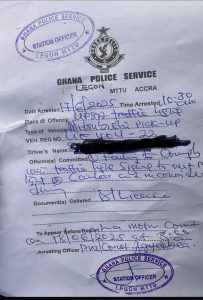
In a social media post that has since gained widespread traction, Nana Ansah recounted a confrontation with police officers on the morning of Tuesday, 17th June 2025, at the traffic intersection near the University of Professional Studies, Accra (UPSA).
According to his account, he was driving through the lights — which had just turned amber — when a police motorcycle with two officers pulled him over.

Notably, he claims that the pillion rider, identified as Constable Agyebea, was not wearing a helmet, a clear violation of Ghana’s road traffic regulations.
“She was breaking the law herself,” Nana Ansah pointed out.
The officers alleged that he had ran through a red light and demanded his driver’s license, which was taken from him before instructing him to follow them to the Legon Motor Traffic and Transport Office (MTTU).
From Citation to Courtroom
What followed, according to Nana Ansah, was a quietly unfolding yet serious test of principle.
Upon arrival at the MTTU office, Constable Agyebea allegedly handed over the case to another officer, stating the vehicle number and the offense of running through a red light.
Nana Ansah said he remained calm throughout, waiting for the formal process to proceed.
However, the situation took a turn when a female officer approached him discreetly and suggested that the court might not favour him — implying that he should consider paying something to resolve the matter.
He says he rejected the suggestion outright.
“I smiled and said no. I will test the law,” he wrote.
The media personality insists he did not run through the red light and says he is prepared to face the La District Court on Wednesday, 18th June, where he hopes to see what evidence the police will present to support the charge.
His decision to go to court, instead of yielding to informal “settlement” tactics, has resonated with many Ghanaians on social media who see his stance as a rare but necessary pushback against the growing public perception of impunity and corruption among some law enforcement officers.
His experience is not uncommon in Ghana, where citizens frequently report being asked for “on-the-spot” settlements for traffic offenses — often without due process or evidence.
However, it is uncommon for individuals, particularly public figures, to challenge such interactions through legal channels.