BY Issah Olegor
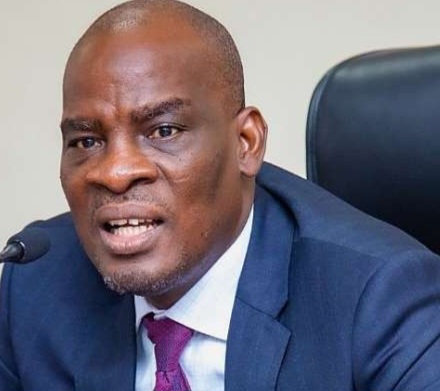
The deepening leadership crisis at the Minerals Income Investment Fund (MIIF) has taken a significant political turn following the quiet exit of Dr. Kwaku Asiedu-Nketiah Jr, Deputy Chief Executive Officer of the Fund and son of the National Chairman of the National Democratic Congress (NDC), Johnson Asiedu Nketiah.
His departure, which insiders link to irreconcilable differences with MIIF’s Chief Executive Officer, Justina Nelson, marks another high-profile casualty in what has become one of the most turbulent periods in the Fund’s short history.
Although Asiedu-Nketiah Jr’s name remains listed on MIIF’s official website, multiple sources confirm that he has ceased active involvement in the Fund’s management. More significantly, all payments made to him during his period of non-participation have reportedly been returned—an unusual move that underscores the seriousness of the breakdown between the deputy CEO and the current leadership.
A Fund Built For Stability, Now Gripped By Turmoil
MIIF was established under the Minerals Income Investment Fund Act, 2018 (Act 978) to manage the mineral royalties and convert finite natural resources into long-term national wealth.
In its early years, the Fund attracted professionals with strong corporate finance, governance, and investment backgrounds, earning a reputation as one of Ghana’s most promising state-owned investment vehicles.
That reputation, however, has come under severe strain since January 2025, when Justina Nelson assumed office as CEO following the abrupt removal of the previous chief executive.
What was initially framed as a routine leadership transition has since escalated into a full-blown institutional crisis.
Clash Of Leadership Styles
Sources close to MIIF say Dr. Asiedu-Nketiah Jr’s exit followed sustained disagreements with the CEO over leadership style, decision-making processes, and internal governance.
According to insiders, the Deputy CEO raised concerns about what he viewed as a centralised, confrontational management approach that discouraged professional dissent and sidelined established internal processes.
Those concerns reportedly placed him on a collision course with the CEO.
While neither Dr. Asiedu-Nketiah Jr nor MIIF management has publicly detailed the dispute, multiple officials familiar with internal developments say the relationship became untenable, leading to his withdrawal from day-to-day operations.
His departure is widely viewed within MIIF as symbolic, given his political lineage and professional stature.
A Wider Leadership Crisis Unfolds
Dr. Asiedu-Nketiah Jr’s exit did not occur in isolation. It forms part of a broader pattern of resignations and dismissals that has hollowed out MIIF’s institutional capacity.
Since Nelson’s appointment, the Fund has reportedly lost more than 15 out of its roughly 35 employees, including: Chief Financial Officer, Chief Investment Officer, Chief Risk Officer, Head of Legal, Entire Corporate Affairs Department, Finance Manager, Head of IT, Legal Officer, Business Development Officers, Deputy Head of Procurement, Several IT and finance professionals.
Former staff describe the work environment as “toxic,” “intimidating,” and hostile to professional integrity.
One former senior officer told the media: “Once you challenged the narrative, you were gone. People were scared. The institution we helped build was collapsing from the inside.”
Audit Controversy Adds Fuel
The leadership turmoil has been compounded by a major governance scandal. MIIF was recently exposed for attempting to seek a restatement of its already audited and signed 2024 financial statements—a move that the Auditor-General flatly rejected as “improper” and misleading.
Insiders say the same finance professionals who resisted pressure to alter financial figures were among those forced out or sidelined, reinforcing perceptions that internal purges were linked to efforts to reshape a narrative of alleged mismanagement.
The audit controversy has since elevated MIIF’s internal problems into a national governance issue.
The Loss of Asiedu-Nketia Jr
With Dr. Asiedu-Nketiah Jr’s exit, MIIF loses a highly credentialed financial and corporate governance expert.
His professional journey spans Africa, Europe, and North America, combining academic depth with practical experience in investment structuring, logistics, mining, and infrastructure development.
He has held senior leadership roles including: Managing Partner, Afrimex Gold Limited,CEO, Joy Transporters Company Limited, Founder and CEO, KAYAB Maritime Services Company Limited.
Academic And Professional Credentials
Dr. Asiedu-Nketiah Jr holds: A DPhil in Management Science from the Central University of Technology, with research focusing on policy reforms, corporate governance, and the performance of state-owned enterprises in Ghana
An MSc in Finance and Management from Heriot-Watt University
A BBA in Accounting and Management from Mount Royal University
He is also a member of the Canadian Association of Petroleum Production Accountants, reflecting his commitment to global professional standards.
Track Records
Over the years, Dr. Asiedu-Nketiah Jr has been associated with several high-impact projects, including:
Negotiating a US$30 billion infrastructure development agreement for the Republic of Cameroon
Playing a role in the discovery of lithium in Ghana, which later underpinned collaboration with Atlantic Lithium Limited
Supporting the establishment of Wankang Ceramics and Kada Ghana Ceramics Company Ltd in Takoradi
The Wankang project alone is valued at US$100 million, while Kada Ceramics has, since 2015, created over 2,000 direct jobs and 5,000 indirect jobs for Ghanaians.
An Institution Bleeding Talent
The departure of a deputy CEO of Asiedu-Nketiah Jr’s calibre reinforces concerns that MIIF is experiencing not just a staff turnover, but a systemic loss of expertise, institutional memory, and investor confidence.
A Sovereign Fund At A Crossroads
MIIF now stands at a critical juncture. With senior professionals exiting, legal battles emerging, and the Auditor-General openly rebuking management actions, pressure is mounting on political and regulatory authorities to intervene.