BY Grace Zigah
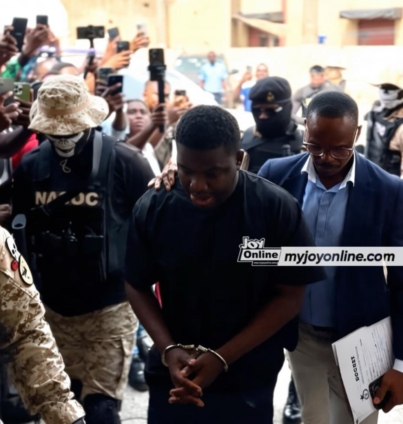
Embattled Swedru-based social media figure Frederick Kumi, popularly known as Abu Trica, was on Tuesday, January 13, 2026, escorted under heavy security to the Gbese High Court in Accra for the second hearing of his extradition case to the United States.
Unlike his first court appearance, where his face was concealed from public view, Abu Trica arrived this time without covering his face, a development that quickly drew widespread public attention and mixed reactions across social media platforms.
The court appearance forms part of ongoing legal proceedings following Abu Trica’s arrest on December 11, 2025, in a joint operation involving the United States Federal Bureau of Investigation (FBI) and multiple Ghanaian security agencies.
His arrest marked the culmination of months of international investigations into an alleged fraud syndicate accused of targeting elderly Americans through elaborate romance scams.
According to an unsealed indictment by the U.S. Department of Justice, Abu Trica—also known as Emmanuel Kojo Baah Obeng—is facing charges including conspiracy to commit wire fraud, money laundering conspiracy and a forfeiture specification.
If convicted, he could face up to 20 years in prison under U.S. federal law.
Prosecutors allege that the criminal network he is accused of being part of had been operating since 2023 and defrauded victims of more than eight million dollars.
Investigators claim the syndicate used Artificial Intelligence-powered tools to create fake online identities on social media and dating platforms.
These digital personas were allegedly used to build emotional relationships with unsuspecting victims, primarily elderly individuals, before manipulating them into sending money under false pretences such as medical emergencies, travel expenses or purported investment opportunities.
The U.S. authorities further allege that Abu Trica played a role in coordinating the distribution of the proceeds to Ghana and other countries.
At Tuesday’s court session, Abu Trica was seen wearing a black T-shirt and jeans, handcuffed and flanked by armed security operatives as he was marched into the court building alongside his alleged accomplices, identified as Lord Eshun and Bernard Aidoo.
He appeared visibly anxious as he entered the courtroom, a stark contrast to the confident persona he once projected on social media.
The case has also drawn attention due to developments involving other individuals linked to Abu Trica.
His girlfriend and mother of his child, Abena Oforiwaa—popularly known as Queenie—was earlier apprehended to assist with investigations.
She was later released following legal interventions led by lawyer and activist Oliver Barker-Vormawor and his firm.
Behind the scenes, the extradition proceedings have not been without legal controversy.
During the latest hearing, counsel for the second accused, Robert Ishmael Aggrey Amissah, revealed that the state had filed to discontinue proceedings against the second and third accused persons.
However, the sitting-in judge reportedly declined to approve the request and recused herself from the matter, a move the lawyer dramatically likened to “washing her hands off the case,” invoking the biblical reference to Pontius Pilate.
The investigation into the alleged fraud syndicate has been led by the FBI’s Cleveland Division, with support from Ghana’s Attorney General’s Office, the Economic and Organised Crime Office (EOCO), the Ghana Police Service, the Cyber Security Authority (CSA), the Narcotics Control Commission (NACOC) and the National Intelligence Bureau (NIB).