BY Grace Zigah
The flagship Free Senior High School (Free SHS) programme is facing a deepening crisis that is rapidly exposing the complexities of policy transition, political rhetoric, and governance realities.
What was once a fiercely criticised policy by the then opposition National Democratic Congress (NDC) during the tenure of former President Nana Addo Dankwa Akufo-Addo has now become a test case for the same party’s ability to deliver on its own promises under the leadership of John Dramani Mahama.
For years, the NDC consistently described Free SHS under Akufo-Addo as “poorly implemented,” citing concerns over food shortages, declining meal quality, overcrowding, and an over-centralised procurement system managed by the National Food Buffer Stock Company.
John Mahama himself repeatedly argued that the centralised system deprived schools of flexibility and contributed to inefficiencies, insisting that headmasters should be empowered with direct funding to procure food locally.
This critique became a cornerstone of his 2024 campaign.
Mahama pledged to decentralise the feeding system by transferring feeding grants directly to school heads, allowing them to purchase food from local farmers and suppliers.
According to him, this approach would improve food quality, eliminate delays, and prevent situations where headmasters had to use personal funds or borrow to feed students.
However, nearly two years into the implementation phase of these promised reforms, the situation in schools suggests that the challenges the NDC once condemned have not only persisted but, in some cases, worsened.
On April 17, 2026, a high-stakes emergency meeting convened by Education Minister Haruna Iddrisu ended in a stalemate, highlighting deep divisions among key stakeholders responsible for managing the programme.
The meeting brought together the Conference of Heads of Assisted Secondary Schools, CHASS, the Ghana Education Trust Fund, GETFund, and the Buffer Stock Company to address what has now become a full-blown food supply crisis in secondary schools.
At the centre of the deadlock is the procurement of perishable food items—vegetables, eggs, and meat—which have become increasingly scarce due to funding delays and rising inflation.
While the minister proposed that GETFund should support CHASS in independently sourcing these perishables, disagreements over implementation, financing, and coordination led to a complete breakdown in talks.
The implications of this failure are severe.
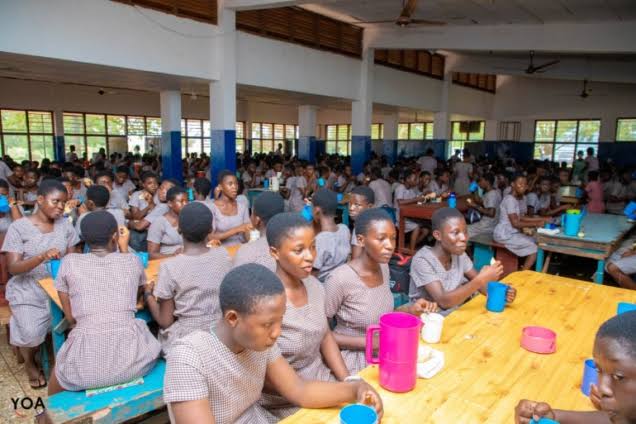
School heads across the country report that they are struggling daily to feed students as supplies from the Buffer Stock Company dwindle.
In many cases, head teachers have reverted to the very practice John Mahama once criticised—using personal funds or taking goods on credit from local vendors to sustain school feeding programmes.
The crisis has pushed both CHASS and the Conference of Principals of Technical Institutions (COPTI) to issue strong warnings, indicating that without immediate financial intervention, schools may be forced to shut down and send students home.
Such a scenario would represent the most significant disruption to Free SHS since its introduction, affecting over 1.2 million students nationwide and threatening preparations for the West African Senior School Certificate Examination (WASSCE).
Critics argue that the current situation reflects a contradiction between political messaging and governance execution. While the NDC built significant political capital by attacking the Akufo-Addo administration over Free SHS challenges, it now finds itself grappling with similar—if not more severe—issues.
Even more striking is that elements of the decentralised policy touted as the solution have already been partially introduced.
Reports in early 2025 indicated that school heads were given interim authority to procure certain food items locally. Yet, without consistent and adequate funding, the policy has struggled to deliver meaningful relief.
This has raised broader concerns about whether the issue lies not just in policy design but in fiscal capacity and inter-agency coordination.
The ongoing standoff also exposes tensions between key implementing bodies, with unclear lines of responsibility between the Ministry of Education, GETFund, CHASS, and the Buffer Stock Company complicating efforts to resolve the crisis.
For many observers, the unfolding situation represents a political full circle.
A programme once criticised as “poorly implemented” is now being described by some stakeholders as “poorly managed,” not because the challenges are new, but because expectations were raised that they would be decisively resolved under a new approach.