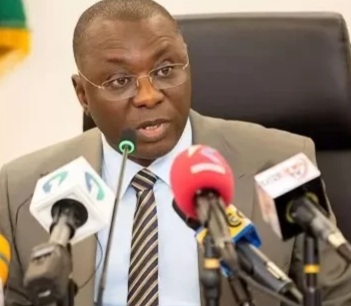
By Issah Olegor
The Executive Secretary of the Chamber of Petroleum Consumers (COPEC), Duncan Amoah, has raised serious concerns about the petroleum security, warning that the country’s current fuel reserves are dangerously low despite assurances from regulators that supplies remain adequate.
Amoah described the existing stockpile of petroleum products as “abysmal,” cautioning that the nation remains highly vulnerable to global supply disruptions, particularly as escalating tensions in the Middle East threaten international oil shipments.
Speaking on The Big Issue programme on Channel One TV on Saturday, March 7, he questioned the adequacy of Ghana’s current reserves, which the National Petroleum Authority (NPA) says can sustain the country for slightly over five weeks.
“I am not particularly enthused by the five weeks of storage we have. It is abysmal, and I’ll put this on record,” Amoah stated, stressing the need for urgent strategic action to safeguard the country’s energy security.
NPA Assurance
His remarks come shortly after the NPA sought to calm fears of potential fuel shortages in the wake of rising geopolitical tensions in the Middle East.
The Authority’s Director of Economic Regulation and Planning, Abass Ibrahim Tasunti, indicated that Ghana currently has more than five weeks of fuel reserves available, assuring the public that the country’s petroleum supply situation remains stable.
However, Amoah insists that the current stockpile provides only a short-term buffer against global supply shocks and does not reflect the level of preparedness required in an increasingly volatile energy market.
Middle East Conflict
The concerns are unfolding against the backdrop of escalating hostilities in the Middle East, which have begun to disrupt global oil supply chains.
According to Amoah, the ongoing conflict and shipping disruptions around the Strait of Hormuz — one of the world’s most critical oil transit routes — have already removed an estimated 22 million barrels of crude oil per day from the global market.
“Things are looking a bit shaky out there. The supply situation is very bad as I speak,” he said.
“Last week I mentioned that for every single day the war continues, the global market is denied a minimum of 22 million barrels daily.”
The Strait of Hormuz handles a significant portion of the world’s oil shipments, and any disruption to traffic through the waterway can rapidly affect global supply and prices.
Early price stability driven by excess supply
Amoah explained that the global oil market initially remained relatively stable in the early days of the conflict because major oil producers were already producing above demand levels.
He noted that the Organisation of Petroleum Exporting Countries (OPEC) and its allies had been pumping additional crude into the market, producing over 200,000 barrels per day above normal levels, which temporarily cushioned the impact of supply disruptions.
“The first few days prices were not that bad because there was already an oversupply situation,” he said.
“OPEC and its allies were producing more than 200,000 barrels daily in excess.”
However, he warned that the continuation of the conflict could quickly reverse that balance and push global oil prices significantly higher.
Call for urgent action by government
Amoah has therefore urged the Minister of Energy, John Abdulai Jinapor, to act swiftly to secure additional fuel reserves for Ghana.
He recommended that the government immediately source additional petroleum supplies from the Lomé fuel trading hub, commonly known as the “Lomé Triangle,” which serves as a major petroleum storage and distribution centre in West Africa.
“If I may advise my brother, the Energy Minister: get to the Lomé Triangle immediately and secure as much stock as you can,” he said.
Ghana has capacity for larger reserves
According to Amoah, Ghana already has sufficient infrastructure to store far larger petroleum reserves than the current five-week supply.
He explained that the Tema Oil Refinery (TOR) alone has storage capacity of nearly one million metric tonnes, which could provide the country with up to two to three months of fuel supply if fully stocked.
In addition, the state-owned Bulk Oil Storage and Transportation Company (BOST) has storage capacity of between 700,000 and 800,000 metric tonnes.
Private storage facilities such as the Tema Fuel Company (TFC) and other depots within the Tema enclave could further increase Ghana’s national petroleum reserves.
With all available infrastructure fully utilised, Amoah believes Ghana could comfortably maintain between four and six months of strategic fuel reserves, significantly strengthening the country’s energy security.
“If you decide to stock up, Ghana could maintain between four to six months of supply at a minimum,” he emphasised. “Five weeks is essentially just one month.”
Potential impact on fuel prices
Beyond supply concerns, Amoah also warned that Ghanaian consumers could soon face higher fuel prices as global oil markets react to the ongoing conflict.
The disruption of shipments through key global oil routes, combined with tightening supply, could drive up international crude prices and ultimately affect local fuel prices during upcoming pricing windows.