By Daniel Bampoe
A strong call for urgent youth employment and inclusive economic growth dominated a high-level town hall engagement between traditional authorities and President John Dramani Mahama, as Daasebre Akuamoah Agyapong II delivered a compelling address that blended praise for government policy with a direct appeal for jobs and opportunity in the Eastern Region.
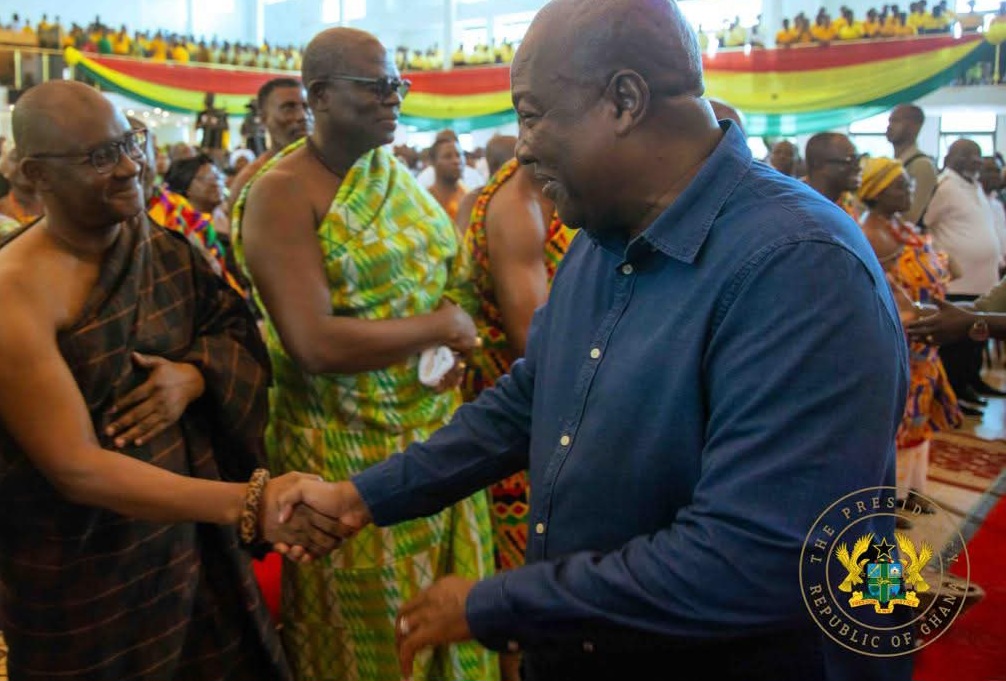
Speaking on behalf of chiefs and people of the region, the Kwahuhene—who also serves as Vice President of the Eastern Regional House of Chiefs—formally welcomed the President, noting that he stood in for the substantive President of the House.
He commended the President’s leadership style, emphasizing that “leadership is not noise; it is clarity, direction, and results,” and added that “the clarity of vision and the steady hand with which you have steered this nation… has not gone unnoticed.”
He further praised the relative stability of the Ghanaian currency, describing it as evidence of discipline in governance.
“The relative stability of the cedi against the dollar… is no small feat. It signals discipline, fiscal discipline, and markets, traders, and ordinary families all respect and benefit from discipline,” he stated, adding that “Nananom are pleased… and the people of this nation are grateful.”
The Kwahuhene also highlighted infrastructure as a critical driver of development, applauding the government’s flagship road initiative.
He described the “Big Push” agenda as “a bold, visionary, and necessary intervention for a nation determined to connect itself, industrialise, and grow,” but was quick to stress the need for equitable distribution.
“We ask only this… let the Eastern Region receive its fair and rightful share of that push. Our roads cry out for attention… We must not be overlooked. We must not be left behind,” he appealed.
Drawing from personal experience as a farmer, he endorsed the government’s agricultural intervention programme, describing the “Nkoko Nketenkete” initiative as “inspired” and “a brilliant concept that speaks directly to the dignity of rural enterprise.”
He urged authorities to leverage traditional leadership structures to scale its impact, stating, “Empower [chiefs] to establish model farms… give them the tools, the chicks, and the support—and they will carry this programme further, faster, and deeper than any government machinery alone can reach.”
He emphasized that “chiefs are the government’s greatest last-mile partners. Use us.”
However, it was his remarks on unemployment that struck the strongest chord. Turning to what he described as “a matter close to my own heart,” Daasebre Akuamoah Agyapong II warned that youth unemployment remains the region’s most pressing challenge.
“Our young men and women are educated, energetic, ambitious, and willing. What they lack is not character. What they lack is opportunity,” he stressed.
In one of the most powerful moments of the address, he issued a direct appeal to the President: “We urge you—we implore you—to act with urgency: create jobs, invest in skills, and anchor real industry here in the Eastern Region.”
He cautioned that the consequences of inaction could be severe, declaring, “A nation that cannot employ its youth cannot sustain its peace.”
The speech comes against the broader backdrop of growing national concern over youth unemployment and economic inclusion, issues that have increasingly dominated public discourse across Ghana.
In the Eastern Region in particular, stakeholders have repeatedly called for targeted investments in industry, agriculture, and infrastructure to absorb the expanding youth population.
Concluding his address, the Kwahuhene reaffirmed the support of traditional leaders for the government’s agenda.
“On behalf of Nananom… we pledge our full support, our cooperation, and our unceasing prayers for your success because your success is Ghana’s success,” he said, offering blessings for wisdom, strength, and a lasting legacy in office.