BY Issah Olegor
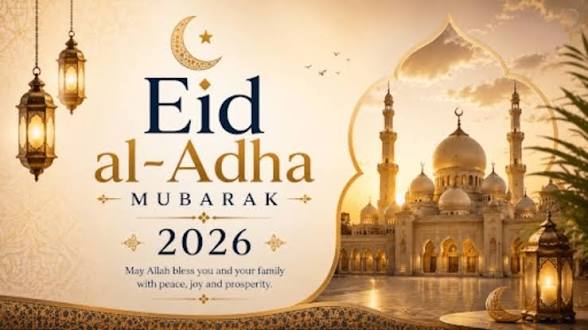
The Government of Ghana has officially declared Wednesday, May 27, 2026, as a national public holiday to mark this year’s Eid al-Adha celebrations across the country.
The announcement, made in line with the public holiday calendar, has however generated widespread discussion on social media, with some citizens questioning why the holiday was not shifted to Friday, May 29, to create a long weekend.
The debate follows recent amendments to the Public Holidays and Commemorative Days Act, which grants the President authority to move certain public holidays that fall on Tuesdays, Wednesdays or Thursdays to either a Monday or Friday.
The policy was introduced partly to improve productivity, reduce disruptions to the workweek and encourage domestic travel and economic activity through extended weekends.
Despite the provision, government authorities have clarified that Eid-ul-Adha cannot legally be rescheduled because it belongs to a category of fixed religious holidays protected under the law.
Officials explained that under Section 3 of the Public Holidays and Commemorative Days Act, 2001 (Act 601), as amended, holidays such as Eid-ul-Adha, Eid al-Fitr, Christmas and Boxing Day are classified as “fixed holidays.”
As a result, these observances must be celebrated on their actual calendar dates and cannot be adjusted for convenience or administrative purposes.
Authorities further noted that Eid-ul-Adha is specifically tied to the Islamic lunar calendar and forms part of important religious observances observed by Muslims worldwide.
Because of its spiritual significance, the holiday must be marked on the exact day determined by Islamic tradition and lunar calculations.
For 2026, the date has officially been confirmed as Wednesday, May 27, meaning the government has no legal authority to move it to Friday, May 29.
The clarification has helped answer growing public concerns online, although conversations continue regarding how holiday scheduling policies should be applied in the future.
Eid-ul-Adha, also known as the Festival of Sacrifice, is one of the most important celebrations in Islam and commemorates Prophet Ibrahim’s willingness to sacrifice his son in obedience to God.
The occasion is marked by prayers, charity, family gatherings and the sharing of food, particularly among Muslim communities across Ghana and the world.
Every year, thousands of Muslims gather at major prayer grounds across the country, including the Independence Square in Accra, to observe the festival.
The government’s declaration of the holiday allows Muslims nationwide to fully participate in the religious observances associated with the celebration.