BY Issah Olegor
Growing frustration is mounting within the automobile trading industry as local vehicle dealers call on President John Dramani Mahama’s administration to urgently intervene in what they describe as an unfair business environment that is steadily pushing indigenous operators out of the market.
The Vehicles and Assets Dealers Union of Ghana (VADUG) has raised alarm over what it says is a combination of government policies, tax disparities and increasing foreign competition that is threatening the survival of local dealerships and putting thousands of jobs at risk.
At a press conference in Accra over the weekend, the leadership of the union accused current policies of creating an uneven playing field that heavily favors foreign automobile manufacturers, particularly Chinese vehicle companies, at the expense of Ghanaian-owned businesses that have dominated the sector for decades.
For many years, local automobile dealers have played a critical role in Ghana’s vehicle market, importing vehicles from established automobile markets such as the United States, Europe and Japan.
The sector has provided employment for thousands of Ghanaians, including sales agents, mechanics, spare parts dealers, transport operators and support service providers.
However, according to VADUG President Bernard Ntrakwa, the emergence of Chinese automobile manufacturers and assemblers operating directly within Ghana is rapidly changing the dynamics of the industry.
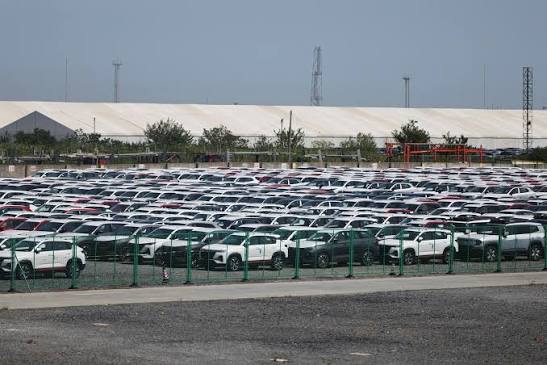
He explained that Chinese companies are increasingly importing, assembling and retailing vehicles directly to consumers, a development the union believes is gradually squeezing local dealers out of the market.
The union argues that the challenge goes beyond competition and is rooted in government policies that provide significant tax incentives to foreign assemblers while local dealers continue to bear heavy import duties.
According to VADUG, local dealers importing vehicles are required to pay between 35 and 50 percent in taxes and duties before their vehicles can be cleared from the ports. In contrast, companies importing Semi-Knocked-Down (SKD) and Completely Knocked-Down (CKD) vehicle kits under the automotive policy benefit from various tax exemptions and incentives.
The union contends that this disparity has enabled foreign assemblers, particularly Chinese automobile brands, to offer vehicles at more competitive prices while local dealers struggle to remain profitable.
As a result, dealers say vehicles remain unsold for longer periods, reducing cash flow and threatening the sustainability of many businesses.
“We do not oppose foreign investment. But this current trend is unsustainable,” the union stated.
VADUG further questioned the growing role of Chinese automobile companies in both wholesale distribution and direct retail sales, arguing that major global vehicle manufacturers traditionally operate through local dealership networks rather than competing directly with indigenous businesses.
The association noted that automobile giants from countries such as the United States, Japan, Germany and South Korea have historically relied on local partners to distribute and retail their products, helping to build local capacity and create employment opportunities.
Beyond the issue of market competition, the union also raised concerns about the quality and type of vehicles entering the Ghanaian market.
According to VADUG, China’s rapid transition towards electric vehicles and cleaner transportation technologies could create a situation where older petrol and diesel-powered vehicles are redirected to developing markets such as Ghana.
The union warned that without stronger regulatory oversight from institutions such as the Ghana Standards Authority (GSA), the Driver and Vehicle Licensing Authority (DVLA) and the Ghana Investment Promotion Centre (GIPC), Ghana could become a dumping ground for ageing and substandard vehicles.
“Without strict regulation from GSA, DVLA and GIPC, Ghana risks becoming a dumping ground for substandard cars. That is a safety and environmental time bomb,” the association warned.
The concerns raised by vehicle dealers also extend to the government’s Artificial Intelligence Publican System used for customs valuation at Ghana’s ports.
According to VADUG, the system has significantly increased the cost of importing vehicles by assigning what dealers describe as excessively high customs values to imported vehicles.
The union claims that many dealers now pay duties far above their expectations, increasing operational costs and making it difficult to compete in a market already experiencing intense competition.
Industry players say the situation has contributed to declining profit margins and growing uncertainty among businesses that rely heavily on imported vehicles.
In response, VADUG is calling on the Mahama administration, the Ghana Revenue Authority and other relevant agencies to engage stakeholders and review existing policies affecting the automobile industry.
Among the proposals put forward by the union are reforms to customs valuation procedures, the introduction of a flat-rate duty system for vehicles and spare parts, and a comprehensive review of tax incentives within the automotive sector.
The association is also advocating stronger enforcement of vehicle quality standards, enhanced consumer protection measures and increased support for indigenous automobile businesses through financing and capacity-building programmes.
VADUG further wants government to explore partnerships with institutions such as the Ghana EXIM Bank to provide affordable financing opportunities that will enable local dealers to expand and modernize their operations.
The latest concerns come amid broader national discussions about the future of the automotive industry following the introduction of the country’s automotive development policy, which was designed to attract investment, create jobs and establish Ghana as a vehicle assembly hub in West Africa.
While the policy has succeeded in attracting several international automobile brands to establish assembly operations in Ghana, local dealers argue that insufficient attention has been paid to protecting existing businesses and preserving jobs within the traditional vehicle trading sector.
For the union, the issue is no longer merely about competition but about survival.