BY Grace Zigah
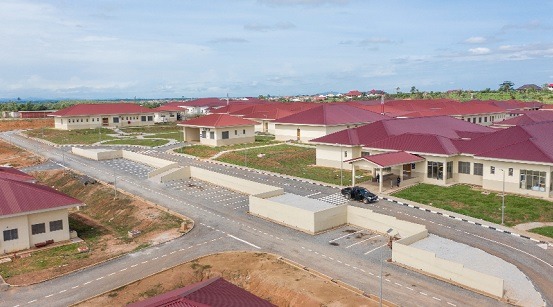
Fresh controversy has emerged over the actual state of completion of the Ashanti Regional Hospital at Sewua, following the publication of official records that appear to contradict widely circulated claims that the facility was between 80 and 90 percent complete when the New Patriotic Party (NPP) administration assumed office in January 2017.
The debate comes at a time when the Sewua Hospital has become a central issue in discussions surrounding healthcare delivery in the Ashanti Region, particularly following the recent crisis at the Komfo Anokye Teaching Hospital (KATH), where concerns over congestion, bed shortages and the persistent “No Bed Syndrome” have renewed calls for the immediate operationalisation of major health facilities across the region.
At the centre of the latest controversy is a detailed review of progress reports relating to the Euroget Hospital Projects, a multi-million-dollar healthcare infrastructure programme undertaken by the Government of Ghana in partnership with Euroget De-Invest S.A.
According to documents attributed to the Ministry of Health, Ministry of Defence, project consultants and project implementation units, the actual completion status of the Sewua Hospital in January 2017 was significantly lower than figures currently being discussed in the public domain.
The records indicate that as of January 2017, the 250-bed Ashanti Regional Hospital at Sewua had achieved approximately 33 percent completion. Subsequent updates reportedly placed progress at about 35 percent by October 2018.
The figures stand in contrast to assertions by some government officials, political commentators and media discussions suggesting that the facility was already nearing completion by the time the NDC administration left office.
The publication seeks to “demystify” what its author describes as misconceptions surrounding construction completion percentages and the interpretation of progress reports on major public infrastructure projects.
The Sewua Hospital forms part of the larger Ghana Euroget Hospital Project, a US$339 million initiative designed to expand healthcare infrastructure across the country through the construction and equipping of two regional hospitals and six district hospitals.
Under the programme, government contracted Euroget De-Invest S.A. to deliver a network of health facilities, including the 250-bed Ashanti Regional Hospital at Sewua, the 160-bed Upper West Regional Hospital in Wa, district hospitals at Tepa, Salaga, Nsawkaw, Twifo Praso and Konongo, as well as the 100-bed Ga East Municipal Hospital at Kwabenya.
Official project updates from January 2017 show varying levels of progress across the different sites.
According to the records, the Wa Regional Hospital had reached approximately 63 percent completion, Nsawkaw stood at 57 percent, Tepa at 54 percent, the Ga East Municipal Hospital at 35 percent, Twifo Praso at 32 percent, Sewua at 33 percent, Konongo at 29 percent and Salaga at 27 percent.
These figures suggest that the Sewua project was among several facilities still under active construction rather than approaching final completion at the time.
Additional Ministry of Health progress reports from January 2020 indicate that the overall completion level of the Sewua Hospital had increased to approximately 59 percent.
The project report further states that this percentage included both completed works and construction materials already delivered to the site.
Project records show that the Sewua Hospital was awarded at a contract value of approximately US$64.96 million and was initially scheduled for completion within 42 months.
The facility was designed to become a major referral hospital for the Ashanti Region, helping to reduce pressure on Komfo Anokye Teaching Hospital and improve access to specialist healthcare services.
According to project documentation, the designs for the hospital received approval in May 2010, while the project site was formally handed over to the contractor on February 25, 2015.
However, despite the importance of the project, progress was repeatedly affected by a series of challenges.
Among the difficulties cited in official records were delays in obtaining tax and customs exemption approvals, contractual disputes involving the main contractor and subcontractors, and administrative setbacks that disrupted the pace of construction.
One of the most significant obstacles involved a prolonged dispute between the main contractor and Top Engineering International Ghana Limited, which reportedly stalled work for an extended period.
The dispute was eventually resolved, leading to the re-award of aspects of the contract to China National Quingjian Corporation (CNQC) in an effort to move the project forward.
Project reports also identified uncertainty regarding staffing requirements as another challenge confronting the hospital’s eventual operationalisation. According to the records, the Ministry of Health and Ghana Health Service were yet to determine the numbers and categories of personnel required to fully run the facility.
The publication of the documents has added a new dimension to the ongoing public debate over accountability for delays affecting major healthcare projects.
The issue has become increasingly significant following recent calls by opposition lawmakers, healthcare professionals and civil society groups for the immediate completion and operationalisation of hospitals such as Sewua, Afari, Trede and Kokoben-Oforikrom.
Advocates argue that these facilities are critical to addressing healthcare congestion and improving patient access to medical services in the Ashanti Region.
The latest records therefore raise important questions about how construction progress has been measured and communicated over the years, and whether public discussions surrounding completion percentages have accurately reflected the realities on the ground.