By Nadia Ntiamoah
President John Dramani Mahama’s decision to reactivate waste transfer stations operated by Zoomlion Ghana Limited has marked a dramatic shift in the relationship between the National Democratic Congress (NDC) government and the Jospong Group, years after leading figures within the party heavily criticised the company’s contracts and vowed to review or terminate aspects of its waste management operations if elected into office.
The renewed partnership comes at a time when Ghana is grappling with severe flooding and worsening sanitation challenges, particularly in the Greater Accra Region, where torrential rains recently displaced residents, submerged communities and exposed the country’s fragile waste management infrastructure.
Faced with the enormous task of clearing drains and evacuating thousands of tonnes of refuse, the Mahama administration has turned to Zoomlion, one of the country’s largest waste management companies, to support nationwide clean-up efforts.
During the period the NDC was in opposition, several party officials questioned the value-for-money of contracts awarded to Zoomlion and other subsidiaries of the Jospong Group.
Some politicians publicly demanded investigations into sanitation contracts, while others argued that waste management should be decentralised to allow greater competition among service providers.
Those criticisms became a major feature of political discourse ahead of the 2024 general elections.
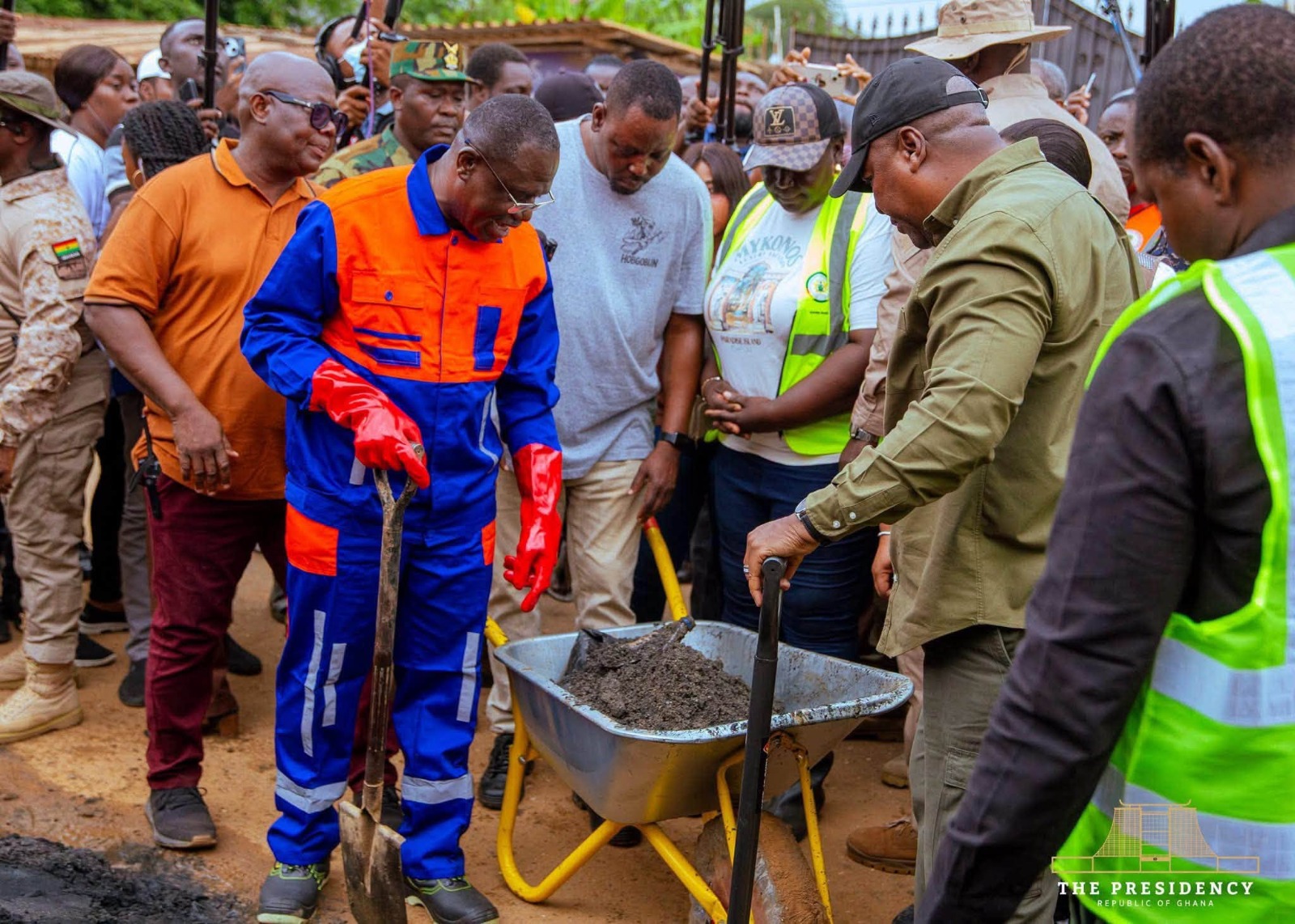
However, in what many political observers describe as a pragmatic policy shift driven by national interest, President Mahama joined Executive Chairman of the Jospong Group, Joseph Siaw Agyepong, during the National General Clean-up Exercise, presenting a united front in the fight against poor sanitation and post-flood waste management.
Speaking during the second and final day of the nationwide clean-up exercise at Alajo, President Mahama directed the immediate operationalisation of all six waste transfer stations managed by Zoomlion Ghana Limited across the Greater Accra Region.
According to him, although the facilities had been constructed more than nine years ago, they remained largely unused, forcing waste collectors to transport refuse over long distances to final disposal sites.
The President explained that under the new arrangement, informal waste collectors, popularly known as “Aboboyaas,” would now discharge refuse at nearby transfer stations instead of travelling all the way to the Accra Integrated Recycling and Compost Plant (IRECOP) at Adjin Kotoku.
The waste would then be compacted and transported by Zoomlion’s heavy-duty haulage trucks to approved recycling and disposal facilities.
The six transfer stations are located at Achimota, Teshie, Kpone, Ashaiman, Pantang and Adipa. According to Zoomlion, all the facilities have now been activated and are receiving waste generated during the nationwide sanitation exercise.
President Mahama described the move as a major milestone in creating a more efficient waste management system but cautioned that sanitation requires both functioning infrastructure and responsible public behaviour.
He urged residents to stop dumping refuse into drains, stressing that drains are designed for stormwater and not waste disposal.
He also expressed satisfaction with public participation in the clean-up exercise, describing the turnout as encouraging while appealing to more residents to join future exercises.
The President acknowledged that two days would not be sufficient to restore sanitation in flood-affected communities and therefore announced that the Ghana Armed Forces and other state agencies would continue the evacuation exercise until all refuse removed from drains had been transported to designated disposal sites.
“Ghana is a resilient country, Accra is a resilient city, and we will bounce back better than before,” President Mahama declared.
Responding to the President’s directive, Dr. Joseph Siaw Agyepong welcomed the renewed collaboration and reaffirmed Zoomlion’s commitment to supporting government efforts to restore cleanliness across the country.
He explained that the second phase of the exercise focused primarily on evacuating massive quantities of refuse collected from drains, homes and public spaces.
According to him, Zoomlion, working together with the Environmental Service Providers Association (ESPA), Metropolitan, Municipal and District Assemblies (MMDAs) and other stakeholders, significantly expanded its operational capacity across the Greater Accra Region.
Agyepong disclosed that approximately 150 haulage trucks, 30 refuse compactors, road sweepers, over 2,000 tricycle waste operators, more than 1,000 Zoomlion personnel and an additional 60 long-haul trailers were deployed to support the operation.
The exercise was simultaneously undertaken across all 29 Metropolitan, Municipal and District Assemblies in the Greater Accra Region, particularly in communities severely affected by flooding.
He urged residents to complement the government’s efforts by adopting proper waste disposal habits, noting that much of the refuse being evacuated had accumulated over several years due to indiscriminate dumping.
Following the President’s directive, Minister for Local Government, Chieftaincy and Religious Affairs Ahmed Ibrahim toured several waste transfer stations and later visited the Accra Integrated Recycling and Compost Plant (IRECOP) to assess operational readiness.
The Minister commended President Mahama for authorising the activation of the transfer stations and praised Dr. Siaw Agyepong for investing in critical sanitation infrastructure.
He observed that the partnership between government and the private sector would play a crucial role in addressing the long-standing waste management challenges.
Ibrahim further indicated that the transfer stations have the capacity to operate around the clock whenever necessary and stressed that preventing sanitation-related diseases is far less expensive than treating their health consequences.