BY Daniel Bampoe
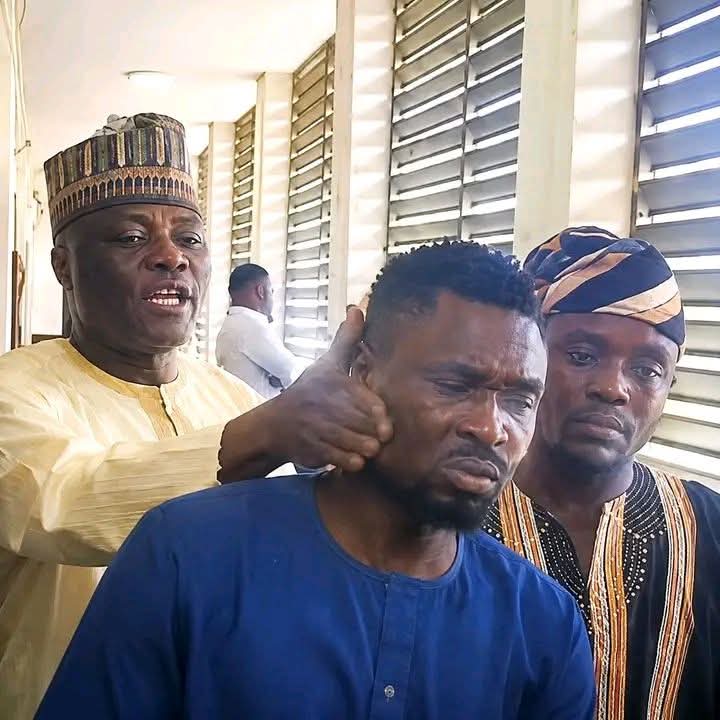
The Police has arrested Sibamay Zakaria, the individual captured in a widely circulated video allegedly assaulting a suspect who was in police custody, as pressure mounts for a full investigation into the circumstances surrounding the incident.
The Police said Zakaria is currently in custody and assisting with investigations. He is expected to be put before the court after the completion of the necessary investigative processes.
The development follows the circulation of video footage purportedly showing a handcuffed suspect believed to be a pastor being physically assaulted while inside the Police Headquarters, an incident that has triggered public concern over the treatment and protection of persons held in state custody.
The Police Service has also referred the matter to its Professional Standards Bureau, which is investigating the circumstances surrounding the alleged assault. According to the Police, any person found culpable will be subjected to the appropriate disciplinary processes.
The latest development comes against the background of a separate religious controversy involving a Muslim cleric and a pastor whose alleged remarks about Prophet Muhammad triggered widespread public debate and condemnation.
What initially appeared to be a dispute involving two individuals quickly assumed a national dimension after a video circulated on social media showing an Imam allegedly calling for mob action against a pastor over comments attributed to him.
The remarks provoked strong reactions from members of the public and religious leaders. The office of the National Chief Imam publicly distanced itself from the alleged call for violence and subsequently called for the Imam to be arrested, stressing the need for the matter to be handled through lawful channels.
The Imam later apologised for his conduct.
The controversy subsequently widened after footage concerning the pastor whose alleged comments had triggered the Imam’s reaction also emerged. The Ghana Police Service eventually arrested both men as authorities sought to prevent further escalation and establish the facts surrounding the dispute.
However, attention has now shifted significantly from the original religious controversy to what allegedly happened after the pastor was taken into police custody.
Videos circulated online appeared to show the pastor, while handcuffed and inside the Police Headquarters, being physically assaulted. The footage generated particular concern because of the location and the fact that the individual appeared to be under the control and protection of the security service.
The arrest of Zakaria indicates that the Police Service has now begun taking concrete action in response to the alleged assault.
But the investigation is likely to extend beyond the person captured in the video.
At the centre of the concerns is how a person being detained by the state could allegedly be assaulted while inside a major police facility. If the footage accurately reflects what occurred, investigators will have to establish who was responsible for the physical assault, how the alleged assailant gained access to the detainee and whether any police personnel witnessed, facilitated or failed to prevent the incident.
The circumstances surrounding the presence of civilians around a handcuffed suspect at the Police Headquarters could also become a critical part of the investigation.
A person placed in police custody is under the protection and responsibility of the state. The security service therefore has a duty to ensure that a detainee is protected from unlawful physical attacks while investigations into any alleged offence are ongoing.
The incident has also generated allegations involving individuals said to have political connections. One person mentioned in discussions surrounding the incident is Alhaji Papa Angola, who has been described as an NDC member associated with the Hajj Board and accused by some sources of involvement in the alleged assault.
Those allegations, however, must be independently established through the investigation and should not be treated as proven facts.
The Police Professional Standards Bureau’s involvement could therefore become important in determining whether there were failures in custody procedures or security protocols in addition to identifying the person or persons who allegedly assaulted the detainee.
The investigation could also examine the origin of the video footage, who recorded it and how it was subsequently circulated on social media.
These questions are significant because the alleged incident did not occur in an ordinary public setting. It reportedly occurred within a police facility while the individual concerned was handcuffed.
The matter has consequently raised broader concerns about the protection of suspects, police accountability and the integrity of the criminal justice system.
The original religious dispute itself remains a separate matter.
Whether the pastor made remarks capable of constituting an offence must be determined through proper investigation and, where appropriate, the courts. Likewise, any alleged call by the Imam for mob action must be dealt with under the law.
Neither allegation, however, can provide justification for anyone to physically attack a suspect who is already in state custody.
This distinction has become particularly important because Ghana has traditionally enjoyed relatively peaceful relations between its Christian and Muslim communities. Religious leaders have frequently played a crucial role in calming tensions when controversial religious issues emerge.
The intervention by the National Chief Imam’s office, which rejected the alleged call for violence and advocated lawful action, demonstrated the importance of using established institutions rather than mob action to resolve sensitive disputes.
The alleged assault therefore risks creating an unfortunate contradiction: a dispute that began with concerns about inflammatory religious speech could itself become a source of further public anger if people believe that a detainee was subjected to violence while under police protection.
There are also concerns that political interpretations of the incident could further complicate an already sensitive matter.
With the political parties gradually positioning themselves ahead of the 2028 general elections, allegations involving government supporters, opposition figures or state institutions can quickly acquire political dimensions.
Authorities will therefore need to ensure that the investigation remains focused on evidence rather than political affiliation.
If Zakaria is found to have assaulted the suspect, the appropriate legal and disciplinary processes should follow. If police officers or other individuals are found to have facilitated the incident or failed in their responsibilities, they too should face the consequences prescribed by law.
The Police Service’s statement that all persons found culpable will be taken through the necessary disciplinary processes will consequently be closely watched.
The case also provides an opportunity for the Police Service to demonstrate that its custody procedures are capable of protecting suspects regardless of their religious, political or social background.
The central issue is now no longer simply what was said about Prophet Muhammad or how the Imam responded.
It is whether a person who had already been arrested and handcuffed was unlawfully assaulted while under the protection of the state—and whether the institutions responsible for his custody allowed that to happen.
The outcome of the Professional Standards Bureau investigation will therefore be critical.