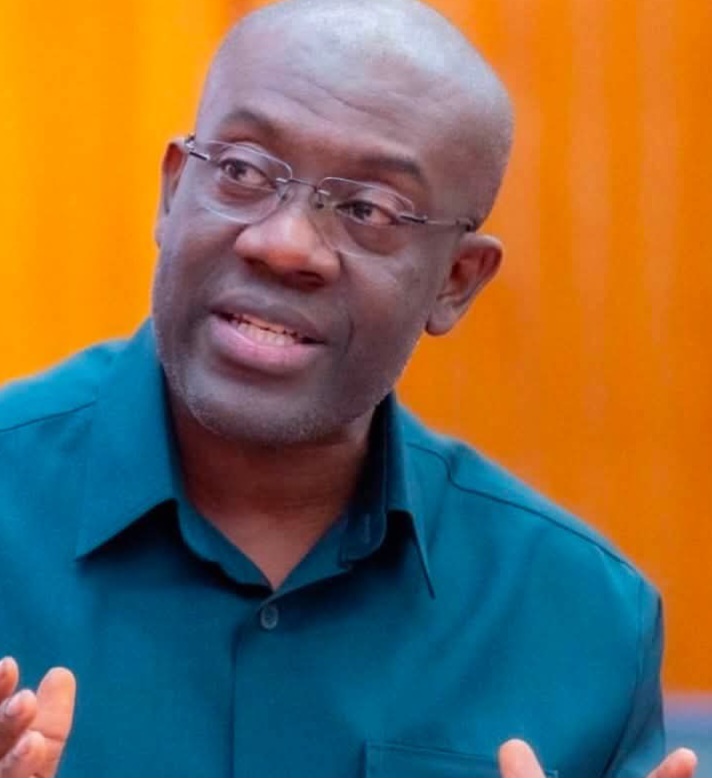
Ofoase-Ayirebi Member of Parliament and former Minister for Information, Kojo Oppong Nkrumah, has rejected claims by Deputy Attorney-General Dr Justice Srem-Sai that his legal challenge over the conduct of criminal trials during the judicial vacation was founded on what the Deputy AG described as a “deliberate falsehood.”
Mr Oppong Nkrumah, reacting to comments attributed to Dr Srem-Sai, said he was disappointed that a senior government lawyer had taken to social media to accuse him and his legal team of deliberately misleading the court and the public.
According to the MP, the allegation does not reflect what transpired during the proceedings at the Supreme Court and could be tested against the official court record.
He argued that several journalists were present in court and that the ruling delivered by Justice Gabriel Pwamang, sitting as a single justice of the Supreme Court, is a matter of public record.
“Where did the Judge find that it was based on ‘deliberate falsehoods’?” Mr Oppong Nkrumah questioned, insisting that the court’s proceedings should be allowed to speak for themselves.
He further disputed the interpretation placed on the court’s proceedings by the Deputy Attorney-General, saying the record would show that Justice Pwamang indicated during the hearing that the Deputy AG had misunderstood aspects of the application brought before the court.
The exchange follows a contentious legal battle over the decision by the Chief Justice to permit selected High Court judges to conduct criminal proceedings during the legal vacation, which runs from August 1 to September 30.
Mr Oppong Nkrumah had challenged the constitutional basis of the arrangement and subsequently sought an interlocutory injunction to halt the conduct of the affected full trials until the Supreme Court determines the substantive constitutional case.
His application was dismissed on Friday, August 21, 2026, by Justice Pwamang, paving the way for the affected criminal proceedings to continue while the substantive constitutional challenge remains pending.
Reacting to the outcome, Mr Oppong Nkrumah maintained that the dismissal of the injunction did not amount to a determination of the substantive constitutional questions raised in his writ.
He stressed that the constitutional case itself is yet to be heard and determined, meaning that the broader questions surrounding the legal vacation arrangements and the exercise of administrative powers by the Chief Justice remain before the court.
The former Information Minister also rejected the argument that the fact that his application had resulted in the courts not sitting for a period of one week could be used to characterise his constitutional challenge as a falsehood.
He argued that citizens and litigants have a constitutional right to approach the courts whenever they genuinely believe that constitutional rights, principles or procedures have been breached.
“If my application has resulted in the courts not sitting for one week, that does not transform the constitutional right to seek interpretation into a falsehood,” Mr Oppong Nkrumah stated.
His comments were directed at the Deputy Attorney-General’s assertion that the legal action had contributed to the suspension of court activities for a week.
Mr Oppong Nkrumah also questioned what he described as an inconsistency in the Deputy AG’s position, arguing that government lawyers could not simultaneously insist that the authority of the courts must be respected while attacking litigants for exercising their constitutional right to invoke those same courts.
“The Deputy Attorney General cannot insist that courts must be respected and then attack litigants for invoking the powers of these very courts,” he argued.
The controversy stems from the substantive suit filed by Mr Oppong Nkrumah challenging the constitutional validity of the Chief Justice’s warrants permitting judges to sit during the legal vacation.
In the original case, he argued, among other things, that the arrangement could amount to unequal treatment and selective justice if certain criminal cases were prioritised for hearing while others remained outside the scope of the vacation sittings.
The Deputy Attorney-General, however, mounted a strong defence of the administrative arrangement during the injunction proceedings and challenged the factual foundation of Mr Oppong Nkrumah’s application.
According to the position attributed to Dr Srem-Sai in the court proceedings, the applicant’s case was premised on the claim that the Chief Justice had assigned “selected cases” to two judges to be heard during the vacation.
He argued that evidence presented in court did not support that characterisation. In particular, he pointed to exhibits tendered by the applicant, including an exhibit concerning the Chief Justice’s warrant, which he said demonstrated that the warrant was general rather than directed at particular cases.
Dr Srem-Sai also relied on another exhibit which, according to him, showed that 29 judges—not two—were sitting during the legal vacation.
The Deputy AG subsequently criticised the legal challenge, arguing that despite what he described as inaccuracies in the applicant’s case, the proceedings had contributed to the courts being unable to operate for one week.
Mr Oppong Nkrumah has now strongly rejected that characterisation, maintaining that seeking constitutional interpretation cannot, by itself, amount to deliberate deception merely because the application was unsuccessful or because it temporarily affected court proceedings.
The MP said his legal team has requested a certified copy of Justice Pwamang’s ruling and intends to study the court’s full reasoning before determining the appropriate next step.
The substantive constitutional case remains unresolved, and no date has yet been fixed for its full hearing.
The dispute has therefore moved beyond the immediate injunction battle into a broader constitutional debate over the scope of the Chief Justice’s administrative authority, the conduct of criminal trials during judicial vacation, equality before the law and the right of litigants to seek constitutional interpretation.
Mr Oppong Nkrumah has maintained that the objective of his legal action is to ensure that what he considers selective application of the law is addressed through constitutional and legal means, while the State insists that the Chief Justice’s administrative arrangements do not unlawfully interfere with the independent judicial decisions of individual High Court judges.
The Supreme Court’s eventual determination of the substantive case is expected to provide the definitive legal position on the constitutional questions raised by the MP’s challenge.