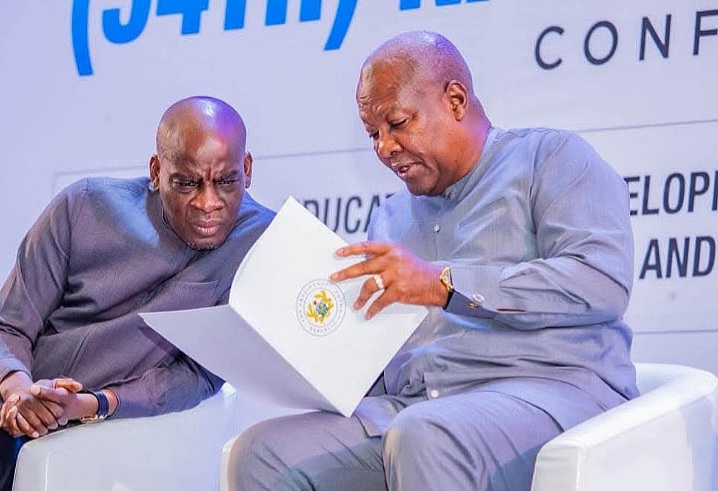
The New Patriotic Party (NPP) has intensified pressure on President John Dramani Mahama over the controversy surrounding the proposed introduction of Arabic and Chinese language studies in Ghana’s schools, arguing that conflicting statements from the Presidency and the Minister of Education, Haruna Iddrisu, have created serious questions about policy coordination within the government.
In a statement issued on September 16, 2026, by the NPP’s Education Sector Policy Committee, the party said the President’s recent declaration that his government had approved “absolutely no new policy” introducing Arabic and Chinese into Ghanaian schools had failed to resolve the controversy. According to the party, the President’s position instead raises questions about how far the Education Ministry had proceeded with the policy and whether the minister had acted with presidential or Cabinet authority.
The dispute dates back to April 24, 2026, when Education Minister Haruna Iddrisu publicly announced that Chinese and Arabic would become compulsory foreign languages at the secondary-school level. In making that announcement, the minister reportedly linked the initiative to President Mahama’s broader vision for education, effectively presenting the policy as a government-backed programme rather than an individual ministerial proposal.
Following the minister’s announcement, the National Council for Curriculum and Assessment (NaCCA) was instructed by the Education Ministry to undertake the curriculum work required to support the proposed changes. The process reportedly involved about 160 writers and reviewers who worked over several months on a revised curriculum. The resulting document included Arabic and Chinese among the foreign-language options.
The NPP said the process did not stop at curriculum development. On July 22, 2026, the revised curriculum was presented to the Education Minister. Rather than rejecting the document or questioning the authority under which NaCCA had undertaken the work, the minister referred it to the Ghana Education Service (GES), directing the service to prepare for what was described as “full implementation readiness.”
The GES was further directed to take early ownership of the process and prepare the necessary conditions for classroom implementation. The NPP argues that these steps gave the impression that the policy had received the necessary governmental backing and was moving through the formal education-sector machinery towards implementation.
The controversy subsequently shifted to the question of whether Arabic and Chinese were intended to be compulsory or optional. When questions emerged over the revised basic-school curriculum, government clarified that Chinese and Arabic would be optional at the basic-school level. The NPP, however, contends that this clarification did not adequately address the Education Minister’s earlier announcement that the two languages would be compulsory at the secondary-school level.
Another development cited by the opposition party was the training of teachers for the Chinese-language curriculum. On September 3, 2026, NaCCA, with support from the Confucius Institute at the University of Cape Coast, organised training for teachers in preparation for implementing the new Chinese-language curriculum.
For the NPP, the sequence of events is central to the controversy. The party argues that the public had every reason to believe that the policy was an authorised government initiative because it had been publicly announced by the Education Minister, attributed to the President’s educational vision and subsequently advanced through state institutions responsible for curriculum development and implementation.
It therefore questions how the President could subsequently state that there was “absolutely no new policy” when significant preparatory work had already taken place. The party says the conflicting positions expose what it describes as a serious problem of policy coordination and legitimacy within the Executive.
The NPP has also raised concerns about public expenditure associated with the process. It points out that curriculum development ordinarily requires the engagement of writers and reviewers, workshops, technical personnel and administrative support. The party is therefore demanding an explanation of the resources committed to the curriculum review, implementation preparations and teacher training if, as the President has said, no new policy had been approved.
Teacher availability has emerged as another point of contention. The President has reportedly questioned where Ghana would obtain sufficient Chinese-language teachers, particularly at a time when the country already faces shortages of French-language teachers. The NPP argues that this concern raises further questions about why the government’s education institutions had already proceeded with curriculum development, implementation preparations and teacher training before the issue of teacher availability had apparently been resolved.
The party, however, distinguishes between Arabic and Chinese in tracing the history of the controversy. It notes that Arabic was already available as an optional subject at the junior-high-school level before the current government assumed office. Chinese, on the other hand, is presented as part of a new process undertaken in 2026, moving from a ministerial directive through curriculum development, submission to the Education Minister, preparations by the Ghana Education Service and teacher training.
Beyond the immediate dispute, the NPP says the episode raises broader questions about ministerial authority and government decision-making. It argues that if a minister could announce a major policy, attribute it to the President, direct public institutions to develop it and commit state resources towards its implementation without the necessary presidential or Cabinet approval, the public would be entitled to question whether similar decisions could be taken elsewhere in government without the required authorisation.
The party is consequently demanding a clear resolution from the Presidency. It argues that if the Education Minister acted without presidential or Cabinet authority, President Mahama should remove him from office. Conversely, if the minister acted with the knowledge or authority of the President or Cabinet, the NPP says the President should explain the circumstances surrounding the policy and account for the resources already committed to the process.
The controversy has consequently moved beyond the question of whether Ghana should teach Arabic or Chinese and into a wider debate about transparency, government communication, ministerial responsibility and the use of public resources.
The NPP maintains that parents, teachers, school administrators and taxpayers deserve a consistent explanation of what policy was actually authorised, what work was undertaken, what expenditure was incurred and who was responsible for the decisions taken.
The party has therefore rejected the suggestion that the matter can simply be considered closed following the President’s denial of a new policy. In its concluding demand, the NPP said the President must either apologise to the Ghanaian public and provide a full account of the process or remove the Education Minister from office.