
BY NADIA NTIAMOAH
The government has begun a new traffic management intervention aimed at easing congestion on some of Accra’s busiest commuter routes, with Aayalolo buses being given priority through a contra-flow system designed to move large numbers of passengers into and out of the capital during peak periods.
The initiative, being implemented by the Greater Accra Passenger Transport Executive (GAPTE), operators of the Aayalolo Quality Bus Service, covers four major corridors: Amasaman–Accra, Pokuase–Accra, Kasoa–Accra and Adenta–Accra. The system commenced on Tuesday, September 29, 2026, following traffic simulations conducted with the Ghana Police Service’s Motor Traffic and Transport Department (MTTD), the Department of Urban Roads, the Ministry of Transport and other stakeholders.
The intervention comes against the background of persistent congestion on the major approaches to Accra, particularly during the morning and evening rush hours. Authorities say the objective is to give high-capacity public transport an advantage over ordinary traffic so that Aayalolo buses can transport large numbers of commuters without being trapped in the same congestion affecting other road users.
How the contra-flow system will work
Under the arrangement, selected road space normally used by vehicles travelling in the opposite direction will temporarily be allocated to Aayalolo buses travelling towards the direction of peak-hour traffic.
The designated lanes will be reserved exclusively for Aayalolo buses during the operational periods. Private cars, taxis, trotros, okadas, trucks and other unauthorised vehicles will not be permitted to use the special lanes. GAPTE route wardens and MTTD personnel are expected to be stationed at major intersections to help enforce the arrangement and manage traffic movements.
The system is scheduled to operate during the busiest commuting periods—6:00 a.m. to 9:00 a.m. for morning inbound traffic and 4:00 p.m. to 8:00 p.m. for evening outbound traffic—after which the affected roads are expected to return to their normal traffic arrangements.
The selected corridors include the Amasaman route, with designated stops at Amasaman, Kwame Nkrumah Circle and Achimota, while the Pokuase corridor links Pokuase with Circle and Achimota.
On the Kasoa corridor, the planned stops include Kasoa Main Station, Tuba Junction, Old Barrier, Weija Barrier and Kaneshie First Light. The Adentan corridor covers Adentan Barrier, Madina Zongo Junction, Legon/Okponglo and the 37 Military Hospital.
Government seeks to make public transport faster
The initiative is being presented as an effort to improve the reliability of public transportation rather than simply creating another traffic lane.
GAPTE Managing Director Dawuda Awudu said the intervention forms part of measures to improve public transport and support the government’s broader 24-hour economy policy by making it easier for workers, traders, health professionals, security personnel and other commuters to travel across the metropolis.
He said congestion remains a major obstacle to productivity and that an efficient transport system is necessary if economic activity is to continue beyond conventional working hours.
The contra-flow arrangement is therefore intended to separate Aayalolo buses from the congestion that has historically affected their operations, allowing the buses to maintain more predictable journey times.
Kasoa-Tudu journey could fall from 2½ hours to 40–50 minutes
GAPTE has cited the Kasoa-Tudu corridor to illustrate the potential effect of the new system.
According to Mr Awudu, commuters travelling that route during peak periods currently spend about two and a half hours on the journey, while the contra-flow arrangement is projected to reduce the travel time to between 40 and 50 minutes.
He said the system would also provide commuters with more reliable journey times because Aayalolo buses would operate according to fixed timetables.
The projected reduction, however, is an estimate provided by GAPTE as part of its justification for the initiative rather than an independently verified outcome of the current full-scale operation.
The intervention follows earlier trials
The current rollout follows earlier assessments of the feasibility of using contra-flow arrangements for Aayalolo buses.
GAPTE had previously worked with the MTTD and other agencies to examine how buses could be given temporary priority on congested roads. In an earlier trial on the Kinbu-Adenta route, GAPTE’s managing director said travel time was reduced from almost two hours to about 45 minutes when buses were given a dedicated movement path through congested sections.
That earlier experience helped shape the current approach, which places emphasis on temporarily reallocating road space during peak periods instead of maintaining a permanent dedicated lane throughout the day.
Ayariga explains the role of Aayalolo and trotros
The Local Government, Chieftaincy and Religious Affairs Minister, Mahama Ayariga, has also explained that the expansion of Aayalolo services is not intended to eliminate the role of commercial passenger vehicles.
He said commuters travelling shorter distances should continue using trotros, while Aayalolo buses should concentrate on carrying large numbers of passengers travelling longer distances into Accra.
“We want to leave that business of somebody who wants to move from Adenta to Madina, leave that to the trotros,” Mr Ayariga said.
He similarly cited shorter journeys such as Madina to Legon as routes that could continue to be served by trotros.
According to him, the larger capacity of Aayalolo buses means that a single bus can carry about 80 passengers at once, thereby reducing the number of individual passengers competing for space in commercial vehicles on longer routes.
“The Aayalolo buses take 80 people at once,” he explained, arguing that moving those passengers directly towards Accra Central would free trotros to concentrate on shorter journeys and potentially increase the number of short-distance trips they can undertake.
Mr Ayariga has separately said the government’s objective is also to persuade some private-car users to switch to public transportation by providing a faster and more predictable alternative during peak periods.
Aayalolo’s wider operational challenge
The contra-flow initiative is also linked to efforts to restore the effectiveness of the Aayalolo system, which has faced operational challenges, including buses being caught in the same traffic as other road users.
Earlier discussions on the system identified congestion as a major factor affecting the ability of Aayalolo buses to maintain predictable travel times. GAPTE has been working on returning repaired buses to service, with the new traffic arrangement expected to allow buses to make more trips instead of spending extended periods stuck in traffic.
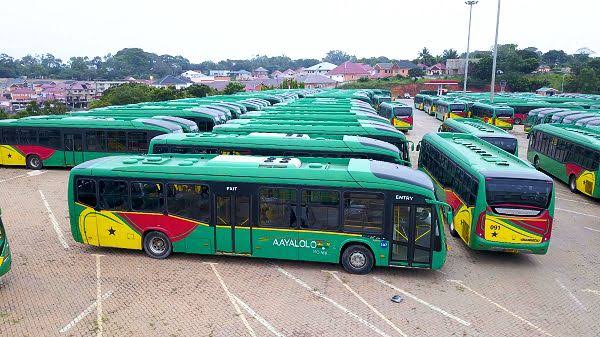
GAPTE has indicated that the wider programme could support the deployment of 126 repaired Aayalolo buses, increasing the capacity of the service on the selected corridors.
Police to enforce the special lanes
Because the arrangement temporarily changes the normal movement of traffic, road safety and enforcement have become central components of the initiative.
MTTD personnel and GAPTE wardens are expected to monitor major intersections and prevent unauthorised vehicles from entering the contra-flow lanes. Road markings, cones, reflective lane dividers and traffic signs are being used to distinguish the temporary bus lanes from ordinary traffic space.
The involvement of the police is intended to ensure that motorists understand and comply with the temporary changes, particularly at points where vehicles travelling in opposite directions would ordinarily share or cross the affected road space.
Authorities have consequently appealed to motorists, commercial drivers and other road users to cooperate with traffic officers and observe the signs and instructions along the selected routes.
Part of broader public transport reforms
The contra-flow system is being introduced as part of wider efforts to strengthen mass public transportation in the Greater Accra Metropolitan Area.
GAPTE says the selected corridors were identified using Aayalolo ridership information, travel-time surveys and congestion mapping conducted between January and August 2026.
The authorities hope that giving buses priority will make public transport more attractive to commuters who currently use private vehicles, thereby potentially reducing the number of cars entering Accra during peak periods.
GAPTE has also indicated that an electronic payment system will soon be introduced to make Aayalolo services more convenient for passengers.


