By Daniel Bampoe
The New Patriotic Party (NPP) has launched a strong rebuttal against the governing National Democratic Congress (NDC) over claims that it inherited a largely grounded and uninsured ambulance fleet from the previous administration, insisting that the Mahama-led government is attempting to shift responsibility for challenges confronting Ghana’s emergency medical services.
In a statement issued in Accra, by the NPP’s Health Sector Policy Committee, the party rejected comments attributed to the Minister for Health, Kwabena Mintah Akandoh, who reportedly claimed that many ambulances were not operational and that none of the vehicles was insured when the NDC assumed office in January 2025.
The NPP described the account as misleading, arguing that the previous administration made substantial investments in expanding the National Ambulance Service and strengthening emergency medical response across the country.
The party’s response has reignited the political debate surrounding former President Nana Addo Dankwa Akufo-Addo’s flagship One Constituency, One Ambulance initiative, which was introduced to improve access to emergency transportation and ensure that communities across Ghana could receive timely medical assistance.
NPP recounts ambulance sector before Akufo-Addo
Providing a historical account of the ambulance sector, the NPP said the situation inherited by the Akufo-Addo administration in 2017 was severely underdeveloped, with fewer than 55 semi-functioning ambulances available to serve the country.
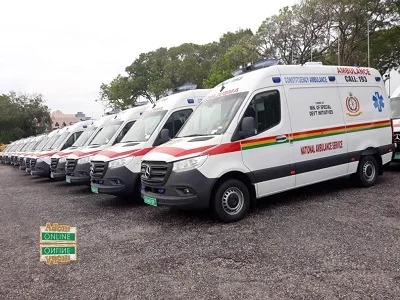
According to the party, the former NPP government subsequently expanded the National Ambulance Service through successive procurements, adding 331 ambulances to the fleet.
The party said the expansion was intended to address longstanding gaps in emergency healthcare transportation and improve the country’s capacity to respond to medical emergencies.
It further argued that the initiative represented a significant improvement over the ambulance system that existed before the NPP assumed office.
The NPP also cited the recruitment and training of almost 2,000 paramedics as part of efforts to provide the necessary personnel to support the expanded ambulance network.
The One Constituency, One Ambulance policy became one of the prominent healthcare initiatives associated with the Akufo-Addo administration, with the objective of making emergency transportation more accessible to constituencies throughout Ghana.
However, the programme has remained a subject of political debate, particularly over the operational condition of the vehicles, maintenance arrangements and the government’s ability to sustain the fleet over time.
NPP challenges claims that ambulances were uninsured
At the centre of the latest controversy is the NPP’s insistence that insurance and maintenance arrangements were put in place for ambulances procured under the previous administration.
The party stated that 307 ambulances procured in 2019 were insured by Enterprise Insurance, while Service Auto Group provided after-sales service and maintenance support for the vehicles.
It added that another 24 ambulances procured subsequently were insured by SIC Insurance.
According to the NPP, these arrangements contradict the suggestion that the ambulance fleet inherited by the current administration was entirely uninsured and lacked maintenance support.
The party, however, did not provide individual insurance records or vehicle-by-vehicle operational assessments in the statement to independently establish the status of every ambulance at the time the NDC took office.
The controversy therefore raises questions about the distinction between insurance arrangements established during the previous administration and the actual insurance status, roadworthiness and operational readiness of the vehicles in January 2025.
The NPP maintains that the current government must provide detailed information about the condition of the fleet it inherited rather than attributing the challenges to the Akufo-Addo administration.
Dispute over proposed procurement of 100 ambulances
The opposition party has also challenged what it considers an attempt by the current administration to take credit for plans to procure an additional 100 ambulances.
According to the NPP, preparations for the procurement had already commenced before Kwabena Mintah Akandoh assumed office as Health Minister.
It argued that the proposed acquisition should therefore not be presented as an initiative originating solely from the current government.
The party said it welcomed the prospect of additional ambulances but insisted that the public deserved an accurate account of the history of the procurement process.
The NPP further pointed to the Health Minister’s reported indication that more than 200 ambulances were functioning and that the government intended to acquire another 100 vehicles.
For the opposition, those figures demonstrate that a substantial ambulance fleet exists and that the immediate priority should be to ensure that the available vehicles remain operational and accessible to the public.
The statement did not independently establish the precise number of ambulances currently operational or provide a breakdown of their distribution across the country’s regions and districts.
30 ambulances at Burma Camp become another flashpoint
The NPP also addressed the controversy surrounding 30 ambulances procured under the previous administration that remained at Burma Camp for years amid questions about their configuration and suitability for their intended purpose.
According to the party, the Ministry of Health retrieved the vehicles in 2026 and handed them over for refurbishment before they could potentially be deployed.
The opposition argued that the circumstances surrounding the 30 vehicles should not be used to dismiss the broader record of ambulance expansion under the Akufo-Addo government.
It challenged the current administration to explain the steps taken to refurbish the vehicles, establish their fitness for purpose and ensure that any usable ambulances are eventually placed into service.
The issue adds another dimension to the political dispute, as questions about procurement, vehicle specifications, maintenance and deployment remain central to public discussions about the management of Ghana’s emergency medical infrastructure.
NPP tells Mahama government to take responsibility
Beyond the dispute over the previous administration’s record, the NPP argued that maintaining public assets is a responsibility of the government in office.
The party stated that ambulance fleets require continuous servicing, repairs, insurance renewals and eventual replacement as vehicles age.
It maintained that an incoming administration inherits both public assets and the responsibility to keep them functional.
The opposition therefore called on the Health Minister to explain the measures being implemented to address vehicle breakdowns, renew expired insurance policies and improve the availability of ambulances.
It insisted that where vehicles are grounded, they should be repaired and returned to service, while additional vehicles should be procured where existing numbers are insufficient.
The NPP said the government must focus on measurable improvements in emergency medical services rather than repeatedly attributing operational challenges to its predecessor.
Emergency healthcare becomes political battleground
The latest exchange highlights the continuing political contest between the NPP and NDC over the management of public healthcare infrastructure and the legacy of government-funded programmes.
For the NPP, the One Constituency, One Ambulance initiative and the expansion of the National Ambulance Service constitute evidence of its investment in emergency medical transportation under Akufo-Addo.
The NDC administration, on the other hand, faces the task of maintaining the inherited fleet, addressing any operational gaps and ensuring that emergency medical services meet the needs of patients across the country.
Ultimately, the effectiveness of the ambulance service depends not only on the number of vehicles procured but also on their roadworthiness, insurance coverage, equipment, staffing, maintenance and ability to reach patients promptly.
The NPP said ordinary Ghanaians were less concerned about which political party purchased an ambulance than whether it would arrive when needed during an emergency.
The party called on the Health Minister to provide accurate information about the fleet and concentrate on improving the delivery of emergency medical services.
The statement concluded that Ghanaians needed functioning ambulances, reliable emergency response times and properly aintained equipment rather than political explanations.