By Issah Olegor
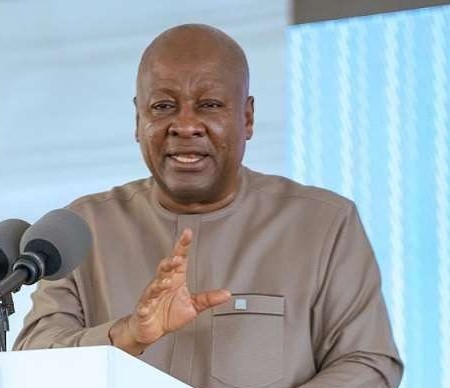
President John Dramani Mahama has taken a swipe at journalists investigating allegations of wrongdoing within his administration, warning that what he describes as a deliberate search for non-existent scandals is distracting government officials from their development responsibilities.
The President’s comments have triggered fresh debate over the relationship between the government and the media, particularly at a time when several public expenditure decisions and activities of government institutions are attracting scrutiny from the opposition, civil society organisations and sections of the public.
Addressing the 30th Ghana Journalists Association (GJA) Media Awards at the Palms Convention Centre, La Palm Royal Beach Hotel, in Accra on Saturday, November 7, 2026, Mahama challenged journalists to distinguish between legitimate investigative reporting and what he described as adversarial journalism.
He expressed concern about media practitioners who, in his view, go beyond their watchdog responsibility by publicly confronting ministers and demanding that they appear on radio and television programmes to answer allegations of discrepancies.
The President specifically criticised journalists who challenge ministers to call into their programmes to defend issues they have uncovered, arguing that such conduct could amount to excessive media zeal.
“We must also draw the line where journalism becomes adversarial. As a trained journalist myself, I believe that it pushes the limits of media zealotry when a journalist publicly challenges a minister to call into his show to expose him over a so-called discrepancy that the journalist has discovered,” he said.
Mahama maintained that his administration would continue to respect the constitutional responsibility of the media to hold public officials accountable but insisted that journalists should not turn routine government activities into controversies without sufficient justification.
“This government that I lead will uphold the media mandate to hold government to account. But it distracts attention from the people’s business when we split hairs in a deliberate search for scandals where none exist,” he stated.
His remarks have attracted attention because they come amid a series of controversies involving government expenditure, the Foreign Affairs Ministry, the Ghana Gold Board (GoldBod) and questions about the accountability of public officials.
GH¢49.7m South Africa Evacuation Controversy
One of the major issues surrounding the government’s financial accountability is the GH¢49.72 million expenditure on the evacuation of 1,964 Ghanaians from South Africa following renewed xenophobic attacks and threats against foreign nationals.
The evacuation exercise, which took place between May 27 and September 4, 2026, was organised by the Ministry of Foreign Affairs to bring affected Ghanaians back home.
Foreign Affairs Minister Samuel Okudzeto Ablakwa announced that the exercise cost GH¢49,721,786, comprising GH¢33,721,786 in direct government funding and GH¢16 million in support from Engineers and Planners, a company owned by businessman and president’s brother, Ibrahim Mahama.
The expenditure covered chartered flights, commercial airline tickets, accommodation, feeding, medical services, ground transportation and other logistical arrangements.
Government also announced that each evacuee was entitled to GH¢5,000 as reintegration support and GH¢500 for transportation.
However, the Minority Caucus in Parliament questioned the documentation supporting the expenditure after obtaining more than 200 pages of records from the Ministry through a Right to Information request.
The Minority, led by the Ranking Member of Parliament’s Foreign Affairs Committee, Samuel Abdulai Jinapor, and Deputy Ranking Member Nana Asafo-Adjei Ayeh, alleged discrepancies involving payment registers, flight manifests, duplicate entries and supporting documents.
In one of its presentations, the opposition caucus claimed that more than GH¢16.4 million in expenditure required further explanation, based on its examination of the documents supplied by the Ministry.
It also questioned whether all beneficiaries received the allowances recorded against their names and called for an independent audit by an internationally reputable accounting firm.
The Minority subsequently demanded Ablakwa’s resignation and warned that it could initiate a parliamentary vote of censure if the minister remained in office.
Ablakwa has rejected the allegations and defended the expenditure, presenting documents and payment records to support the Ministry’s account of the exercise.
The Office of the Special Prosecutor has since commenced an examination of the expenditure to establish whether public funds were properly accounted for and whether any public officer or private individual improperly benefited.
The OSP has clarified that its examination concerns the management of public funds and should not be interpreted as questioning the government’s humanitarian decision to evacuate citizens whose safety was at risk.
The investigation remains ongoing, and no finding of criminal wrongdoing has been established against the minister.
GoldBod and the Debate Over Public Financial Accountability
Another issue attracting attention is the financial performance and operations of the Ghana Gold Board, popularly known as GoldBod, and the Bank of Ghana’s Domestic Gold Purchase Programme.
The programme has become a subject of parliamentary and public debate following concerns about its financial implications, transaction costs, exchange-rate exposure and the management of gold purchases.
The Minority Leader, Alexander Afenyo-Markin, has raised questions about the programme’s financial implications and the role of companies involved in the gold purchasing arrangements.
The International Monetary Fund has also estimated losses associated primarily with the Bank of Ghana’s Domestic Gold Purchase Programme in 2025 at approximately US$1.7 billion.
However, the financial debate has involved different interpretations of the programme’s costs, benefits and wider economic objectives.
The Christian Council of Ghana, after engaging GoldBod management and the Minority leadership, called for stronger accountability and transparency, while cautioning that its engagements were not forensic audits or statutory investigations.
The issue has therefore remained part of the wider discussion about how public institutions manage financial risks and account for state resources.
Mahama’s Warning Comes Amid Growing Media Scrutiny
Mahama’s criticism of what he calls adversarial journalism has reopened the debate over the boundaries between responsible reporting and aggressive investigative journalism.
For journalists, the constitutional watchdog responsibility requires them to question government decisions, examine public expenditure and demand explanations where official records appear inconsistent.
For the President, however, such scrutiny must be based on credible information and should not become a deliberate attempt to manufacture controversies around government activities.
His comments also raise questions about how ministers and other public officials should respond when journalists demand explanations over allegations involving public funds.
While the President insists that his administration respects the media’s mandate, critics may argue that challenging ministers to answer questions is itself an important part of democratic accountability, particularly when the issues involve taxpayers’ money.
The controversy surrounding the South Africa evacuation illustrates the competing positions. The Minority says the documents it obtained require further reconciliation and an independent audit, while the Foreign Affairs Minister maintains that the expenditure has been properly explained.
The OSP’s ongoing examination is expected to help establish the facts surrounding the disputed expenditure.