By Daniel Bampoe
The Minority in Parliament has renewed its demand for a full parliamentary inquiry into the gold-purchasing operations after citing fresh concerns raised by the World Bank about the monitoring of risks associated with the Ghana Gold Board (GoldBod).
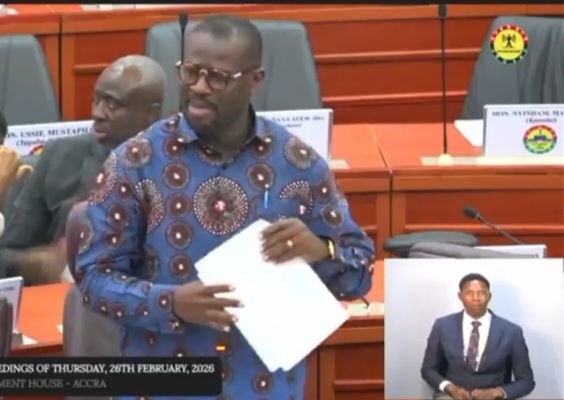
Weija-Gbawe MP and Second Deputy Minority Whip, Jerry Ahmed Shaib, says the latest World Bank assessment strengthens the Minority’s argument that Parliament must investigate how the gold reserves and the Domestic Gold Purchase Programme (DGPP) have been managed.
His intervention follows the publication of the World Bank’s 10th Ghana Economic Update: Reset for Growth, Sustaining Macroeconomic Recovery and Unlocking Transport for Transformation in August 2026.
According to Jerry Shaib, the World Bank identifies GoldBod-related operations, alongside other areas of the economy, as a “significant and insufficiently monitored risk” to Ghana’s economic stability.
The MP argues that the finding is particularly significant because it comes shortly after an assessment by the International Monetary Fund (IMF) revealed substantial losses associated with the Domestic Gold Purchase Programme totaling over $1.7billion.
IMF puts gold programme losses above US$1.7bn
The IMF’s August 2026 Ghana: Selected Issues report examined the legacy of the Bank of Ghana’s Domestic Gold Purchase Programme, which was introduced in 2021 and expanded significantly in subsequent years.
The Fund found that the programme generated more than US$1.7 billion (GHC22billion) in losses in 2025, equivalent to about 1.5 per cent of the GDP. The losses were largely linked to Gold-for-Reserves transactions involving artisanal and small-scale mining gold.
The IMF said the losses arose from a combination of service and assay fees paid to GoldBod, discounts on gold sold to off-takers and, most significantly, exchange-rate losses associated with the difference between the forex bureau rate used to purchase gold and the Bank of Ghana’s reference rate used for accounting.
The Fund also noted that the losses weakened the Bank of Ghana’s balance sheet, with the central bank’s negative equity reaching 6.7 per cent of GDP at the end of 2025.
The IMF, however, also acknowledged the broader role played by the programme in Ghana’s external position. It said the DGPP contributed significantly to the accumulation of international reserves and foreign-exchange inflows during the economic recovery.
In 2025 alone, the Bank of Ghana purchased and exported approximately 104 tonnes of artisanal and small-scale mining gold worth US$10.9 billion, while also purchasing about US$1.26 billion in gold bullion from large-scale mining operations.
Minority says the problem is management
Jerry Shaib has drawn a distinction between the concept of using the gold to strengthen reserves and what he describes as the manner in which the programme has subsequently been managed.
He credited the previous Nana Addo Dankwa Akufo-Addo administration and former Vice President Dr Mahamudu Bawumia with the policy concept, arguing that using domestic gold to support reserves and strengthen the cedi was a sound economic strategy.
“The Domestic Gold Purchase Programme was a smart idea birthed by the Nana Addo Dankwa Akufo-Addo administration, with Dr Mahamudu Bawumia as the brain behind its design,” he said.
His criticism, however, is directed at what he describes as the current administration’s management of the programme and GoldBod.
Shaib argues that a policy designed to strengthen the reserves should not become a source of substantial financial losses without Parliament and the public receiving adequate explanations.
He has therefore used the latest international assessments to renew calls for a detailed investigation.
World Bank warning adds pressure
The World Bank’s assessment provides another layer to the debate.
The Bank’s 10th Ghana Economic Update says financial pressures linked to GoldBod, the energy sector, COCOBOD, state-owned enterprises and ongoing financial-sector restructuring remain important sources of fiscal risk.
The Bank has warned that delays in implementing reforms in these areas could threaten the hard-won gains in macroeconomic stability and debt sustainability.
The World Bank report, according to the Minority, also raises questions about the manner in which gold reserves accumulated through the programme are tracked in relation to the other reserves.
Shaib says the concerns identified by the World Bank and IMF together warrant parliamentary scrutiny rather than continued political exchanges.
GoldBod takes over DGPP operations
The development also comes at a significant transition point for the gold policy.
The IMF report states that the Domestic Gold Purchase Programme was largely phased out at the Bank of Ghana by the end of June 2026, with operations and associated costs transferred fully to GoldBod from July 1, 2026.
Under the new arrangement, the Bank of Ghana is expected to exit the DGPP and no longer carry its quasi-fiscal financial risks, while continuing to act as GoldBod’s fiscal agent and receive monetary gold for the country’s reserves.
The IMF said the costs of the programme are expected to be assumed transparently by the government and reduced significantly.
It reported that some progress had already been made in 2026, with costs associated with the programme falling from 14.5 per cent of gold purchased in 2025 to 11.4 per cent in the first quarter of 2026.
But the Fund also noted that Ghana intends to significantly expand domestic gold purchases under its Ghana Accelerated National Reserve Accumulation Policy (GANRAP), with a target of building reserves equivalent to 15 months of import coverage by 2028.
That ambition makes transparency, cost control and risk management even more important, particularly given the losses recorded under the previous arrangement.
Minority demands disclosure of off-takers and discounts
Against this background, Shaib has renewed demands for detailed information about the commercial arrangements underpinning the gold programme.
Among the questions being raised is the identity of the off-takers who purchased the gold and the discounts applied when the gold was sold.
The Minority wants government to disclose the fees charged during the transactions and establish clearly whether the associated costs and losses were borne by GoldBod or the Bank of Ghana.
These questions are significant because the IMF specifically identified off-taker discounts, service and assay fees and exchange-rate differences as contributors to the DGPP’s losses.
The Minority is also calling for systematic disclosure of contingent liabilities associated with the programme.
It wants gold reserves accumulated under the programme to be properly reflected in standard reserve reporting rather than being accounted for in a manner that makes them difficult for Parliament and the public to track.
Five demands from the Minority
Shaib has outlined a renewed set of demands following the World Bank’s assessment.
The Minority wants Parliament to conduct a full inquiry into GoldBod and the Bank of Ghana’s gold operations, including the power to summon officials and demand relevant documents.
It is also demanding full disclosure of the identities of off-takers, discounts granted, fees charged and the institutions that ultimately bore the financial consequences of the transactions.
The Minority further wants government to publicly disclose contingent liabilities associated with the programme and ensure that gold reserves are accounted for under standard reserve reporting.
Finally, it is calling for a clear government plan and timeline to address the risks identified by both the IMF and World Bank, including concerns relating to GoldBod, weak financial institutions, COCOBOD and Ghana’s exposure to fluctuations in international gold prices.
Parliamentary scrutiny now in focus
The Minority says the World Bank’s latest assessment has strengthened its case for parliamentary scrutiny of the programme.
Shaib has indicated that the Speaker of Parliament has admitted the Minority’s motion on the matter, creating a potential avenue for a formal investigation.