By Issah Olegor
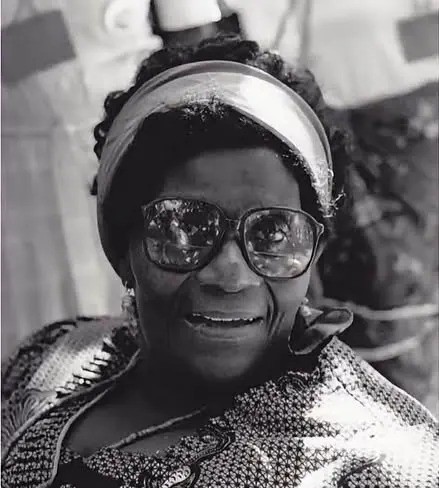
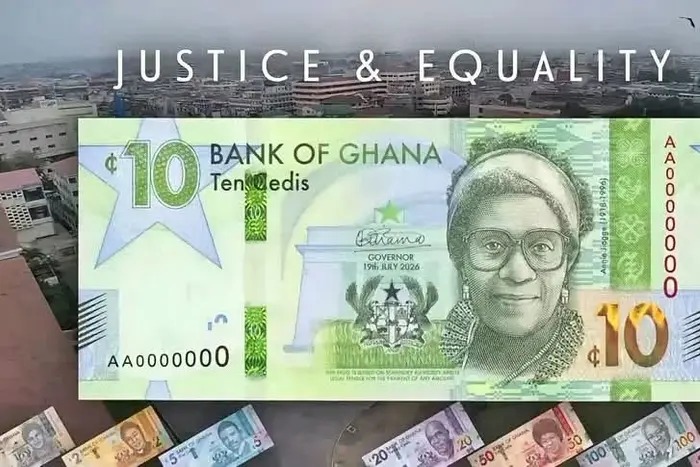
The newly introduced GH¢10 banknote has triggered conversations beyond its historical significance, with some social media users drawing comparisons between the portrait of celebrated jurist Justice Annie Ruth Jiagge and First Lady Lordina Mahama.
The redesigned currency, introduced under the Bank of Ghana’s Cedi Heritage Series, has brought renewed attention to the life and achievements of one of the most influential female legal figures.
However, the unveiling of her portrait has also generated unexpected public reactions, including claims by some observers that she bears a resemblance to the current First Lady.
Other social media conversations have focused on her family background, with some users pointing out that Justice Jiagge is the grandmother of Emefa Hardcastle, Chief Executive Officer of the Ghana Petroleum Commission. These discussions have added another dimension to the public interest surrounding the new currency.
The comparisons and family connections have become talking points, while opposition voices and critics have also taken to social media to mock aspects of the new banknote and the government’s broader presentation of the currency.
Behind the portrait attracting public attention is a woman whose achievements remain significant in the legal and political history.
Justice Annie Ruth Jiagge, born Annie Ruth Baeta on October 7, 1918, in Lomé, then part of French Togoland, was a trailblazer whose career broke several barriers for women in the country’s judiciary.
She initially pursued a career in education, obtaining her teaching certificate from Achimota School in 1937. She subsequently worked as a teacher and headmistress before deciding to pursue law at a time when women had limited opportunities in many professional fields.
Her legal education took her to the London School of Economics, and she was called to the Bar at Lincoln’s Inn in 1950.Jiagge began her judicial career as a magistrate in 1953 before becoming a Circuit Court judge in 1959. Her appointment as a High Court judge in 1961 made her the first woman to occupy that position in Ghana.
She continued to rise through the judicial system, joining the Court of Appeal in 1969. In 1980, she achieved another historic milestone when she became the first woman to serve as President of the Court of Appeal, a position she held until her retirement in 1983.
Her achievements placed her among the most prominent women in Ghana’s legal history and helped demonstrate that women could occupy the highest positions within the country’s judicial system.
Beyond her judicial responsibilities, Justice Jiagge was a prominent advocate for women’s rights and gender equality.
Between 1962 and 1972, she served on the United Nations Commission on the Status of Women, becoming its president in 1968.
During her time with the commission, she contributed to the development of the Declaration on the Elimination of Discrimination Against Women, which was adopted by the United Nations in 1967.
Her advocacy was not limited to international platforms. In Ghana, she played an important role in the establishment of the National Council on Women and Development in 1975, an institution created to promote women’s advancement and participation in national development.
She also contributed to initiatives aimed at improving women’s economic opportunities, including efforts associated with Women’s World Banking.
In 1993, she was appointed a member of Ghana’s Council of State, extending her public service into the country’s constitutional advisory system.
Justice Jiagge died in Accra on June 12, 1996, aged 77. Her contributions were recognised through several honours, including the Grand Medal and an honorary Doctor of Laws degree from the University of Ghana.
Her inclusion on the new GH¢10 note forms part of the Bank of Ghana’s Cedi Heritage Series, which seeks to recognise personalities whose contributions have shaped the country’s history and development.
The front of the redesigned note carries her portrait, while the reverse features Ghana’s Supreme Court building, reflecting her contribution to the country’s judicial system.
The Adinkra symbol Epa, associated with law and justice, has also been incorporated into the design.The new note is printed on reinforced cotton paper intended to improve durability and is smaller than previous versions. It is being introduced alongside existing currency, which will be gradually withdrawn as the transition progresses.
While the comparisons with Lordina Mahama, discussions about her family connections and political reactions have generated attention online, Justice Jiagge’s appearance on the currency represents recognition of a distinguished career that extended beyond the courtroom.