By Daniel Bampoe
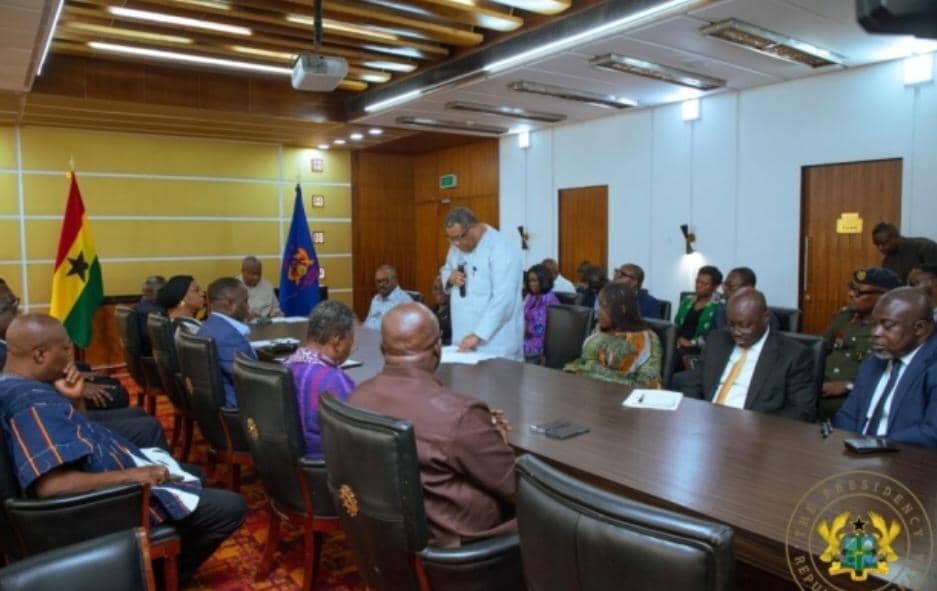
In a major policy step to breathe life into his flagship campaign promise, President John Dramani Mahama on Monday, May 5, 2025, inaugurated a 19-member Presidential Committee on Accelerated Export Development (PCAED).
The initiative, a cornerstone of his 24-hour Economy and Export Development Programme, is aimed at transitioning Ghana into a competitive, export-driven economy.
The PCAED is tasked with transforming Ghana’s non-traditional export sector by removing systemic bottlenecks and stimulating round-the-clock productivity across key economic sectors.
This aligns with President Mahama’s ambitious 24-hour economy agenda, which was at the heart of his victorious 2024 election campaign.
The newly formed committee comprises a cross-section of policymakers, economists, export professionals, and industry leaders.
Key members include President Mahama himself, Presidential Advisor on the 24-hour Economy Augustus Obuadum Goosie Tanoh, Finance Minister Dr. Cassiel Ato Forson, Minister of Trade Elizabeth Ofosu Agyare, Attorney General Dr. Dominic Ayine, as well as representatives from the Ghana Revenue Authority, Ghana Ports and Harbours Authority, Association of Ghana Industries, and academia.
At the inauguration ceremony, Mr. Tanoh emphasized that the committee would not serve a ceremonial role.
“The PCAED is not a symbolic body; it is a strategic engine,” he stated, underlining that the body’s purpose is to provide the president with practical, evidence-based recommendations to shift Ghana from raw commodity dependence to value-added exports.
He outlined three pillars of the programme—production transformation, market system efficiency, and human capital development—as key to achieving sustainable growth and job creation.
According to him, Ghana’s current non-traditional export value of $3.5 billion is “inadequate for an economy of Ghana’s potential.”
Mr. Tanoh acknowledged challenges such as complex export regulations, port inefficiencies, and limited access to international certification, but asserted that Ghana’s location, infrastructure growth, and political stability offer a strong foundation for overcoming these obstacles.
“This is about building national wealth and restoring dignity through jobs and industrial competitiveness,” he added.
However, the announcement has reignited public debate over the credibility of the 24-hour economy promise, which critics initially dismissed as a political gimmick.
Following the President’s State of the Nation Address earlier this year, opposition lawmakers accused Mahama of failing to outline concrete steps for implementation.
Their skepticism has been fueled further by the initiative’s absence in the 2025 Budget Statement.
Leading the charge was former Finance Minister and NPP MP Mohammed Amin Adam, who in March questioned the initiative’s economic logic.
“If the 24-hour economy is truly meant to boost growth, we should expect a higher projection for the industrial sector,” he said, pointing to the 2025 budget’s modest 4.4% GDP growth target—down from the 5.7% achieved in 2024 under the previous administration.
Amin Adam argued that under the NPP, industry had led economic growth with a 7.1% rise in 2024, driven by sectors such as construction and ICT.
He accused the current government of underplaying these achievements and noted that Mahama’s previous administration had underperformed in comparison.
The opposition insists that without concrete policies in the budget or significant investments in energy and infrastructure, a 24-hour economy remains a lofty idea rather than an actionable plan.
“Ghanaians are yet to see how this will translate into jobs or improved export performance,” Amin Adam added.
Despite these criticisms, the government remains optimistic that the PCAED will catalyze economic transformation.
By focusing on exports, the committee’s mandate overlaps with broader national goals, including leveraging Ghana’s position as host of the African Continental Free Trade Area (AfCFTA) Secretariat.