BY Daniel Bampoe
The historic adoption of a United Nations resolution declaring the transatlantic slave trade as “the gravest crime against humanity” may have been sealed under President John Dramani Mahama, but the diplomatic architecture that made it possible was painstakingly constructed years earlier by his predecessor, Nana Addo Dankwa Akufo-Addo.
The March 25, 2026 vote at the United Nations General Assembly, backed by 123 member states, represents the culmination of a sustained campaign initiated during Akufo-Addo’s administration—one that repositioned Ghana at the forefront of the global reparations movement and unified Africa behind a common cause.
The foundation of this effort was laid in February 2023 in Addis Ababa, when Akufo-Addo presented a bold proposal to the African Union Assembly. The resolution, which called for “Building a United Front to Advance the Cause of Justice and the Payment of Reparations to Africans,” was adopted unanimously.
That decision marked a turning point, transforming reparations from a fragmented advocacy issue into a coordinated continental agenda.
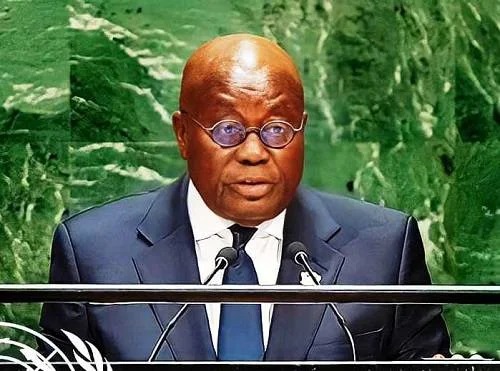
Later that year, Akufo-Addo took the campaign beyond Africa. In September 2023, addressing the 78th session of the UN General Assembly in New York, he issued a direct and unambiguous call for the transatlantic slave trade to be recognised globally as a state-sponsored crime deserving reparations.
The speech elevated the debate to the highest diplomatic level, challenging the international community to confront the moral and legal implications of centuries of enslavement.
The momentum intensified in November 2023 when Ghana hosted the Accra Reparations Conference under Akufo-Addo’s leadership. The conference produced the landmark Accra Proclamation, which established a continental mandate, outlined a clear action plan, and led to the creation of the African Committee of Experts on Reparations. These structures provided the strategic direction and institutional backing necessary to sustain the campaign.
By the time Akufo-Addo left office, the groundwork had been firmly established: Africa was united, the issue had gained global visibility, and a roadmap for action was in place. Crucially, his administration also secured the creation of the African Union Champion on Reparations role—ensuring continuity of leadership beyond his tenure.
When John Dramani Mahama assumed office in January 2025, he inherited not just a title but a fully developed diplomatic agenda.
As AU Champion on Reparations, Mahama’s task was to carry forward a process already set in motion—translating years of advocacy into a binding global resolution.
That final step came this week in New York, where Mahama formally tabled the resolution and secured its passage. The motion declares the trafficking of enslaved Africans and racialised chattel enslavement as crimes against humanity, while urging nations to consider formal apologies and contribute to a reparations framework.
Although the resolution does not specify financial compensation, it represents a major shift in international recognition. It also calls for the return of stolen cultural artefacts, reforms to global systems to promote equity, and stronger protections for Africans and people of African descent.
The vote was not without resistance. The United States, Israel and Argentina opposed the resolution, while 52 countries—including the United Kingdom and several European Union members—abstained. Yet, the overwhelming support it received underscores the strength of the consensus first built under Akufo-Addo’s leadership.
At the global level, António Guterres welcomed the resolution but urged member states to go further. He called for decisive action to dismantle systemic racism and address the lingering effects of slavery and colonialism embedded in global institutions.
For Mahama, the moment was one of moral reckoning and remembrance. Speaking on behalf of the African Union, he framed the vote as a duty to honour the more than 12.5 million Africans affected by the transatlantic slave trade, urging nations to choose justice over neutrality.
Yet, even as Mahama delivered the final diplomatic push, the roots of the achievement trace back to Akufo-Addo’s strategic vision—his ability to unify Africa, internationalise the reparations debate, and institutionalise a process that could outlive his presidency.
In effect, the 2026 UN resolution stands not only as a victory for Ghana and Africa, but also as a testament to a rare continuity in leadership—where one administration’s vision was carried through to fruition by the next, turning years of advocacy into a defining moment in the global pursuit of justice.