By Issah Olegor
The Confederation of African Football (CAF) has delivered some of the heaviest disciplinary punishments in recent African football history, handing record fines and suspensions to both Senegal and host nation Morocco following the disorder that overshadowed the Africa Cup of Nations (AFCON) 2025 final in Rabat.
The much-anticipated tournament finale, played on January 18, 2026, at the Prince Moulay Abdellah Stadium, Rabat, ended with Senegal defeating Morocco 1–0 in extra time to lift their second AFCON crown.
Pape Gueye’s decisive strike secured victory for the Teranga Lions, but the match will be remembered as much for the controversy and chaos as for the football itself.
CAF’s Disciplinary Board launched an investigation after the final was marred by stoppages, crowd trouble, and confrontations involving players, officials, and supporters.
Central to the turmoil was a late VAR-awarded penalty decision in Morocco’s favour during regulation time, following a challenge on Moroccan star Brahim Diaz.
The call sparked furious protests from Senegal’s camp, leading to an unprecedented moment when Senegalese players briefly walked off the pitch, delaying play for approximately 15 to 17 minutes before they returned.
Clashes also erupted in the stands, involving Senegalese supporters and stadium security, while tensions continued to simmer even after the final whistle.
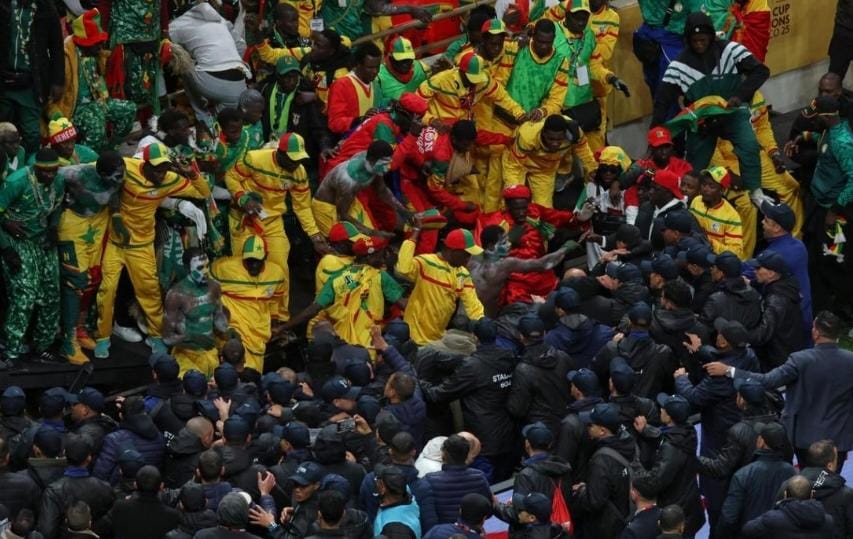
The fallout drew widespread condemnation across the football world and prompted CAF to respond with strong punitive measures aimed at protecting the integrity of the competition.
Senegal, as champions, faced the harsher penalties. The Fédération Sénégalaise de Football (FSF) was hit with a total fine of $615,000, broken down into multiple charges.
CAF imposed $300,000 for improper conduct by supporters that brought the game into disrepute, another $300,000 for unsporting behaviour by players and technical staff in violation of principles of fair play, loyalty and integrity, and an additional $15,000 for team misconduct after five Senegalese players received yellow cards.
Individual punishments were also severe. Senegal head coach Pape Bouna Thiaw was suspended for five official CAF matches and fined $100,000, with CAF citing his role in the team’s brief protest walk-off as unsporting conduct that damaged the image of the game.
Players Iliman Ndiaye and Ismaila Sarr were each suspended for two official CAF matches for inappropriate behaviour towards the referee.
Morocco, despite being the host nation, also faced significant disciplinary action.
The Fédération Royale Marocaine de Football (FRMF) was fined a total of $415,000 for multiple breaches. CAF imposed $200,000 over misconduct involving stadium ball boys, $100,000 for improper conduct by Moroccan players and staff — including entering the VAR zone and obstructing match officials — and $15,000 for supporters’ use of lasers during the match.
Further sanctions were handed to key Moroccan players. Midfielder Ismail Saibari received a suspension of three CAF matches alongside a fine, while Captain Achraf Hakimi was banned for two official CAF matches.
In a major ruling, CAF also rejected Morocco’s appeal requesting that Senegal be stripped of the AFCON title due to the walk-off incident.
The governing body confirmed that Senegal’s 1–0 victory remains valid, officially recognising them as AFCON 2025 champions despite the disruption.
CAF’s Disciplinary Board stressed that the sanctions were issued under the CAF Disciplinary Code, with the aim of upholding sporting integrity, ensuring respect for match officials, and preventing violence or disorder at future tournaments.
While both federations retain the right to appeal, the punishments represent one of the strongest statements CAF has made in years regarding discipline and tournament conduct.
Although Senegal’s triumph remains intact, the heavy fines, coaching bans and player suspensions will have lasting consequences for their preparations for upcoming continental competitions. Morocco, meanwhile, faces renewed scrutiny over stadium organisation and crowd control, despite hosting what was otherwise a landmark edition of the Africa Cup of Nations.