
By Issah Olegor
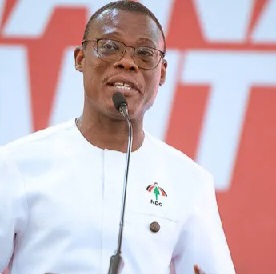
The growing national debate over a possible third presidential term for President John Dramani Mahama has taken a sharper turn, following a strong and unusually blunt intervention by the General Secretary of the National Democratic Congress (NDC), Fifi Fiavi Kwetey.
Speaking at the party’s 31st December Movement celebration in Ada, Greater Accra, Fifi Kwetey launched a scathing attack on what he described as rising sycophancy within the party, warning that such conduct threatens the ideological foundation of the NDC and the integrity of the democracy.
Fifi Kwetey’s comments come at a time when internal and public speculation over a potential third-term bid by President Mahama has intensified, fueled by statements from party sympathisers, political activists, and some outspoken allies who argue that Ghana should amend its Constitution to allow Mahama to continue in office beyond the two-term limit.
Addressing party faithful, Fifi Kwetey expressed deep concern over what he described as an emerging culture of excessive praise singing and political bootlicking.
He said some individuals within the party now believe that praising the leader uncritically is the only route to relevance or political survival.
According to him, this mentality directly contradicts the founding principles of the NDC and undermines the values upon which the party was built.
He warned that such behaviour was not only unhealthy but dangerous, stressing that the party was never founded on blind loyalty to individuals but on collective discipline, accountability, and service to the people.
Drawing historical parallels, Kwetey reminded supporters that the late former President Jerry John Rawlings, founder of the NDC, was never encouraged to pursue a third term, even at the height of his popularity.
“The NDC was not built on personalities but on principles,” Fifi Kwetey stressed.
“No individual, no matter how popular or accomplished, is bigger than the party or the nation. Leaders come and go, but the movement must endure.”
His comments were widely interpreted as a direct response to growing calls from certain quarters including the Majority Leader, Mahama Ayariga, urging President Mahama to consider remaining in power beyond the constitutionally mandated two terms.
Some of these calls have come from political actors and vocal supporters who argue that Mahama’s leadership is essential to consolidating economic recovery and national stability.
One of the most outspoken voices in this debate has been Kwame Asare Obeng, popularly known as A Plus, the Member of Parliament for Gomoa Central.
A Plus has publicly advocated for a constitutional amendment to allow Mahama to contest again, insisting that national development should take precedence over constitutional restrictions.
He has argued that if the Ghanaian people desire continuity in leadership, the law should not stand in their way.
A Plus has gone further to challenge Mahama’s own declaration that he will not seek a third term, questioning why the president would preemptively rule himself out when the constitution could theoretically be amended.
He has openly declared his willingness to mobilize public support to “test the law” and push for constitutional changes if necessary.
These comments, however, have sparked widespread criticism across the political spectrum.
Many legal scholars, civil society organizations, and senior figures within the NDC have warned that tampering with presidential term limits would undermine the democratic stability and set a dangerous precedent.
They argue that the 1992 Constitution, which limits presidents to two terms, was deliberately crafted to prevent authoritarianism and ensure peaceful transfers of power.
President John Mahama himself has repeatedly stated that he has no intention of seeking a third term and has emphasized his commitment to upholding the Constitution.
He has also indicated that stepping aside at the end of his tenure would allow him to govern without the distractions of electoral ambition and strengthen democratic institutions.
Within the NDC, however, uncertainty persists. While some party figures quietly align themselves with the idea of extending Mahama’s tenure, others, including senior party elders, see such efforts as self-serving and potentially damaging.
They argue that the party’s strength lies in its ability to renew leadership and remain faithful to its founding principles, rather than bending constitutional rules to suit political convenience.


