By Issah Olegor
The government’s declaration that Ghana is beginning to win the fight against illegal mining is facing a painful test on the ground, as deaths linked to collapsing and abandoned galamsey pits continue to raise questions about whether the country’s anti-illegal mining campaign is achieving the results being promised.
The latest concerns follow the deaths of seven illegal miners at Asaman Tamfoe in the Atiwa East District of the Eastern Region, after a mining pit collapsed at about 11 p.m. on Saturday, August 29, 2026, while the victims were underground searching for gold. Rescue efforts continued through the night, with emergency personnel and local volunteers responding to the disaster.
The Asaman Tamfoe tragedy is only one of several incidents that have kept the dangers associated with illegal mining in the national spotlight.
Days earlier, the Ashanti Regional Minister, Dr Frank Amoakohene, disclosed that at least 23 people, including 11 children, had died after falling into abandoned illegal mining pits in the region. Nineteen bodies had reportedly been retrieved at the time, while four remained trapped underground.
According to the Regional Minister, many of the victims were residents who fell into uncovered pits while using routes leading to their farms.
The galamsey tragedy continues to inflict pain on households in the mining communities as another tragic incident was recorded in the Ashanti region just last week with report of eight people perishing.
Seven illegal miners were confirmed dead after a mining pit collapsed on them at Manso Domi Keniago in the Amansie South District of the Ashanti region.
One other miner was trapped underground. Report say the trapped miner may not survive bringing deaths associated with galamsey to 38 within a spate of less than three weeks.
The latest incident occurred on Thursday evening, September 3, 2026, while the miners were reportedly engaged in illegal mining activities in search of gold within the pit.
The deaths have consequently raised a difficult question for government: how can the country be said to be winning the galamsey war when abandoned mining pits are still claiming lives and illegal mining continues to threaten communities?
Minister declares victory
The question comes shortly after Lands and Natural Resources Minister Emmanuel Armah-Kofi Buah declared that Ghana was beginning to win the war against illegal mining.
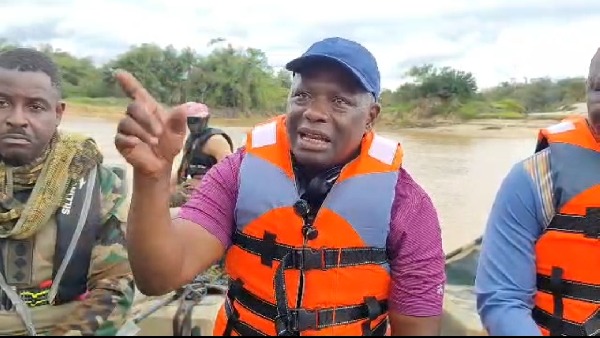
Armah-Kofi Buah made the declaration after joining personnel of the National Anti-Illegal Mining Operations Secretariat (NAIMOS) and Special Forces on a 16-kilometre inspection tour of the Ankobra River as part of the second phase of Operation Water Shield. Interestingly the river was heavily polluted by galamsey operators an evidence that the battle is far from winning. The NAIMOS task force has also been hit with allegation of corruption, with members allegedly receiving money through mobile money from illegal miners.
According to the Minister, the situation along the Ankobra had changed significantly compared with what he encountered during an earlier visit.
He said the river had previously been turned into what he described as a virtual workshop, with changfan machines and other makeshift mining equipment operating along its banks.
This time, however, he said close to 3,000 mining machines had been removed from the Ankobra, Pra, Birim and other rivers, while more than 237 arrests had been made, including 144 foreign nationals.
“I am very confident that we are winning this war and the impunity is going away,” Armah-Kofi Buah boasted.
He acknowledged that the government had not yet restored the affected rivers to the condition it wanted but argued that the progress recorded on the Ankobra represented a significant milestone.
“I have not gotten to the point where we want them to be as blue as we want, but what I have seen today warms my heart,” he said.
From river victories to deaths underground
The government’s account presents a picture of intensified enforcement, but the continuing deaths associated with galamsey pits provide a starkly different dimension to the crisis.
While Operation Water Shield focuses heavily on protecting water bodies and removing mining machinery, communities continue to confront another legacy of illegal mining: deep, abandoned and uncovered pits left behind after mining activities.
The disclosure by the Ashanti Regional Minister that 23 people, including 11 children, had died after falling into abandoned pits demonstrates the scale of the danger beyond the rivers.
Dr Amoakohene said some of the victims were simply travelling along routes leading to their farms when they fell into the uncovered pits.
He said the Regional Security Council, with support from the Ministry of Lands and Natural Resources, had started reclaiming and covering abandoned illegal mining pits in affected communities.
But the deaths raise concerns over whether reclamation efforts are moving quickly enough to prevent further tragedies.
The Eastern Region tragedy
The latest fatal collapse at Asaman Tamfoe has further exposed the deadly conditions under which illegal mining continues.
The seven victims were underground searching for gold when the pit collapsed.
Local residents and volunteers responded after the incident, while the police, the National Disaster Management Organisation and the National Ambulance Service were involved in the emergency response.
The incident has renewed attention on the risks faced by illegal miners themselves, many of whom work in unstable underground structures without the safety systems associated with regulated mining.
It has also highlighted the wider danger posed by the abandoned pits to people who do not participate in illegal mining but live and work in communities where mining has taken place.
Galamsey spreads beyond the traditional hotspots
Concerns are not confined to the Ankobra, Pra, Birim or parts of the Ashanti and Eastern regions.
Reports have also pointed to continuing illegal mining activities around Bole-Bamboi in the Savannah Region, including areas affecting farmlands and water sources such as the Yonkamba Stream, which feeds into the Black Volta.
The reported activities have generated political criticism and renewed questions about enforcement, particularly when illegal mining is alleged to be taking place in communities that should be receiving strong government attention.
In the Eastern Region, concerns have also been raised about ongoing galamsey activities along the Densu River between the Suhum and Abuakwa South Municipality borders.
Mining activities have also reportedly continued around Konongo along the highway and in the Anyinam area, adding to concerns that the illegal mining problem remains widespread despite alleged intensified government operations.
Government says strategy has changed
Armah-Kofi Buah insists that the government is not relying on the sporadic raids that have characterised some previous anti-galamsey operations.
He said Operation Water Shield represents a shift towards permanent deployment, with security personnel expected to remain in affected areas rather than withdraw after temporary operations.
“Operation Water Shield is not something we are stopping. It is basically changing the face of this fight, especially in the protection of our water bodies, making sure that we stay on permanently to fight all the way to the end,” he said.
The Minister argued that past experience showed that illegal miners often returned when security personnel left.
“We are going to be here as long as it takes,” he stressed.
Government targets financiers
The government also says it intends to move beyond seizing mining machines and arresting operators to identifying the people who finance and organise illegal mining operations.
Armah-Kofi Buah described the financiers and sponsors behind the operations as “powerful forces” operating behind the scenes.
“The machines that destroy it, the excavators we’ve seized, those behind them are powerful forces that are hiding in the dark, and our next phase is continuing to fish them out,” he said.
He added that government would continue pursuing sponsors and financiers until the illegal mining problem was brought under control.
Can enforcement alone solve the problem?
The government’s strategy also includes attempts to move some young people away from illegal mining and into organised small-scale mining.
According to Armah-Kofi Buah, some young people who were previously engaged in illegal mining along the Ankobra have moved into cooperative mining and responsible small-scale mining programmes.
He said the objective was to demonstrate that gold could be extracted without destroying rivers, forests and other natural resources.
“You can look for gold without destroying our water bodies and our forests. You can look for gold without damaging our environment. You can look for gold responsibly and sustainably, and that is the future we are looking for,” he said.
The approach is intended to combine enforcement with alternative livelihoods, training and responsible mining practices.
The uncomfortable contradiction
The government’s reported seizure of thousands of machines and hundreds of arrests provides evidence of intensified enforcement. The reported improvement along parts of the Ankobra also gives the government grounds to argue that its strategy is producing results.
But the continued deaths tell another part of the story.
For communities living around abandoned mining sites, the galamsey crisis is not measured only by the colour of rivers or the number of excavators seized. It is also measured by the people who fail to return home after entering dangerous pits, farmers who risk falling into abandoned excavations and children whose lives are cut short by holes left behind by mining activities.
The reported deaths in the Ashanti Region and the Asaman Tamfoe disaster therefore put pressure on government to demonstrate that its anti-galamsey campaign is producing results beyond headline figures.
‘We are not where we want to be’
Armah-Kofi Buah himself acknowledges that Ghana has not yet reached the desired destination.
He says the government is encouraged by what it has seen on the Ankobra but recognises that much more work remains.
“If you ask me what we inherited and compare it with the Ankobra today, I am very clear that we are making great progress,” he said.
He insists that Ghana can eventually win the fight if enforcement is sustained and the government succeeds in dismantling the networks financing illegal mining.