By Daniel Bampoe
The Minority in Parliament has launched a blistering attack on Finance Minister Dr. Cassiel Ato Forson’s 2026 Mid-Year Budget Review, accusing the government of presenting what it describes as a catalogue of activities instead of tangible economic outcomes, particularly for the struggling youth.
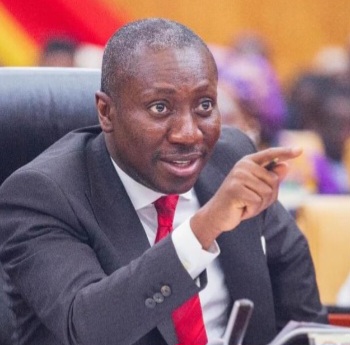
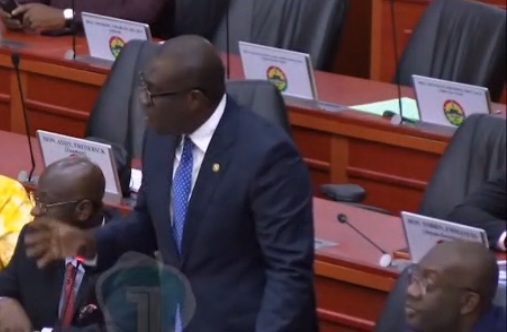
Leading the criticism was the Member of Parliament for Akuapem North, Sammi Awuku, who argued that the Mid-Year Review failed to demonstrate how government programmes have improved the lives of ordinary Ghanaians despite highlighting numerous policy initiatives and projects.
Speaking during the parliamentary debate on the Mid-Year Budget Review, Mr. Awuku said the document resembled “an inventory of activity” rather than a genuine assessment of the impact of government policies on employment, livelihoods and economic well-being.
“This review reads like an inventory of activity, not a record of impact,” the Akuapem North legislator declared, insisting that merely listing projects and programmes cannot be equated with meaningful development.
He stressed that government reports should focus on measurable improvements in the lives of citizens rather than the number of initiatives launched or payments made.
“Inventories do not pay rent or acquire property. An inventory of activity does not pay school fees or feed anyone,” Sammi Awuku told Parliament.
According to him, a Mid-Year Budget Review is intended to serve as a report card on the government’s performance and should clearly demonstrate the outcomes of public expenditure.
“A Mid-Year Review should be a report card, Mr. Speaker, not a register of activities as presented by Minister Forson. It must show what has changed in the lives of our young people, not what government started or also paid for,” he argued.
The criticism comes against the backdrop of the Mahama administration’s insistence that its economic recovery programme is beginning to produce positive results.
Since assuming office, the NDC government has pointed to declining inflation, improved exchange rate stability, stronger foreign reserves and enhanced fiscal discipline as evidence that the economy is recovering from years of macroeconomic challenges.
The government has also rolled out flagship initiatives, including the 24-Hour Economy Programme, the Big Push Infrastructure Programme, youth entrepreneurship interventions and industrial expansion policies, all aimed at creating employment and stimulating economic growth.
However, Sammi Awuku argued that despite these initiatives, the Mid-Year Budget Review fails to provide measurable evidence that young Ghanaians are benefiting from the programmes.
He noted that although the review reported a national unemployment rate of 12.8 percent for the first three quarters of 2025, it failed to adequately address the much higher unemployment rate among young people.
Citing data from the Ghana Statistical Service, the MP said unemployment among Ghanaians aged 15 to 35 years stands at 21.9 percent, a figure significantly higher than the national average.
According to him, nearly 1.95 million young people remain outside employment, education or training, describing the situation as a national crisis requiring urgent intervention.
“That is a population the size of Kumasi sitting idle and doing nothing,” he lamented.
Sammi Awuku further criticised the government for failing to establish measurable benchmarks to track progress in reducing youth unemployment.
He argued that the Mid-Year Budget Review contains no youth employment baseline, no reduction targets and no data indicating how many young people have secured sustainable employment through the government’s interventions.
Without such measurable indicators, he said, Parliament and the Ghanaian public cannot objectively assess whether government programmes are achieving their intended purpose.
“This is a tragedy,” the lawmaker stated, adding that “government cannot ask this House to accept as progress a youth jobs record that it refuses to measure.”