By Knii Fiofio
Greenpeace Africa has called on the government of Ghana to prohibit the importation of unusable second-hand clothing, warning that the growing volume of discarded textiles entering the country is worsening environmental pollution and placing an additional burden on local waste-management systems.
The environmental organisation urges authorities to distinguish between second-hand clothes that can still be worn, repaired, or repurposed and what it calls “dead waste”—garments that cannot be reused, repurposed, or resold.
The demand was made during a media engagement in Accra, where Greenpeace Africa presented findings from an investigation into discarded clothing linked to some of the world’s major fashion brands, including H&M, Primark and Marks & Spencer.
Hellen Kahaso Dena, Project Lead for Greenpeace Africa’s Pan African Plastics Project, said the volume of unusable clothing entering Ghana through the second-hand market was enormous and required urgent government intervention.
According to Ms Dena, discussions with traders at the Kantamanto Market in Accra suggested that a substantial proportion of the clothes arriving for resale were unsuitable for further use. She estimated that approximately 40 per cent of clothing entering the market ended up as waste.
The findings raise questions about the quality of textiles exported to Ghana and the extent to which the international second-hand clothing trade is transferring the environmental costs of fashion consumption to countries with limited capacity to manage the resulting waste.
As part of its investigation, Greenpeace Africa conducted a brand audit of 201 discarded garments collected from Jamestown Beach, Kantamanto Market and Agbogbloshie Market in Accra between October 2 and 5, 2026.
The audit identified garments bearing the labels of major international fashion brands, including H&M, Primark and Marks & Spencer, among the discarded clothing found at the selected locations.
The presence of branded clothing in waste sites, however, does not by itself establish the circumstances under which each garment was discarded or whether the brands directly exported the items as waste. Greenpeace’s central concern is that the current system allows large quantities of unusable clothing to enter Ghana, leaving traders, waste collectors, communities and public authorities to deal with the consequences.
Ms Dena stressed that the organisation was not calling for a blanket prohibition on second-hand clothing imports, acknowledging the trade’s importance to livelihoods and economic activity in Ghana.
Instead, she called for restrictions specifically targeting garments that have no realistic prospect of being worn, repaired, repurposed or sold.
“What we do not want is for fashion brands in the global north to actually use that loophole to continue dumping,” she said.
She maintained that clothing entering Ghana should meet minimum standards of quality and usability rather than being allowed into the country merely because it has been classified as second-hand merchandise.
Beyond the visible piles of discarded clothes, Greenpeace Africa has raised concerns about the less obvious environmental consequences of textile waste, particularly pollution associated with synthetic fibres.
Sam Quashie-Idun, Head of Investigations at Greenpeace Africa, said the brand audit formed part of wider investigations into the environmental effects of discarded clothing in Ghana.
He cited a 2024 Greenpeace report titled Fast Fashion, Slow Poison, which found that 89 per cent of 164 discarded garments tested at three dumpsites in the Greater Accra Region contained synthetic fibres.
Synthetic materials used in clothing can shed fibres during washing, wearing and deterioration. When garments are discarded in open environments or break down over time, these materials can contribute to plastic pollution and the release of microplastics.
The concern is particularly significant for communities where textile waste accumulates alongside other refuse, including at beaches and open dumping sites.
Greenpeace argues that efforts to address textile pollution must therefore go beyond collecting discarded garments after they have entered the environment. It says measures are needed to prevent unusable clothing from entering the country in the first place and to ensure that companies take greater responsibility for the products they manufacture and sell.
Isabelle McAllister, a Sweden-based spokesperson for Greenpeace, said fashion companies should remain responsible for the environmental consequences of their products even after those products leave their original markets.
She called for stronger Extended Producer Responsibility (EPR) regulations that would require fashion companies to contribute to the management of waste generated by their products throughout their life cycle.
Under an effective producer-responsibility framework, companies could be required to help finance or organise collection, sorting, reuse, recycling and other appropriate waste-management processes. Such arrangements could also encourage manufacturers to design more durable products and reduce the volume of clothing that becomes waste.
Greenpeace believes that without stronger accountability, the cost of managing discarded garments will continue to fall disproportionately on importing countries and the communities where the waste eventually accumulates.
Ms McAllister reiterated that the organisation was not seeking a complete ban on second-hand clothing imports, noti ng the economic importance of the trade to Ghana.
“We don’t want to see a total ban on import here. The quality needs to be better and we have to stop the overproduction,” she stated.
Her comments reflect Greenpeace’s broader position that the response to textile waste should address both the volume of clothing produced globally and the quality of garments exported into markets such as Ghana.
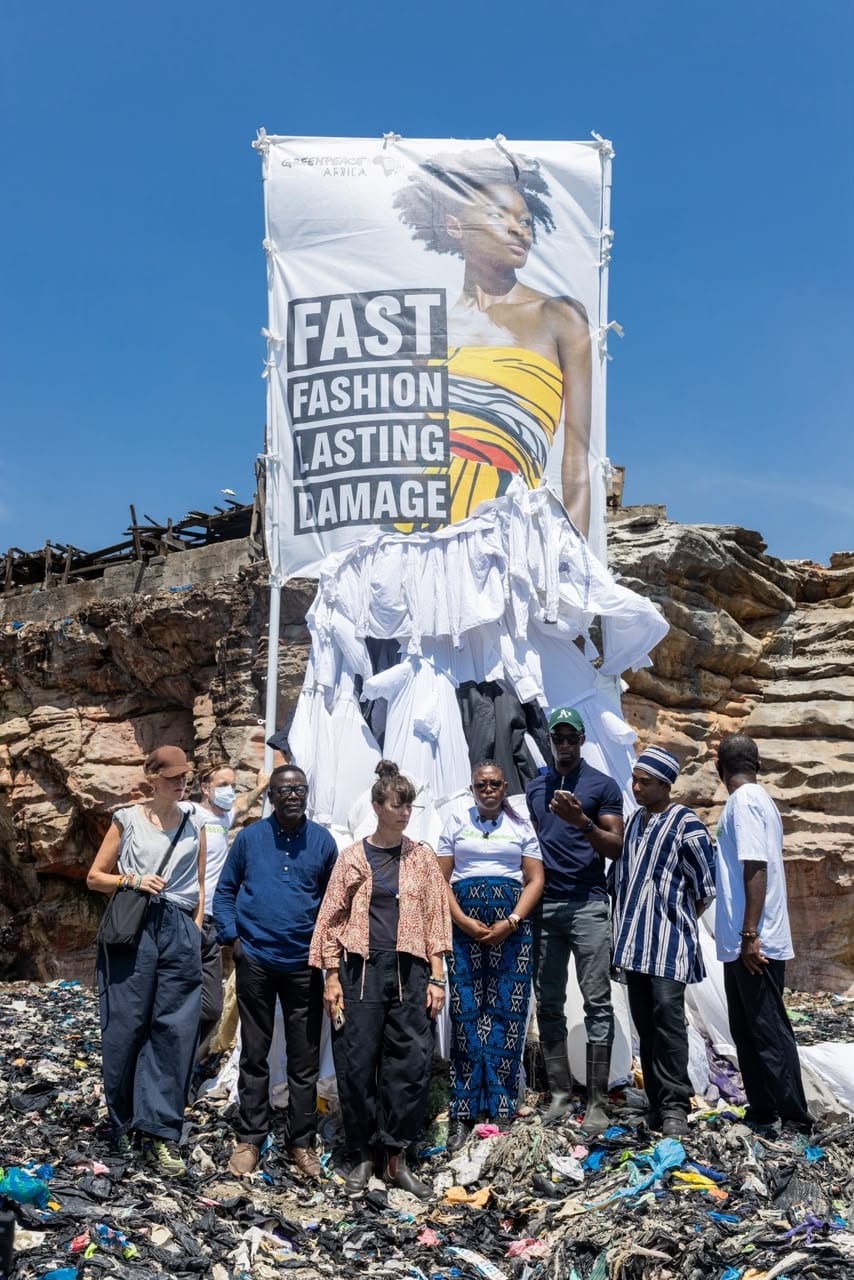
To draw public attention to the issue, Greenpeace Africa unveiled a six-metre installation at Jamestown Beach in Accra under the title Fast Fashion, Lasting Damage.
The installation was created from discarded garments by The Revival, an upcycling collective based at Kantamanto Market.
It depicts a model wearing a dress with an enormous skirt made from hundreds of discarded garments. The skirt spreads across the ground and merges visually with other waste materials, symbolising the scale of textile waste and its growing presence in Ghana’s environment.
The display was designed to provoke discussion among policymakers, fashion companies, traders, consumers and environmental advocates about the consequences of the global clothing trade.
By situating the installation at Jamestown Beach, Greenpeace sought to connect the problem of discarded clothing with the wider challenge of waste accumulating in public spaces and coastal environments.