By Issah Olegor
The Institute of Economic Affairs (IEA) has challenged the growing political narrative surrounding the reported US$1.7 billion loss associated with the Domestic Gold Purchase Programme (DGPP), arguing that the figure should not simply be presented as a direct financial loss suffered by the Ghana Gold Board (GoldBod) or the country.
The IEA’s position introduces another dimension into an increasingly heated debate over the financial performance of GoldBod and the role of the Bank of Ghana (BoG) in the government’s gold-purchasing strategy.
While the Minority in Parliament has repeatedly demanded explanations over the reported loss and questioned the financial arrangements underpinning the programme, the IEA says the figure contains several components that need to be properly separated before conclusions are drawn.
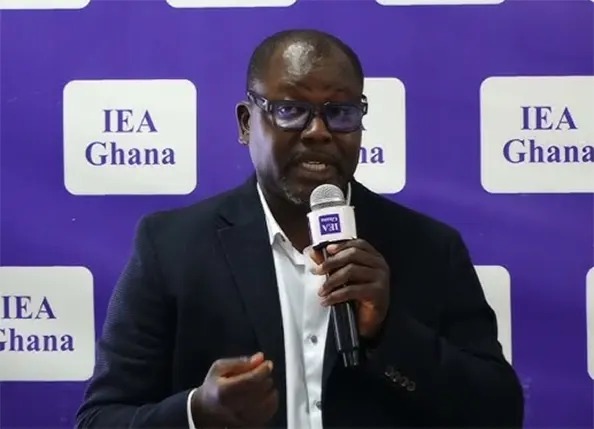
Professor Alexander Bilson Darku, Director of Research at the IEA, said the reported amount included service fees, assaying fees and foreign-exchange valuation differences arising from GoldBod’s gold purchasing and export activities.
He therefore rejected the suggestion that the entire amount represented a loss to GoldBod. His argument is that some amounts classified as costs or losses on the Bank of Ghana’s books could simultaneously represent revenue received by GoldBod as the institution providing services to the central bank.
“I don’t understand why somebody would call revenue as a loss,” Prof. Darku said during the IEA’s assessment of the 2026 mid-year budget review, held under the theme, “From Stabilisation to Transformation: An Assessment of Ghana’s 2026 Mid-Year Budget Review.”
The controversy stems from the financial structure of the Domestic Gold Purchase Programme, under which gold purchases were undertaken to support the foreign-exchange reserves and broader macroeconomic objectives.
GoldBod, which was established to play a central role in Ghana’s gold value chain, became a key player in the programme, while the Bank of Ghana was involved in financing and reserve-related transactions.
The arrangement has subsequently attracted scrutiny over the costs incurred, the treatment of transactions between state institutions and the ultimate impact on public finances.
According to Prof. Darku, approximately 90 per cent of the reported GH¢1.7 billion figure was primarily attributable to foreign-exchange valuation differences rather than an actual destruction of national wealth.
His explanation is that GoldBod purchased gold on behalf of the Bank of Ghana, with proceeds eventually converted from US dollars into cedis using the central bank’s applicable reference exchange rate. Where the exchange rate at the time of purchase differed from the rate used to value the proceeds, an accounting difference could emerge on the Bank of Ghana’s books. Such a difference, he argued, should not automatically be interpreted as money physically disappearing from the economy.
“It is merely a book accounting issue, and not a significant loss to the nation,” he stated.
The IEA researcher further argued that the transactions cannot be properly understood by looking at the Bank of Ghana or GoldBod in isolation because both are public institutions. In his view, what appears as an expense or loss on the books of one state institution may correspond to income or a gain recorded by another.
“To the Government, its monetary authority, which is the Central Bank, has made that loss. To the Government, its Gold Board has made that gain,” he explained.
His position therefore challenges attempts to automatically equate the reported BoG loss with an equivalent loss to the Ghanaian state as a whole, without first examining the consolidated effect of the transactions.
The IEA, however, has not suggested that GoldBod should escape scrutiny. Prof. Darku stressed that the institution’s financial operations require careful examination, particularly following its transition away from direct Bank of Ghana financing towards obtaining funding from commercial sources and private-sector participants.
He said the new financing arrangement could potentially deepen the capital markets if properly managed, but warned that transparency, financial discipline and effective oversight would be essential. His comments come against the backdrop of broader concerns about GoldBod’s funding structure, its relationship with the central bank and how the costs and benefits of the gold programme are ultimately allocated between public institutions.
The debate also comes as GoldBod has increasingly been credited by government officials with contributing to Ghana’s improved macroeconomic indicators.
Prof. Darku acknowledged that increased gold exports, foreign-exchange inflows and reserve accumulation have supported cedi appreciation and greater exchange-rate stability.
He argued that a stronger currency could have wider economic consequences by reducing the cedi cost of imports, helping to moderate inflation and potentially improving the country’s debt-to-GDP position, particularly because a significant portion of Ghana’s obligations are denominated in foreign currency.
However, he cautioned that Ghana should not become excessively dependent on gold as the principal instrument for maintaining currency stability and accumulating reserves.