By Daniel Bampoe
Kofi Ofosu Nkansah, former Chief Executive Officer of the National Entrepreneurship and Innovation Programme (NEIP) and a prominent member of the New Patriotic Party (NPP), has suffered a personal loss following a week of intense legal and political turmoil.
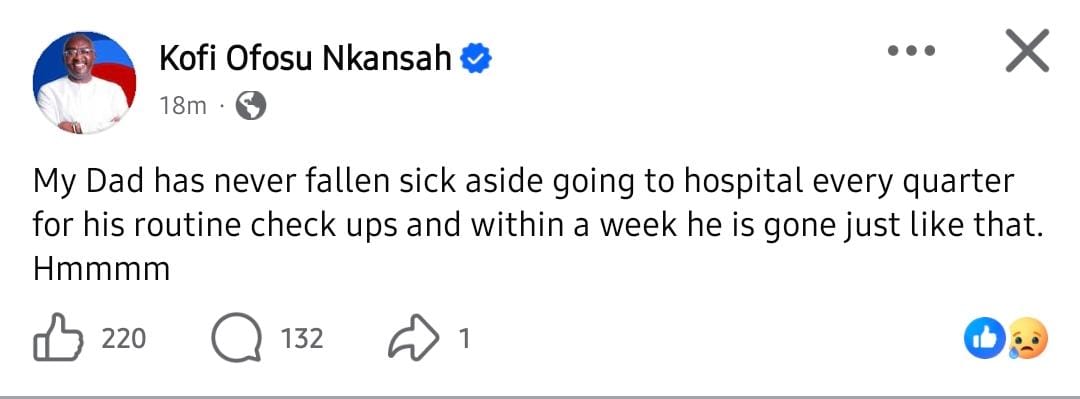
On Sunday morning, Mr. Nkansah shared on social media the sudden death of his father, describing it as an unexpected and shocking event.
In his own words, he wrote: “My Dad has never fallen sick aside going to hospital every quarter for his routine check-ups, and within a week he is gone just like that. Hmmmm.”
The loss comes on the heels of Mr. Nkansah’s highly publicized detention and investigation by the National Intelligence Bureau (NIB) now BNI over allegations he had made regarding the sale of government-funded overseas scholarships.
The former NEIP CEO had voluntarily presented himself to the NIB on February 5, 2026, to assist with the investigation following comments he made on Sompa Radio 106.5 FM.
He was later detained, his residence searched by heavily armed officers, and reportedly rushed to hospital while under NIB custody due to health concerns.
Mr. Nkansah was formally charged with publishing false information, and after mounting political pressure and public attention—including statements from the New Patriotic Party, the Minority Caucus in Parliament, and vocal legal advocacy—he was granted bail of GH¢500,000 on February 11, 2026.
His court appearance scheduled for February 12 was subsequently cancelled.
Throughout the ordeal, Mr. Nkansah had been balancing legal battles with personal responsibilities, including attending to his father, who had recently fallen ill.
Reports indicate that the former NEIP boss was in Kumasi when he received news of his father’s deteriorating condition, a situation made more emotionally taxing by the preceding days of detention and legal proceedings.
The political fallout of Mr. Nkansah’s arrest and investigation had already drawn national attention. The NPP condemned the NIB’s actions as politically motivated, describing them as harassment and abuse of state power.
Similarly, the Minority Caucus highlighted infringements on Mr. Nkansah’s rights, describing the search of his home and forced custody transfers as excessive and counterproductive to the democracy and rule of law.
Mr. Nkansah’s loss is now being mourned not only as a personal tragedy but also as a poignant reminder of the intense pressure and stress experienced during politically sensitive investigations in Ghana.
Observers note that the combination of legal battles, public scrutiny, and personal strain may have compounded the emotional toll on him and his family.