In what is shaping up to be one of the most consequential constitutional showdowns in recent Ghanaian history, five Supreme Court justices are set to determine the legality of the ongoing processes to remove Chief Justice Gertrude Torkornoo.
At the heart of the controversy is a legal suit filed by Member of Parliament for Old Tafo, Vincent Ekow Assafuah, challenging the constitutionality of President John Mahama’s handling of petitions for the CJ’s removal.
The Legal Crossroads
Assafuah’s injunction, filed in the Supreme Court, claims that President Mahama acted outside the bounds of constitutional procedure by forwarding petitions against the Chief Justice directly to the Council of State without first determining if a prima facie case existed.
According to Article 146(3) of the 1992 Constitution, the President must initially assess if the petitions warrant further action before involving the Council of State.
Assafuah is therefore seeking a declaration that Mahama’s actions are “null, void, and of no effect.”
Until the Court rules on this matter, the entire removal process remains in limbo.
The Petitions Against Chief Justice Torkornoo
Three separate petitions have been lodged against Chief Justice Torkornoo.
The most detailed among them comes from Daniel Ofori, a private citizen, who has submitted a 25-point dossier accusing the CJ of financial misappropriation, abuse of office, interference in high-profile judicial cases, and nepotistic administrative appointments.
Among Ofori’s claims is an allegation that the Chief Justice used GHS 261,890 of public funds on a private trip to the United States in 2023, accompanied by her husband and daughter—who, he argues, were not entitled to state-sponsored travel. He further alleges that over USD $30,000 was claimed as per diem on the same trip.
Additional accusations include unauthorized investigations into judicial IT systems, meddling in the criminal trial of Assin North MP Gyekye Quayson, and strategic appointments of loyalists to key judicial roles.
One of the earlier petitions also cited the CJ for making disparaging off-record remarks during proceedings and accused her of tampering with official transcripts—claims that amount to “misbehavior and incompetence,” according to the petitioner.
While the Council of State has not yet concluded its review of the petitions, the stakes are already high.
A recommendation for further investigation would allow the President to establish a formal committee of inquiry, during which the CJ could be suspended under Article 146(10).
Who Are the Judges on the Panel?
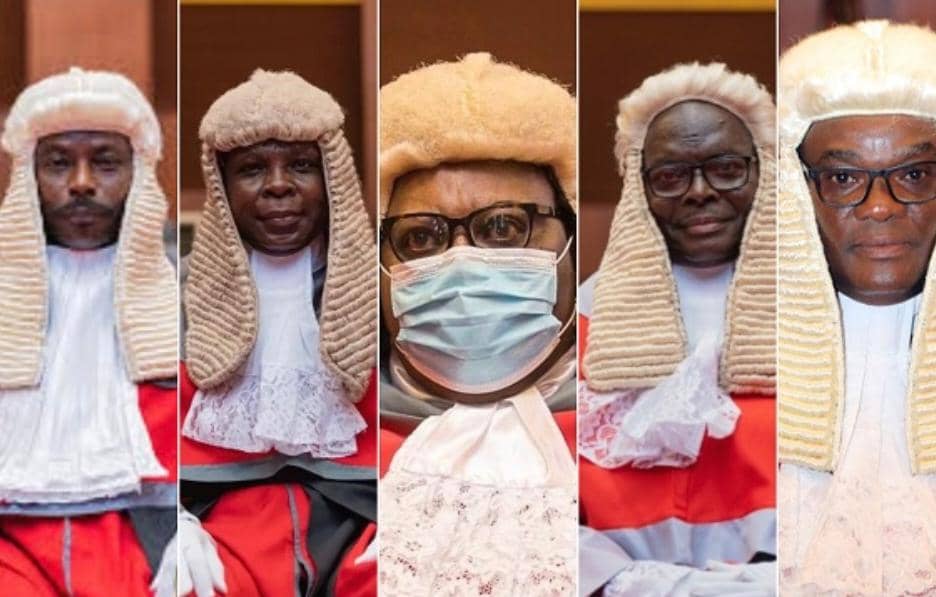
The Supreme Court panel that will rule on this constitutional challenge is chaired by Justice Prof. Henrietta Mensa-Bonsu and includes Justices Ernest Yao Gaewu, Richard Adjei-Frimpong, Yaw Darko Asare, and Samuel Kwame Adibu-Asiedu.
Here’s a closer look at the five justices entrusted with this politically sensitive case:
Justice Prof. Henrietta Mensa-Bonsu
Chairing the panel is the eminent Justice Henrietta Mensa-Bonsu, a respected legal academic and former United Nations panel member.
A professor at the University of Ghana School of Law and a former president of the Ghana Academy of Arts and Sciences, she was appointed to the Supreme Court by President Nana Akufo-Addo in 2020.
Justice Ernest Yao Gaewu
A former New Patriotic Party (NPP) parliamentary candidate, Justice Gaewu left active politics to become a High Court judge in 2020.
His elevation to the Supreme Court in 2023 was historic—marking the first direct appointment from the High Court to the apex bench in over four decades.
Justice Richard Adjei-Frimpong
Appointed to the Supreme Court in January 2024, Justice Adjei-Frimpong previously served on the Court of Appeal.
He has received several academic and patriotic service awards, including one for the best interpretation of deeds and statutes during his legal training.
Justice Yaw Darko Asare
Justice Asare, another recent Supreme Court appointee (January 2024), brings a wealth of private legal practice experience, having founded and led Beulah Chambers for 17 years.
He was also a guest lecturer at the University of Ghana’s law faculty and served as a Court of Appeal judge.
Justice Samuel Kwame Adibu-Asiedu
Justice Adibu-Asiedu ascended to the Supreme Court in December 2022 after serving in the High Court and Court of Appeal.
He also has academic experience, having taught at institutions such as Wisconsin University and the Ghana School of Law.
A Judiciary at a Crossroads
This case not only puts Chief Justice Torkornoo’s tenure on the line—it also tests the resilience of Ghana’s constitutional framework.
The judicial system now faces a critical moment: balancing accountability with judicial independence and institutional stability.
–BY Daniel Bampoe