
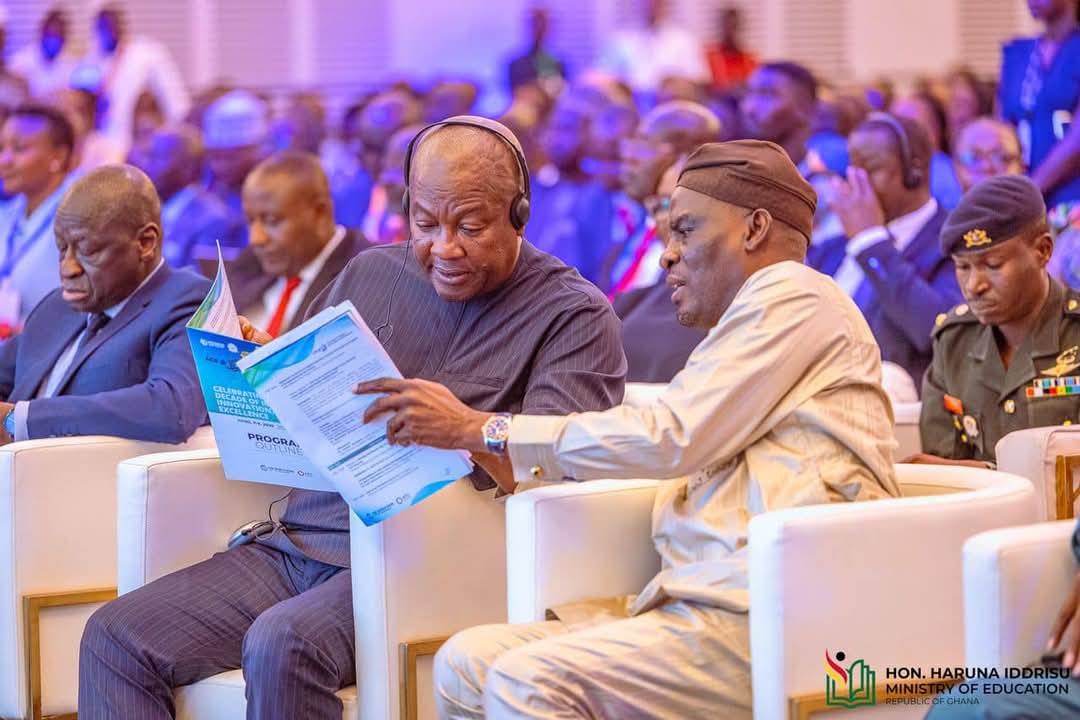
The National Democratic Congress (NDC) is facing increasing scrutiny over its shifting position on the double-track system used in the Senior High Schools (SHSs), as the Minister for Education, Haruna Iddrisu announces government can only phase out the system by 2027.
“We expect that by the year 2027, the double-track system will be a thing of the past,” Minister Iddrisu said during a meeting with the Conference of Heads of Assisted Secondary Schools (CHASS) in Sunyani.
He emphasized that the government’s goal is to return to a unified academic calendar through curriculum reforms and infrastructural expansion, backed by changes in how the Ghana Education Trust Fund (GETFund) is administered.
This pronouncement, however, sharply contradicts the NDC’s 2024 campaign pledge to abolish the system within just 100 days of taking office.
In their manifesto, the NDC promised a quick fix to double track, branding it as a sign of systemic failure in managing Free SHS.
“The next NDC government will review the Free SHS policy within 100 days, with top priority given to abolishing the double-track system,” the manifesto reads.
Sammy Gyamfi, National Communications Officer for the NDC, reinforced this stance in an interview on GTV in August 2024.
“The double-track system is detrimental to children’s education,” he said, blaming the NPP for inadequate infrastructure. Gyamfi claimed that President Mahama’s administration would “complete abandoned e-blocks, expand existing facilities, and use private SHS campuses” to end the system by January 2026.
But critics argue that the NDC’s position lacks practical grounding. Under the current transitional calendar, the double-track system—initially implemented in 2018 to manage surging enrolment under the Free SHS policy—has enabled schools to admit 50% more students using existing infrastructure.
Data shows that under this system, schools with 3,000 spaces now accommodate 4,500 students across three cohorts by rotating attendance.
Former GES Director-General, Prof Kwasi Opoku-Amankwa warned that “abolishing the double-track calendar will deny an estimated 1.8 million students access to free SHS and TVET education from 2025 to 2028.”
He added that contrary to popular belief, the system actually increases teacher-student contact hours—up to 162 hours more than the old trimester model—leading to improved WASSCE performance since 2020.
The NDC’s 100-day plan has sparked concern over whether the party has adequately accounted for these realities.
“Any attempt to tinker with the double track/transitional calendar without proper planning will collapse the entire Free SHS policy,” Opoku-Amankwa cautioned, highlighting the risk of eroding access for hundreds of thousands of students.
Meanwhile, the New Patriotic Party (NPP) maintains that infrastructure expansion and improved staffing have laid the foundation to gradually phase out the double-track system without disrupting access.
The NPP government has reportedly completed over 4,000 SHS infrastructure projects and recruited over 50,000 teaching and non-teaching staff since 2017.
Former Vice President Dr. Mahamudu Bawumia echoed this gradualist approach, pledging to “protect and enhance Free SHS while phasing out double track responsibly.”
He emphasized the NPP’s commitment to equity and access through continued investment, particularly in STEM and TVET.
With both major parties promising an end to double track—albeit on vastly different timelines and premises—the debate reflects deeper ideological divisions over how best to balance quality and access in Ghana’s educational future.
Yet, as critics point out, the NDC’s conflicting promises raise questions about whether their approach is policy or political posturing.
-BY Daniel Bampoe


