
BY Issah Olegor
A service disruption that affected subscribers of MTN Ghana across parts of the Greater Accra Region has triggered a broader debate about regulatory independence, following an unusual communication approach adopted by the National Communications Authority (NCA).
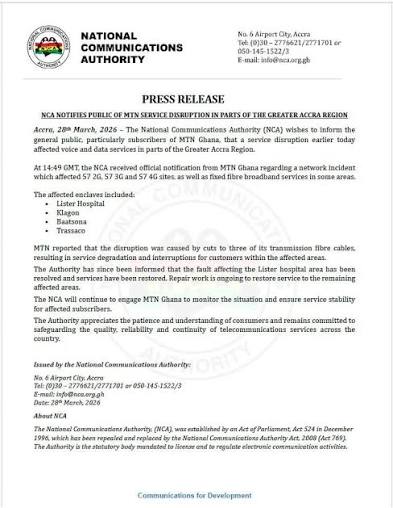
In a press release issued on March 28, 2026, the NCA—not MTN Ghana—took the lead in informing the public about a network failure that disrupted voice, data, and fibre broadband services in several areas.
According to the Authority, the outage, which was reported at approximately 14:49 GMT, impacted 57 sites each across 2G, 3G, and 4G networks, affecting communities including Lister Hospital, Klagon, Baatsona, and Trassaco.
The regulator attributed the disruption to cuts in three of MTN’s transmission fibre cables, which resulted in service degradation for customers in the affected enclaves.
While the NCA confirmed that services around the Lister Hospital area had been restored, it noted that repair works were ongoing in other locations, with continued engagement between the Authority and MTN Ghana to stabilise the network.
However, beyond the technical details of the outage, it is the NCA’s decision to assume the role of primary communicator that has raised eyebrows among industry observers.
Traditionally, in a well-structured telecommunications ecosystem, the service provider is expected to promptly communicate directly with its customers during service interruptions, offering updates, explanations, and timelines for restoration.
The NCA’s proactive communication—while informative—has sparked concerns that the regulator may be stepping beyond its supervisory mandate. Analysts argue that by taking centre stage in public messaging, the Authority risks blurring the line between regulator and operator, potentially undermining its neutrality.
This development has reignited longstanding concerns about regulatory independence in Ghana’s telecommunications sector. Established under the National Communications Authority Act, 2008 (Act 769), the NCA is mandated to license, regulate, and ensure fair competition among electronic communications providers.
Central to this mandate is the expectation that the Authority acts as an impartial overseer, enforcing accountability rather than appearing to shield or represent operators.
Critics suggest that the current situation creates a perception of regulatory bias—or worse, regulatory capture—where the regulator appears aligned with the interests of the entity it is supposed to oversee.
The relative silence from MTN Ghana during the outage, contrasted with the NCA’s detailed public updates, has further deepened these concerns.
Questions are now being raised about whether MTN Ghana was instructed to withhold its own communication, or whether the situation reflects a deeper lapse in communication protocols within the sector.
The absence of direct engagement from the telecom operator has left many subscribers without the usual customer-facing reassurances expected during such disruptions.
They warn that failure by the NCA to clarify its role in this incident could erode public trust in the institution’s credibility. Transparency in both regulatory conduct and corporate communication, they argue, is essential to maintaining confidence in the rapidly evolving digital infrastructure.