By Issah Olegor
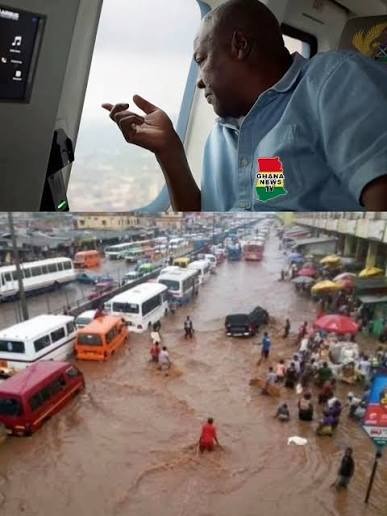
The Mahama administration is facing mounting criticism over its handling of Accra’s recurring flooding crisis, with political opponents questioning the effectiveness of the government’s anti-flood strategy after President John Dramani Mahama conducted an aerial inspection of flood-ravaged communities and subsequently ordered emergency relief for victims.
The criticism comes in the wake of one of the capital’s worst flooding incidents in recent years, which left at least 12 people dead, displaced hundreds of residents, destroyed homes and businesses, and brought economic activities to a standstill across several parts of the Greater Accra Region.
Following the disaster, President Mahama boarded a military helicopter to assess the extent of destruction from the air before directing Finance Minister Dr. Cassiel Ato Forson to release GHC300 million from the Contingency Fund to support victims through the National Disaster Management Organisation (NADMO).
The President later praised emergency responders, including the Ghana National Fire Service, the Ghana Police Service, the Ghana Armed Forces and NADMO, for rescuing stranded residents and announced plans to demolish structures obstructing waterways while pursuing long-term measures to address Accra’s perennial flooding.
However, the government’s response has drawn sharp criticism from opposition members, who argue that the administration has focused more on assessing the disaster than on implementing preventive measures before the rains intensified.
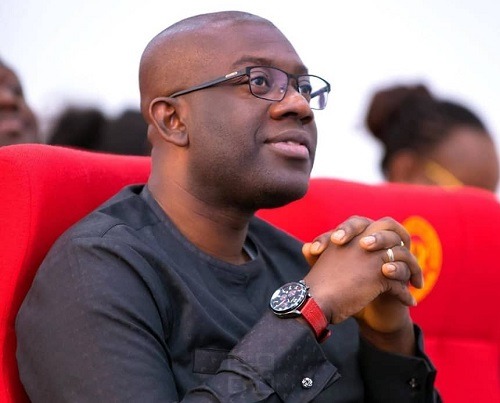
Leading the criticism is Dennis Miracles Aboagye, Director of Communications for the 2024 Bawumia Campaign, who questioned whether the President’s aerial inspection would translate into immediate action to protect lives during the ongoing rainy season.
In a public statement, Aboagye acknowledged the President’s decision to inspect the flood situation from the air but argued that Ghanaians now require practical interventions rather than expressions of sympathy.
“Mr. President was in the air yesterday checking on us and verifying whether indeed we have been flooded the way he was seeing and reading in the news. Fair deal,” he wrote.
According to him, the more pressing concern is what decisions the government intends to take as further rainfall is forecast.
He therefore called on President Mahama to immediately convene an emergency Cabinet meeting to adopt concrete measures capable of reducing the impact of additional rainfall expected in the coming days.
“Can we know the time for the emergency Cabinet meeting today to take specific, clear-cut decisions in ensuring the rains coming today and the day after today will not take our lives away?” he questioned.
Aboagye further challenged the President to publicly disclose the recommendations presented by the government’s anti-flood technical committee headed by Stan Dogbe following the aerial inspection.
He argued that residents deserve to know what solutions have been proposed to prevent another humanitarian disaster.
“Can you kindly describe what you saw from the chopper and, based on the brief you have received from the anti-flood technical committee, what their solutions are in ensuring we would not lose our lives again in the coming days,” he stated.
The opposition communicator maintained that flooding is no longer confined to isolated communities but has become a city-wide crisis affecting nearly every part of Accra.
According to him, each episode of heavy rainfall now expands the list of affected communities, with floodwaters moving from one neighbourhood to another as storms persist.
“The floods are wiping away the capital city. Not just a few. The entire city is under siege. Every day of rain in Accra sees a new neighbourhood flooding in addition to the existing list,” he argued.
He stressed that while expressions of empathy for flood victims are appreciated, they cannot substitute for decisive action.
“Solutions—that’s what we need now, sir. Not assurances, not commiserations, not empathy,” he wrote.
Aboagye also expressed concern that the worst of the rainy season may still lie ahead, warning that many residents remain fearful as dark clouds continue to gather over the capital.
He urged the President to outline immediate interventions capable of protecting lives during subsequent rainfall events rather than focusing solely on long-term plans.
“Tell us what you are going to do to protect us today, not the future. Today’s rain must be survived first,” he appealed.
Meanwhile, policy commentator P.K. Sarpong has questioned why the President only instructed the release of emergency funds after the flooding had already caused widespread destruction.
According to him, the directive suggests that ministries responsible for flood prevention may not have received adequate funding before the disaster.
He argued that several government projects have reportedly stalled because ministries have struggled to access budgeted allocations from the Ministry of Finance.
Sarpong alleged that Finance Minister Dr. Cassiel Ato Forson has delayed the release of funds needed by ministries to execute critical projects, including interventions aimed at reducing the impact of flooding.
“Why should President Mahama wait till floods cause mayhem before asking Ato Forson to release funds for works aimed at minimising the impacts of floods going forward?” he questioned.
He further claimed that ministers have privately expressed frustration over delays in the release of budgetary allocations, resulting in stalled projects across several sectors.
According to Sarpong, government should have prioritised preventive investment before the onset of the rainy season instead of responding only after lives had been lost.
He also criticised what he described as an excessive emphasis on maintaining macroeconomic stability at the expense of funding critical public infrastructure.
“What is the essence of embarking on policies that bring inflation down and keep the cedi strengthened if that can lead to citizens perishing because of floods?” he asked.
The criticisms come as government continues emergency relief operations for affected residents while promising both immediate and long-term interventions.
President Mahama has attributed the flooding to a combination of unusually heavy rainfall, climate change, illegal construction on waterways, poor drainage infrastructure and indiscriminate dumping of refuse.
He has also announced plans to demolish structures obstructing waterways, improve drainage systems and develop a new city outside Accra to reduce population pressure on the capital.
Despite those assurances, opposition figures insist that the immediate priority should be protecting lives during the current rainy season through rapid implementation of flood mitigation measures.