BY Issah Olegor
The foreign exchange market has once again returned to the centre of national debate as the Ghana Cedi continues to fight off renewed depreciation pressures.
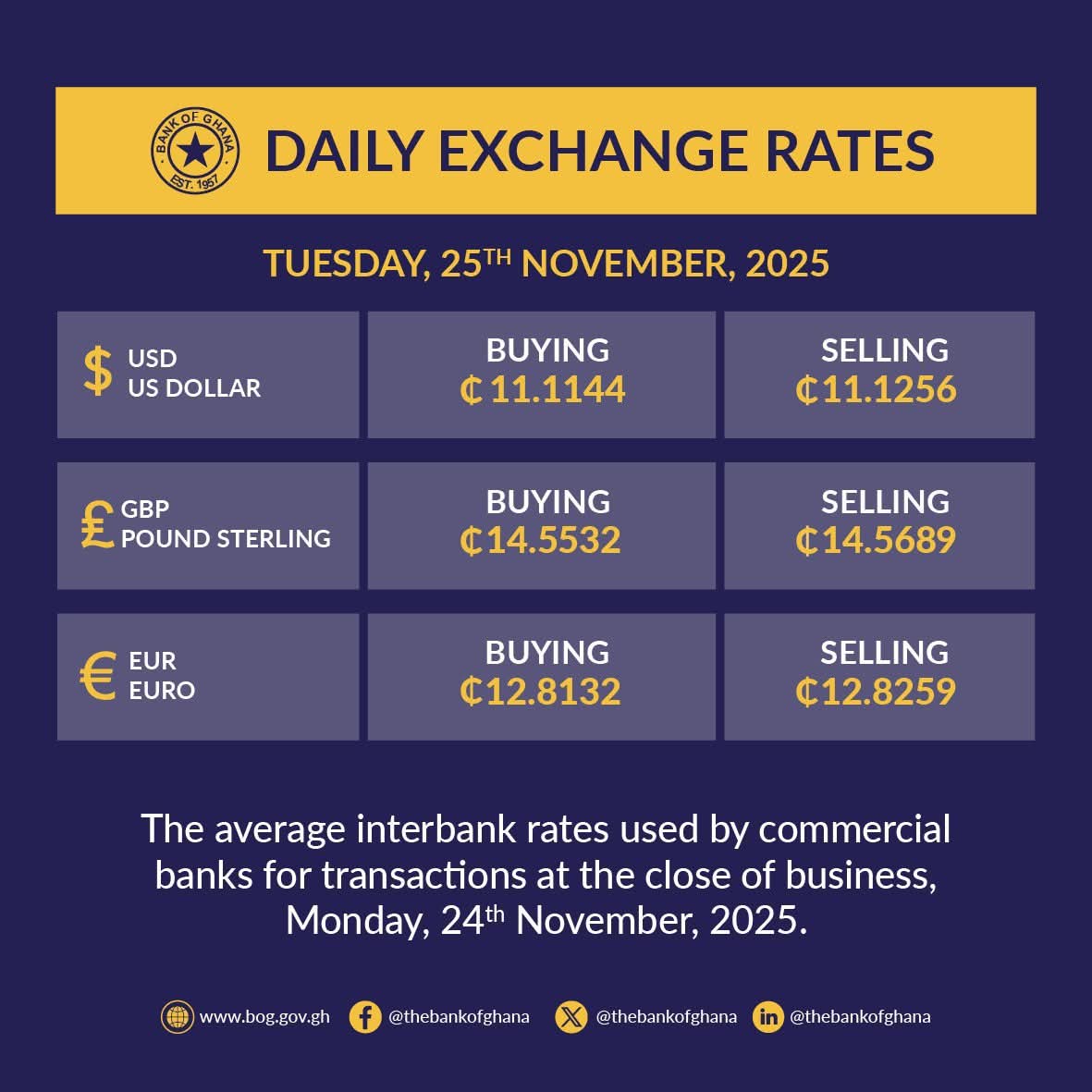
Fresh daily figures released by the Bank of Ghana on Tuesday, November 25, 2025, show the local currency trading at GH¢11.11 buying and GH¢11.12 selling to the US dollar, while the pound sterling traded at GH¢14.55 buying and GH¢14.56 selling.
The euro, similarly, closed Monday’s interbank session at GH¢12.81 buying and GH¢12.82 selling.
Although the Cedi has not experienced a major fall in recent weeks, economic analysts say the stability remains fragile—propped up largely by short-term interventions, including periodic dollar injections by the central bank.
The Bank of Ghana insists these injections are aimed at providing liquidity and smoothing volatility, but many Ghanaians continue to question the sustainability of these measures.
This debate intensified after comments on government’s foreign-exchange spending resurfaced, particularly suggestions that billions have been spent over the years in attempts to “stabilise” the Ghana Cedi—raising public frustration about the real impact of such interventions.
Some citizens have sarcastically questioned whether the “dollar is being employed more than the youth,” a reaction to anecdotes around the cost of maintaining exchange rate stability.
The conversation gained further national attention last month during the launch of the Cedi@60 celebration, where Finance Minister Dr. Cassiel Ato Forson insisted that government remains committed to protecting the value of the Cedi.
Speaking at the Accra International Conference Centre, he described the 60th anniversary of Ghana’s currency as a “new dawn” in the country’s journey to economic resilience and monetary sovereignty.
“For 60 years, through inflation, devaluation and recovery, the Cedi has endured,” he said. “Our commitment to fiscal discipline has contributed to its strengthening… we shall stay the course to ensure that the Ghana Cedi remains stable.”
The minister cautioned businesses and individuals against the habitual quoting of prices in foreign currencies—especially the US dollar—arguing that such practices undermine confidence in the Cedi and distort local market structures.
He stressed that maintaining currency stability is not the sole responsibility of government or the central bank but also a civic duty of every Ghanaian.
The Cedi@60 commemoration, themed “60 Years of the Cedi: A Symbol of Sovereignty, Stability and Economic Resilience,” comes at a time when public scrutiny of the currency’s performance is at an all-time high. Ghana has endured years of exchange rate instability, driven by global shocks, rising import bills, and domestic fiscal pressures. Even though recent reforms and IMF-supported programmes have slowed the rate of depreciation, many citizens remain doubtful, linking the temporary stability to constant central bank intervention rather than real economic transformation.
Market observers warn that unless sustainable, long-term strategies—including improved export earnings, stronger fiscal discipline, and reduced dependence on imports—are aggressively pursued, the Cedi may continue to rely on emergency measures such as dollar injections, which come at high cost to the state.