
BY Daniel Bampoe
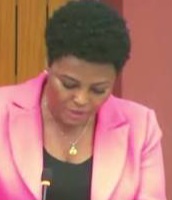
The debate on the 2026 Budget Statement and Economic Policy took a fiery turn when the Member of Parliament for Ayensuano, Ida Adjoa Asiedu, launched a scathing critique of the Mahama administration over what she described as weak commitments to human rights, women’s empowerment, and job creation.
Addressing Parliament during the budget debate, the MP said the government’s promises—particularly the yet-to-be-implemented Women’s Development Bank—had become symbols of “rhetoric without results.”
Debate
Human rights allocations in the annual budget have long been a contentious issue, often raising questions about whether government commitments match constitutional obligations and international treaties.
The 1992 Constitution guarantees fundamental human rights in Articles 12 to 33, while the country is also bound by the African Charter on Human and Peoples’ Rights and the Universal Declaration of Human Rights.
Under the previous New Patriotic Party (NPP) government, several policies—such as steps toward an Affirmative Action Bill, skills training for women, and financial inclusion programmes—were introduced to expand opportunities for women and rural communities.
The current administration, however, has positioned itself as even more “gender-responsive,” with President Mahama promising a 30% female representation in his appointments and unveiling a proposal to establish a Women’s Development Bank.
But according to Ida Asiedu, these commitments remain largely unfulfilled.
Where Is the Women’s Development Bank?
The Ayensuano MP questioned the government’s sincerity regarding its flagship gender initiative—the Women’s Development Bank—announced in President Mahama’s maiden State of the Nation Address in February.
The bank, meant to provide low-interest loans and dedicated financial support to women-led small and medium enterprises, was expected to begin operations within the President’s first 120 days.
The 2025 budget allocated GH¢51 million as seed capital for the project. Nine months later, the MP argued, there is no clarity on whether the institution exists beyond paper.
Yet the 2026 budget assigns an additional GH¢400 million to the same project.
“On paper it looks great,” she told Parliament, “but implementation is what matters. Ghanaian women want answers, not headline allocations.”
Stagnant Funding for Menstrual Hygiene
The MP also highlighted what she called another example of stagnation in women-centered policies: the allocation for menstrual hygiene. In 2025, GH¢292 million was used to provide sanitary pads to 1.3 million schoolgirls at the basic level.
The allocation remains unchanged for 2026.
Calling menstrual health a “fundamental right that determines whether a girl stays in school or drops out,” she argued that the policy must be expanded to cover senior high school students if the country is serious about eliminating period poverty.
Domestic Violence Fund: “An Insult Wrapped in Statistics”
Ida Adjoa Asiedu reserved her harshest criticism for the Domestic Violence Fund, which received a GH¢337,500 allocation in 2025 and has now been raised to GH¢1 million in 2026.
Though the increase represents a 196% rise, she described it as a “shameful figure” considering the magnitude of domestic abuse in the country.
The MP referenced 2024 DOVVSU records showing over 14,000 domestic violence cases—and noted that the actual figure is likely above 50,000 given that 71% of sexual violence survivors never report incidents.
She broke down the numbers to Parliament: GH¢1 million divided by 14,000 victims = GH¢71 per case.
If the real number exceeds 50,000, then government support amounts to roughly GH¢20 per victim.
“Is that what the life of a battered woman is worth in Ghana?” she asked. “Less than a bag of cement? Less than an olonka of gari?”
She further noted that a single 30-bed shelter costs between GH¢8–12 million to build and at least GH¢4 million annually to run—making the GH¢1 million allocation “totally meaningless.”
The Minority is calling for GH¢50 million to be ring-fenced yearly to support at least 10 shelters nationwide, fund crisis hotlines, enhance prosecution, expand public education, and build a credible data system for gender-based violence.
Unfulfilled Job Creation Promises
Switching to economic rights, the Ayensuano MP argued that the right to work—protected under global human rights conventions—is being undermined by the government’s unfulfilled job creation promises.
She questioned the impact of several NDC flagship initiatives, including: the “Nkoko Nketeke” programme, the coders training programme, the 24-hour economy and the “Big Push” infrastructure agenda.
According to her, the youth continue to face unemployment and frustration despite the repeated assurances.
The 2026 Budget announces plans to create 800,000 additional jobs through garment production, agro-processing, the Integrated Oil Palm Development Programme, and the Big Push initiative.
But the MP insisted that without immediate and visible implementation, these promises will remain “paper pledges.”
A Call For Accountability
The Ayensuano MP, Ida Adjoa Asiedu concluded her submission with a forceful appeal for Parliament to hold the executive accountable.
“History will judge this House not by the speeches we make, but by the silences we keep when women scream for help,” she said. “Increase the Domestic Violence Fund or admit you do not care.”


