
By Daniel Bampoe
A high-level delegation from the Eastern Region to the seat of government unintentionally reignited deep-seated tensions over the leadership of the Kwahu Traditional Area, raising fresh concerns about legitimacy, representation, and the state of chieftaincy governance.
On Wednesday, April 22, 2026, a delegation led by the Eastern Regional House of Chiefs, accompanied by Eastern Regional Minister Rita Akosua Adjei Awatey, paid a courtesy call on President John Dramani Mahama at the Jubilee House.
The meeting focused on key developmental priorities and traditional governance matters affecting the region, and was widely seen as a symbol of cooperation between the state and traditional authorities.
However, beyond the official agenda, the visit has triggered an unexpected wave of debate—particularly among the people of Kwahu—over a question that has lingered for months: who truly represents Kwahu?
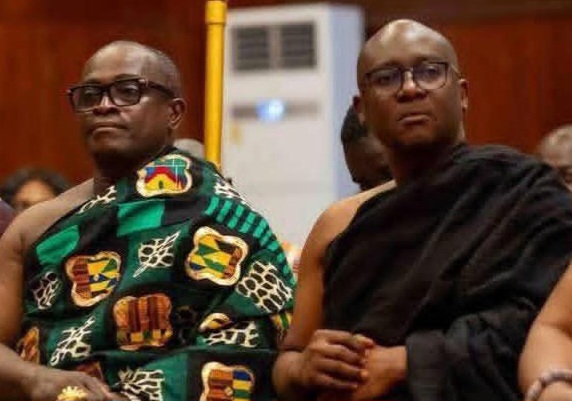
At the center of the controversy was the appearance of Daasebre Akuamoah Agyapong II, who was seen representing Kwahuman during the engagement.
His presence has left many residents and indigenes puzzled, especially as others had anticipated that Daasebre Akuamoah Boateng III would occupy that role instead.
Across Kwahu communities and social platforms, the reaction has been swift and pointed. Residents are openly asking why Daasebre Akuamoah Agyapong II was chosen to represent the area, what the current status of the chieftaincy dispute is, and why his rival was not present in a similar capacity.
For many, the issue is not merely about attendance at a state function—it reflects deeper concerns about identity, authority, and the integrity of traditional leadership.
The unease is rooted in a protracted chieftaincy dispute that has plagued the Kwahu Traditional Area since late 2024.
The conflict intensified following the purported destoolment of Daasebre Akuamoah Agyapong II by some kingmakers—an action he and his supporters have consistently challenged as unlawful and procedurally flawed.
Subsequent legal battles saw the High Court in Koforidua intervene, granting injunctions that restrained rival figures from presenting themselves as leaders or interfering with the operations of the Kwahu Traditional Council.
The Judicial Committee of the Eastern Regional House of Chiefs also issued directives aimed at preserving order, including preventing parallel claims to the stool while petitions were under consideration.
Despite these rulings, the dispute has remained unresolved on the ground. Competing factions continue to assert legitimacy, creating an atmosphere where representation at national events—such as the Jubilee House meeting—carries significant symbolic and political weight.
Some observers interpret Daasebre Akuamoah Agyapong II’s presence at the Presidency as an indication of recognition by certain state or traditional structures.
Others argue that the continued contestation suggests the matter is far from settled, and that such appearances risk deepening divisions if not clearly explained.
There are also growing concerns about the lack of consistent communication to the people of Kwahu.
In the absence of authoritative updates, speculation has flourished, with each public move by either faction interpreted as a shift in legitimacy or endorsement.


