By Issah Olegor
A fresh controversy has erupted around the Human Sexual Rights and Family Values Bill, 2025, after Minority Leader and Effutu Member of Parliament, Alexander Afenyo-Markin, distanced himself from a viral social media post that appeared to criticise the legislation recently passed by Parliament.
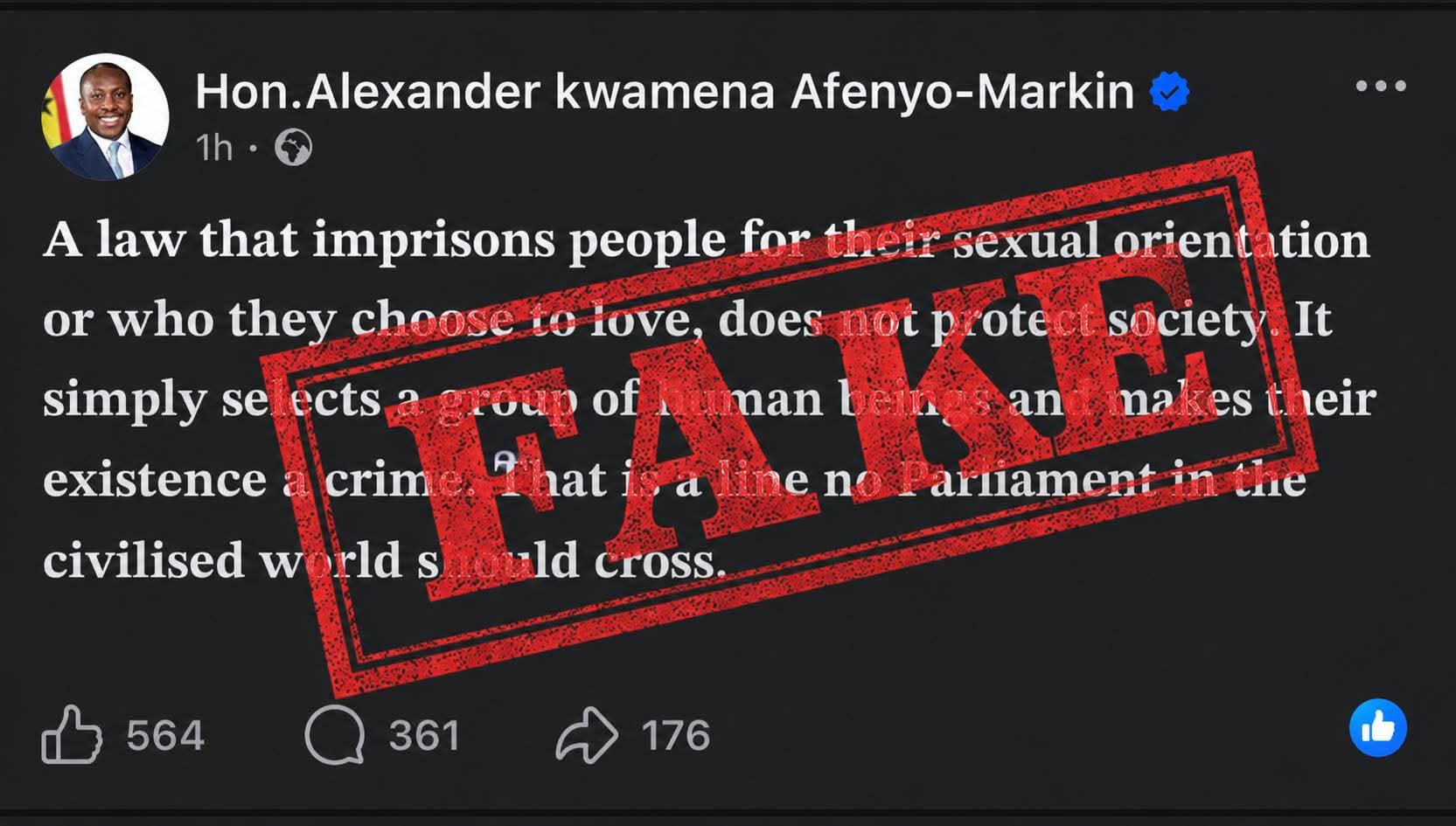
The post, which spread rapidly across social media platforms on Tuesday, portrayed the Minority Leader as opposing the controversial bill, popularly known as the Anti-LGBTQ Bill. In the statement, attributed to Afenyo-Markin, the writer argued that laws should not criminalise individuals based on their sexual orientation or personal relationships.
“A law that imprisons people for their sexual orientation or who they choose to love does not protect society. It simply selects a group of human beings and makes their existence a crime. That is a line no Parliament in the civilised world should cross,” the viral post stated.
The comments quickly generated widespread public reaction, particularly because Afenyo-Markin leads the Minority Caucus in Parliament, where several members have actively supported the Human Sexual Rights and Family Values Bill.
Screenshots of the post circulated extensively online, sparking intense debate among supporters and opponents of the legislation.
However, shortly after the post gained traction, it was deleted from the platform. A new message subsequently appeared on Afenyo-Markin’s official Facebook page, disassociating him from the publication.
“Kindly disregard this post. Account was compromised,” the Minority Leader wrote, suggesting that his social media account had been accessed without authorization.
The clarification has added another layer of intrigue to the already contentious debate surrounding the bill, which remains one of the most discussed pieces of legislation in the recent political history.
The Human Sexual Rights and Family Values Bill was originally introduced in Parliament in 2021 as a bipartisan private member’s bill sponsored by lawmakers from both the New Patriotic Party (NPP) and the National Democratic Congress (NDC).
Supporters argued that the legislation was necessary to strengthen existing laws and protect what they describe as the cultural, religious and family values.
After years of public consultations, parliamentary debates and committee reviews, Parliament first passed the bill in February 2024. However, legal challenges filed at the Supreme Court prevented presidential assent before the dissolution of the Eighth Parliament, causing the legislation to lapse.
The bill was subsequently reintroduced in the Ninth Parliament and passed again on May 29, 2026, albeit with several amendments that sparked fierce disagreement between the Majority and some sponsors of the legislation.
Among the amendments approved by Parliament were exemptions protecting lawyers who provide legal representation to LGBTQ persons, journalists and media houses reporting on LGBTQ-related issues, and healthcare professionals offering medical, surgical, psychological and counselling services.
The amendments were strongly opposed by some sponsors of the bill, including Assin South MP Rev. John Ntim Fordjour and Bosome Freho MP Nana Asafo-Adjei Ayeh, who argued that the changes weakened the original objectives of the legislation and created loopholes that could undermine its effectiveness.
The bill’s passage has since attracted additional scrutiny following intervention by Speaker of Parliament Alban Bagbin, who raised concerns about whether parliamentary procedures were fully complied with during the final stages of consideration and passage.
The Speaker subsequently called for Parliament to revisit the legislation to ensure adherence to Standing Orders and preserve bipartisan consensus.
Meanwhile, the legislation continues to divide public opinion across Ghana and beyond. Religious organizations, traditional authorities and conservative groups have welcomed the bill as a necessary measure to safeguard societal values, while human rights advocates, legal experts and international organizations have expressed concerns about its implications for constitutional freedoms and human rights.
Against this backdrop, the viral post attributed to Afenyo-Markin briefly fueled speculation about divisions within the political establishment over the legislation.
His subsequent denial and claim that his account had been compromised have, however, shifted attention to concerns about social media security and misinformation in the midst of one of the most sensitive public policy debates.