By Daniel Bampoe
Accra’s perennial flooding problem is no longer merely a consequence of heavy rainfall but the result of decades of poor urban planning, environmental degradation, weak enforcement of regulations, and unsustainable development practices, according to the Ghana Institution of Engineers (GhIE).
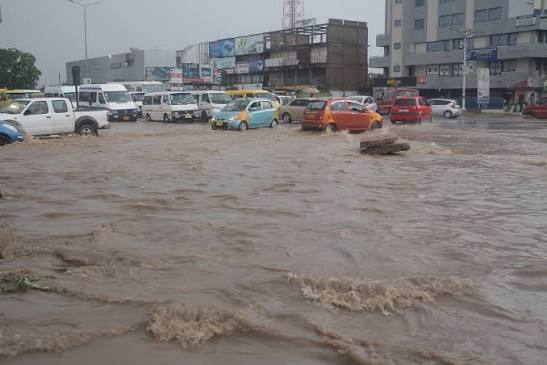
The warning comes as parts of the capital continue to grapple with the aftermath of recent floods that inundated several communities, displaced residents, disrupted transportation, and reignited public debate over the effectiveness of the flood management strategies.
Speaking on Joy FM’s Super Morning Show on Thursday, June 4, 2026, President of the Ghana Institution of Engineers, Ing. Ludwig Annang Hesse, described Accra’s worsening flooding situation as largely saelf-inflicted, arguing that the city has systematically destroyed its natural flood-control systems over several decades.
According to him, flooding in Accra has become so predictable that residents no longer require warnings to anticipate its occurrence.
“These days, we do not need a prophet to tell us that when it rains, Accra will flood,” he remarked.
He noted that while flooding was once an occasional phenomenon occurring every five, ten or even twenty years, it has now become an annual reality affecting communities across the capital.
Ing. Hesse attributed the growing crisis to years of unregulated urban expansion, encroachment on wetlands, and the destruction of natural water-retention areas that historically absorbed excess rainwater before it reached the city.
For more than three decades, he explained, development has increasingly taken place in low-lying areas, waterways, and natural flood basins that should have remained protected.
According to the GhIE President, the consequences have been profound. Rainwater that previously took several hours to travel from the Akuapem Ridge through areas such as Aburi into Accra now reaches the city in a fraction of the time due to the disappearance of natural barriers and retention systems.
“Water that once took about 12 hours to travel from Aburi to Accra now takes roughly an hour,” he stated, warning that the city’s ability to manage stormwater has been severely compromised.
He stressed that nearly all of Accra’s natural water-retention zones have been altered or destroyed through construction activities, significantly reducing the environment’s capacity to absorb excess rainfall.
The latest floods have once again highlighted the broader climate resilience challenges facing the rapidly growing urban centres.
Climate experts have repeatedly warned that increasingly intense rainfall patterns linked to climate change are placing additional pressure on urban infrastructure that was not designed to accommodate such volumes of water.
However, Ing. Hesse argued that climate change alone cannot explain Accra’s recurring flood disasters.
He identified indiscriminate waste disposal as another major contributor to the crisis, noting that drainage systems across the city remain heavily clogged with silt, plastic waste, and other refuse.
“The drainage channels downstream, which are already operating beyond capacity, are filled with rubbish, silt and plastic waste,” he said.
The situation is further compounded by continued development in critical flood-prone areas, including wetlands and water-retention basins around communities such as Sakumono, Teshie and Korle.
According to him, these natural ecosystems serve as essential buffers against flooding, yet they continue to be reclaimed for residential, commercial and industrial projects.
“If we continue on this path, we are heading towards a disaster,” he cautioned.
The engineer also questioned the effectiveness of Ghana’s long-standing approach to flood control, arguing that successive governments have focused primarily on downstream engineering solutions such as expanding drainage channels while neglecting the root causes of flooding.
Over the years, substantial public resources have been invested in drainage expansion projects across Accra.
Yet flooding continues to worsen because the natural systems designed to slow, store and absorb water have been eliminated.
As a result, he is advocating a fundamental shift towards what engineers describe as upstream flood management.
Rather than relying solely on larger drains to transport water away, Ing. Hesse believes future flood management strategies should prioritize retaining rainwater close to where it falls.
He proposed measures that would encourage households and property owners to temporarily store rainwater and release it gradually after peak rainfall periods have passed, thereby reducing pressure on the city’s drainage network.
While acknowledging that such interventions would require significant planning, public education and regulatory reforms, he described them as among the few remaining long-term solutions available.
Meanwhile, the Ghana Institution of Engineers has announced plans to strengthen its role in national infrastructure accountability.
Ing. Hesse disclosed that the Institution is currently consulting engineers from various disciplines to develop a unified position on the recurring flooding and infrastructure challenges.
The Institution is also preparing to launch the second edition of its Infrastructure Report Card before the end of June.
The report will assess the condition of critical infrastructure nationwide and identify sectors requiring urgent intervention.
In addition, GhIE is developing a new monitoring framework that will periodically evaluate whether governments are delivering on promises related to engineering projects, flood-control systems, drainage infrastructure and other public works.
According to Ing. Hesse, the proposed accountability platform will provide independent assessments of infrastructure commitments and help ensure that public officials remain accountable for development promises.
The initiative comes at a time of growing public frustration over recurring floods, despite decades of investments in drainage projects and urban flood mitigation programmes.