By Issah Olegor
The government is preparing to begin salary deductions from thousands of public sector workers who have failed to repay student loans obtained from the Student Loan Trust Fund (SLTF), in a move aimed at strengthening loan recovery and ensuring the long-term sustainability of tertiary education financing in Ghana.
The Controller and Accountant-General, Kwasi Agyei, has revealed that approximately 4,000 public sector employees currently on the government payroll have outstanding loan obligations owed to the Student Loan Trust Fund.
According to him, the Controller and Accountant-General’s Department is collaborating closely with the Student Loan Trust Fund to identify affected beneficiaries and implement a structured recovery mechanism through deductions from their monthly salaries.
The initiative forms part of broader efforts by government and education financing institutions to improve loan repayment rates and make more resources available for future generations of students seeking financial support for higher education.
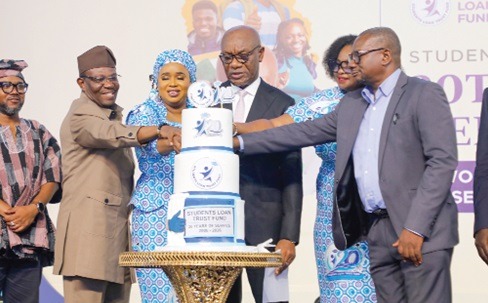
Speaking at the launch of activities marking the 20th anniversary of the Student Loan Trust Fund on June 18, 2026, Agyei emphasized that the exercise would be carried out within the framework of existing laws and regulations governing payroll administration in the public sector.
He explained that extensive data matching between the Controller and Accountant-General’s Department and the Student Loan Trust Fund had already identified thousands of beneficiaries who remain indebted despite being gainfully employed within the public service.
“We have already identified over 4,000 on the government payroll through the collaboration with the Trust Fund. In the coming days, we will engage with the Trust Fund on the modalities of implementing these deductions. We envisage that this deduction will become one of the important statutory sanctions on their salaries,” he stated.
According to Agyei, the planned deductions are expected to enhance compliance among loan beneficiaries while improving the financial sustainability of the student loan scheme.
The Student Loan Trust Fund was established to provide financial assistance to students pursuing tertiary education, particularly those who may face challenges funding their academic programmes.
Since its establishment two decades ago, the Fund has become one of the most important sources of educational financing for thousands of Ghanaian students attending universities, technical universities and other tertiary institutions.
However, like many student loan schemes globally, the Fund has faced challenges with loan recovery, often affecting its ability to expand support to new beneficiaries.
Education financing experts have long argued that effective repayment systems are critical to the sustainability of revolving student loan programmes because repayments from former beneficiaries help finance loans for future students.
The latest recovery initiative is therefore being viewed as an important step toward strengthening the Fund’s financial base and ensuring that resources remain available for generations of students.
The announcement came as the Student Loan Trust Fund celebrated its 20th anniversary, a milestone that provided an opportunity for stakeholders to assess the impact of the scheme and discuss strategies for improving access to tertiary education financing.
At the same event, the Chief Executive Officer of the Student Loan Trust Fund, Dr. Saajida Shiraz, announced a significant expansion in support for students across the country.
According to her, the Fund has increased access to its regular student loan package by 50 percent, allowing a greater number of students to benefit from financial assistance.
She attributed the achievement largely to the timely release of funds from the Ghana Education Trust Fund (GETFund), which has enabled the Student Loan Trust Fund to significantly improve its operations and support more students.
Dr. Shiraz disclosed that the Fund has so far disbursed more than GH¢127 million to over 46,000 students nationwide.
She further indicated that, for the first time, all eligible loan requests received by the Fund had been fully honoured, marking a major milestone in efforts to improve access to tertiary education financing.
The increase in disbursements is expected to provide relief for thousands of students and families facing the rising cost of higher education.