By Issah Olegor
The Minister for Local Government, Chieftaincy and Religious Affairs, Ahmed Ibrahim, has announced that the government has constituted a multi-sectoral committee to compile a comprehensive national database of shrines and other religious sites across Ghana.
The initiative is intended to determine the actual number of shrines in the country while establishing a clear and nationally accepted definition of what constitutes a shrine.
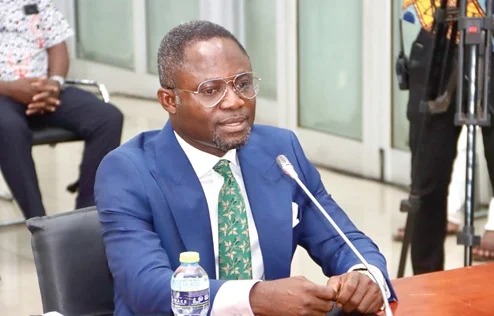
The minister made the disclosure when he appeared before Parliament’s Committee on Assurances, where he explained that the exercise forms part of efforts by the ministry to improve the regulation and understanding of religious institutions and traditional worship centres across the country.
According to him, the database will serve as a reliable reference for policy formulation and the administration of matters relating to chieftaincy and religious affairs.
Ibrahim explained that the working group comprises officials from the Chieftaincy and Religious Affairs Directorate, the Policy, Planning, Monitoring and Evaluation Directorate, as well as the Research, Statistics and Information Management Directorate.
The committee will also work closely with the country’s Regional Coordinating Councils to gather information from all parts of Ghana.
“Honourable Chair, the Minister for Local Government, Chieftaincy and Religious Affairs has set up a working group comprising officers from the Chieftaincy and Religious Affairs, Policy, Planning, Monitoring and Evaluation, Research, Statistics and Information Management Directorates to create the database on shrines and other religious sites in the country,” he told the committee.
The minister noted that identifying and counting shrines is far more complicated than it may appear because shrines exist in different forms and are deeply rooted in spiritual beliefs.
He stressed that there is currently no universally accepted standard for defining a shrine, making the work of the committee essential.
“This is simply because a shrine is not just one thing. Even as we sit here, if I want to count a shrine, I need to be given the power. When I see you, I’ll remove your shirt and check you and do a body check. So clearly it is not simple and straightforward,” Mr. Ibrahim explained.
He further indicated that some individuals in various communities claim to operate shrines without any clear basis, making it necessary for government to develop guidelines that distinguish genuine shrines from other forms of religious practice.
“You go to certain communities, and somebody will come there and say he has a shrine and maybe begin to be doing things. No, that is another form of religion, but we are in charge of religion,” he stated.
According to the minister, the committee’s work will provide the legal, administrative and policy foundation needed to define shrines in a manner that reflects both their traditional and spiritual significance.
“The nature of shrines will have to be agreed on. That is why a committee with expertise has been put in place,” he said.
Ibrahim also emphasized that shrines are not necessarily confined to physical structures, explaining that objects regarded as spiritually significant may equally qualify depending on traditional beliefs and practices.
“A shrine can be a pen. It can be a photo, a picture. It can be anything. And these are spiritual issues. The lawyers may disagree with you. So we need to have a very firm foundation as to what a shrine is,” he added.